
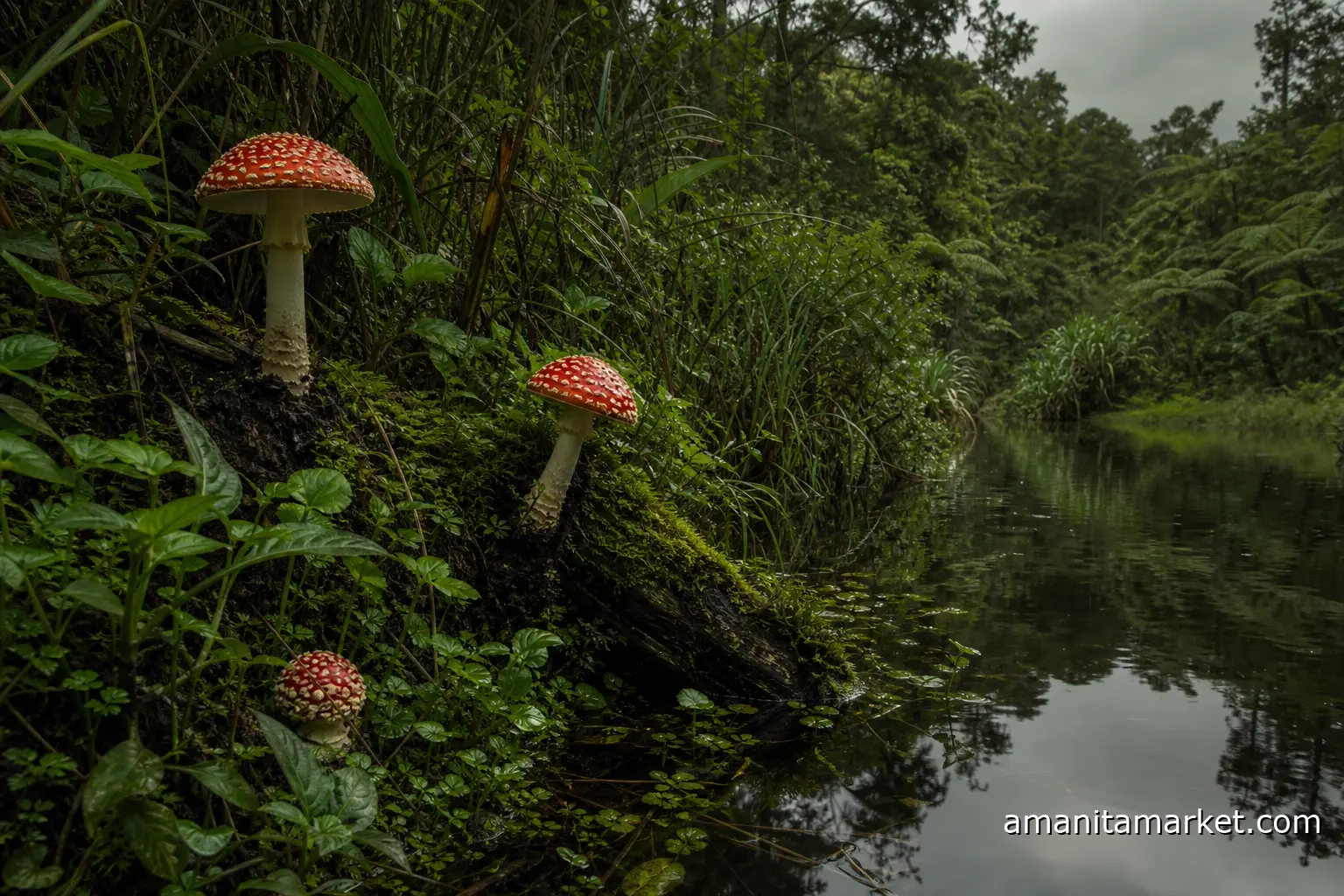
The Amazon rainforest is the world’s most biodiverse ecosystem — and one where Amanita muscaria is conspicuously absent. Fly agaric is a temperate and boreal species that requires specific tree partners and specific climate conditions. But South America is home to its own remarkable Amanita species, and the broader cultural relationship between Amazonian peoples and fungi is far deeper than most outside observers recognise.
Amanita Muscaria’s Absence from South America
Amanita muscaria does not grow naturally in the Amazon basin or in tropical South America. The mushroom requires mycorrhizal associations with birch, pine, and spruce — temperate and boreal trees that are absent from tropical forest ecosystems. The climate conditions of the Amazon — year-round heat and humidity, the absence of the seasonal cooling that triggers fly agaric fruiting — are also incompatible with the mushroom’s biology.
Amanita muscaria has, however, been introduced to parts of the southern hemisphere through human activity. In Chile, Argentina, Brazil’s southern states, and New Zealand, the mushroom now occurs wherever introduced European pines and birches have been planted — following its symbiotic partners to new continents. In these introduced habitats it is genetically identical to the northern hemisphere populations it came from.
Native Amanita Species in South America
While Amanita muscaria is absent from most of South America, the continent has its own native Amanita species, many of which have been described scientifically only in recent decades. The Amazon basin and the Andes contain Amanita diversity that remains incompletely surveyed. Several of these species are associated with local trees in mycorrhizal relationships that parallel fly agaric’s partnership with northern hemisphere conifers.
The South American Amanita flora includes both edible species and toxic ones, and local indigenous knowledge systems have developed around distinguishing them. However, the specific cultural significance associated with Amanita muscaria in Siberian and European traditions does not have a direct parallel among South American Amanita species, whose cultural profiles are quite different.
Psychoactive Fungi of the Americas — Clearing the Confusion
Amanita muscaria is routinely lumped together with the other psychoactive organisms associated with the Americas, but they are entirely separate. The table below untangles the three most commonly confused.
| Name | What it is | Native to the Americas? | An Amanita? |
|---|---|---|---|
| Amanita muscaria | Muscimol / ibotenic-acid mushroom | No — introduced via pine plantations | Yes |
| Psilocybe mushrooms | Psilocybin mushrooms | Yes — deep Mesoamerican roots | No |
| Ayahuasca | A plant brew (vine + leaf) | Yes — Amazonian | No — not a fungus at all |
The psychoactive fungi with the deepest cultural roots in the Americas are the psilocybin-containing mushrooms documented in Mesoamerican traditions, while ayahuasca is a plant preparation, not a mushroom. None of these are Amanita species. The fly agaric’s South American story is primarily one of ecological absence followed by recent human introduction.
The Southern Cone: Introduced Fly Agaric
The presence of introduced Amanita muscaria in Chile and southern Argentina represents an interesting case study in fungal biogeography. These populations arrived with European settlers who planted pine plantations from the 19th century onward. The mushroom hitched a ride in the root systems of imported seedlings and has now naturalised extensively in Patagonian pine forests. The first formal record of fly agaric fruiting in Patagonia dates to 2001, in a pine plantation in Lanín National Park.
Genetic studies, including work by Geml et al. (2006), have traced South American fly agaric populations to their European and Siberian source populations. The introduced South American populations carry the genetic signatures of their original source regions — a molecular fingerprint of the colonial tree-planting that brought them south. For more on the genetic diversity of fly agaric globally, see our article on Amanita muscaria genetic diversity.
An Invasive Newcomer: The Nothofagus Jump
What began as a plantation curiosity has become an ecological concern. Fly agaric is an ectomycorrhizal generalist, and in the southern hemisphere it has repeatedly “jumped” from introduced pines onto native trees. In Argentine Patagonia, molecular analysis published in 2025 confirmed Amanita muscaria associating with native southern beech (Nothofagus dombeyi and N. pumilio) inside national parks — evidence that it can colonise the roots of native trees, not just exotic pines. The same pattern is documented in New Zealand, where it has spread through native Nothofagus forests, and in Australia, where it has switched to Myrtle Beech (Nothofagus cunninghamii).
Although these invasive patches are still relatively limited, researchers warn that further spread could displace native ectomycorrhizal fungi and alter protected forest ecosystems. It is a striking reminder that fly agaric belongs ecologically to the northern hemisphere — where it evolved alongside its native tree partners — and behaves as an introduced weed where humans have carried it south.
Indigenous Amazonian Ethnomycology
While fly agaric is absent from the Amazon, Amazonian indigenous peoples have developed sophisticated ethnomycological knowledge relating to the fungi of their own ecosystem. Several fungal species are used in traditional Amazonian medicine and ritual contexts — primarily Basidiomycete species associated with Amazonian trees that have no counterparts in temperate zones.
The academic documentation of Amazonian ethnomycology lags significantly behind work on plant-based traditional knowledge. This is partly a research resource issue and partly a consequence of the systematic disruption of indigenous knowledge through colonisation. The emerging field of tropical ethnomycology is beginning to address this gap. For the broader global picture of fly agaric across world cultures, see our article on fly agaric in world cultures.
What This Means for Sourcing
The biogeography carries a practical point. Fly agaric is at home in the northern birch and pine forests where it co-evolved with its tree partners, and material from that native range comes from established, stable ecosystems rather than from introduced or invasive southern-hemisphere patches. Our wild-harvested Baltic fly agaric is sourced from exactly that native northern range — a traceable origin with a known ecological context.
Frequently Asked Questions
Does fly agaric grow in the Amazon?
No. The Amazon is tropical, and fly agaric needs the temperate or boreal tree partners (birch, pine, spruce) and seasonal cooling that the rainforest does not provide. It is ecologically absent from the Amazon basin.
Is fly agaric found anywhere in South America?
Yes, but only as an introduced species. It arrived with European pine plantations and is now naturalised in Patagonia and parts of Chile and southern Brazil — and has begun invading native Nothofagus forests.
Is South American fly agaric the same as European?
Genetically, yes. The introduced southern-hemisphere populations descend directly from European and Siberian source populations and carry their genetic signatures.
Sources
- Geml et al., 2006 — Beringian origins of fly agaric and source of introduced populations (Molecular Ecology)
- Biological Invasions (2025) — Molecular analysis confirms the invasion of Amanita muscaria in native Nothofagus forests of Patagonia
- Wikipedia — Amanita muscaria: global distribution and introduced populations
- Wikipedia — Ethnomycology: the study of human-fungal cultural relationships globally
- Wikipedia — Amanita genus: global diversity and distribution
Fly agaric from its natural home — premium Baltic Amanita muscaria, wild-harvested in the northern birch and pine forests where it belongs. Buy fly agaric from a traceable native source.