
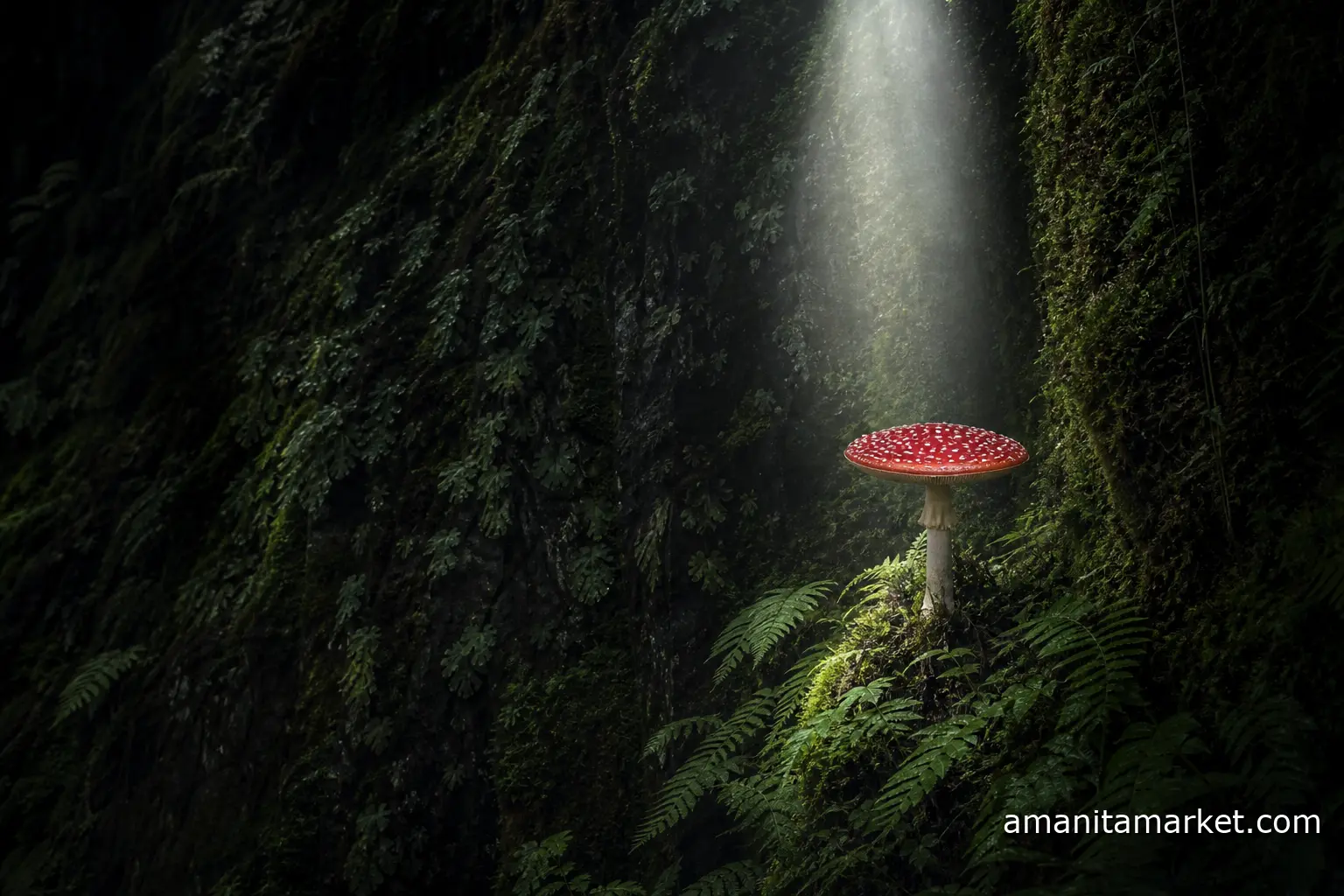
For centuries, Buddhist and Shinto monks in Japan’s mountain temples encountered Amanita muscaria in the surrounding forests — and the mushroom found its way into temple art, garden design, and monastic lore. The relationship between Japanese mountain religious traditions and fly agaric is subtle and primarily symbolic rather than documented in the way Siberian shamanic use is, but it is genuine and worth exploring for what it reveals about how different cultures encounter the same remarkable organism.
Mountain Buddhism and Forest Fungi
Japanese mountain Buddhism — particularly in its Shugendo expression, practised by yamabushi ascetics — developed in forest environments where Amanita muscaria was a common and conspicuous presence. The yamabushi underwent intensive mountain retreats in the deep forests of Dewa Sanzan, Kii Peninsula, and other mountain ranges, spending weeks or months in isolation and extreme physical and spiritual practice.
In these environments, the wild mushroom landscape was part of the practitioner’s daily experience. Japanese Buddhism developed a sophisticated awareness of the natural world’s spiritual dimensions — the concept of satoyama (the sacred mountain village) encodes an understanding of forest ecology as inherently spiritual. In this context, a mushroom as visually striking and biologically unusual as fly agaric would not have been overlooked or treated as merely biological.
The Tengu Yamabushi Connection
The tengu — the supernatural mountain beings associated with Amanita muscaria through the mushroom’s Japanese name beni-tengu-take (red tengu mushroom) — are specifically connected to the yamabushi tradition. In medieval Japanese iconography, tengu are depicted wearing the distinctive yamabushi costume: the small black hat (tokin), the white robe, and the carrying frame (kataogi). The tengu and the yamabushi became intertwined in Japanese imagination, with the supernatural mountain spirit serving as teacher and initiator to the human mountain practitioner.
Within this framework, the mushroom named after the tengu carries specific spiritual associations. Finding fly agaric during a mountain retreat was not a neutral botanical event — it was an encounter with the domain of the tengu, a marker of the landscape’s numinous character. For more on the tengu connection, see our dedicated article on Amanita muscaria in Japan.
Key Japanese Terms
The Japanese cultural encounter with fly agaric is carried in its vocabulary. The table below gathers the terms that recur in this story and how each connects to the mushroom.
| Term | Meaning | Connection to fly agaric |
|---|---|---|
| Beni-tengu-take | “Red tengu mushroom” | The Japanese name for Amanita muscaria itself |
| Tengu | Supernatural mountain spirits | Namesake of the mushroom; teachers of the yamabushi |
| Yamabushi | Mountain ascetic practitioners | Encountered fly agaric on retreats; dressed like tengu |
| Shugendo | Mountain ascetic tradition | Seeks altered states through extreme practice |
| Satoyama | Sacred mountain-village landscape | Frames the forest and its fungi as inherently spiritual |
Shugendo and Altered States
Shugendo practice explicitly seeks transformative altered states through extreme physical means: prolonged fasting, sleep deprivation, cold-water immersion, suspension, and sustained chanting. Whether botanical agents ever supplemented these practices is not documented in mainstream historical sources, and it would be wrong to assert that fly agaric was used ritually in the way it was in Siberia.
What scholars have noted, more cautiously, are the structural parallels between Shugendo and Siberian shamanism — the mountain retreat, the spirit-teacher, the pursuit of ecstatic states, and the symbolic charge attached to a striking forest mushroom. These parallels are intriguing precisely because they remain unresolved: similar cultural patterns formed around the same organism, apparently independently, on opposite sides of the Eurasian landmass.
Zen Gardens and Natural Symbolism
The Japanese aesthetic tradition of incorporating natural materials with symbolic resonance has produced garden designs, ikebana arrangements, and decorative arts that draw on forest imagery. While fly agaric does not appear prominently in the canonical Zen garden aesthetic — which favours moss, stone, and raked gravel — the mushroom appears in folk craft and decorative traditions as a forest marker with symbolic weight.
Japanese ceramics, lacquerware, and textile design from the Edo period (1603–1868) include recurring mushroom motifs, some of which appear to represent Amanita muscaria based on their colouration and spot patterns. These decorative appearances suggest that the mushroom occupied a place in the broader Japanese visual vocabulary of the forest world, even if not specifically in the high-art traditions of Zen Buddhism.
Contemporary Japanese Mycophilia
Modern Japan’s relationship with fly agaric is shaped by the country’s extraordinary fungal culture. Japan is one of the world’s most mycophilic nations — the language has specific words for dozens of mushroom species, seasonal mushroom foraging is a national pastime, and mushroom cuisine occupies a prestigious place in Japanese food culture.
Amanita muscaria is well-known to Japanese foragers as a toxic species to avoid — its Japanese name and its distinctive appearance make it easily recognisable. But this knowledge exists alongside the aesthetic appreciation of the mushroom as a forest being with its own presence and character. In contemporary Japanese illustration, animation, and design, fly agaric appears consistently as a forest symbol with magical and otherworldly associations. If this cross-cultural presence draws you to the real thing, our dried Amanita muscaria is wild-harvested from Baltic forests. For the pop culture dimension of this global visual presence, see our article on Amanita muscaria in pop culture.
Frequently Asked Questions
What is the Japanese name for fly agaric?
It is beni-tengu-take, meaning “red tengu mushroom” — naming the mushroom directly after the tengu, the supernatural mountain spirits of Japanese folklore.
Did Japanese monks use fly agaric like Siberian shamans?
There is no documented evidence of ritual ingestion. The Japanese relationship is symbolic and aesthetic; Shugendo practitioners pursued altered states through extreme physical austerities, not mushrooms. Scholars note parallels with Siberian shamanism but do not claim direct equivalence.
Is fly agaric eaten in Japan?
No. Despite Japan’s rich mushroom cuisine, fly agaric is recognised as toxic and avoided. Its value in Japanese culture is symbolic and visual rather than culinary.
Sources
- Wikipedia — Shugendo: Japanese mountain asceticism and yamabushi tradition
- Wikipedia — Tengu: Japanese mountain spirits and their yamabushi connections
- Wikipedia — Yamabushi: mountain ascetics of Shugendo
- Wikipedia — Japanese Buddhism: mountain traditions and forest spirituality
- Wikipedia — Mycophilia: Japan’s cultural relationship with fungi
The mushroom that crosses cultures and centuries — premium dried Amanita muscaria from Baltic wild harvest. Buy fly agaric from a traceable source.