
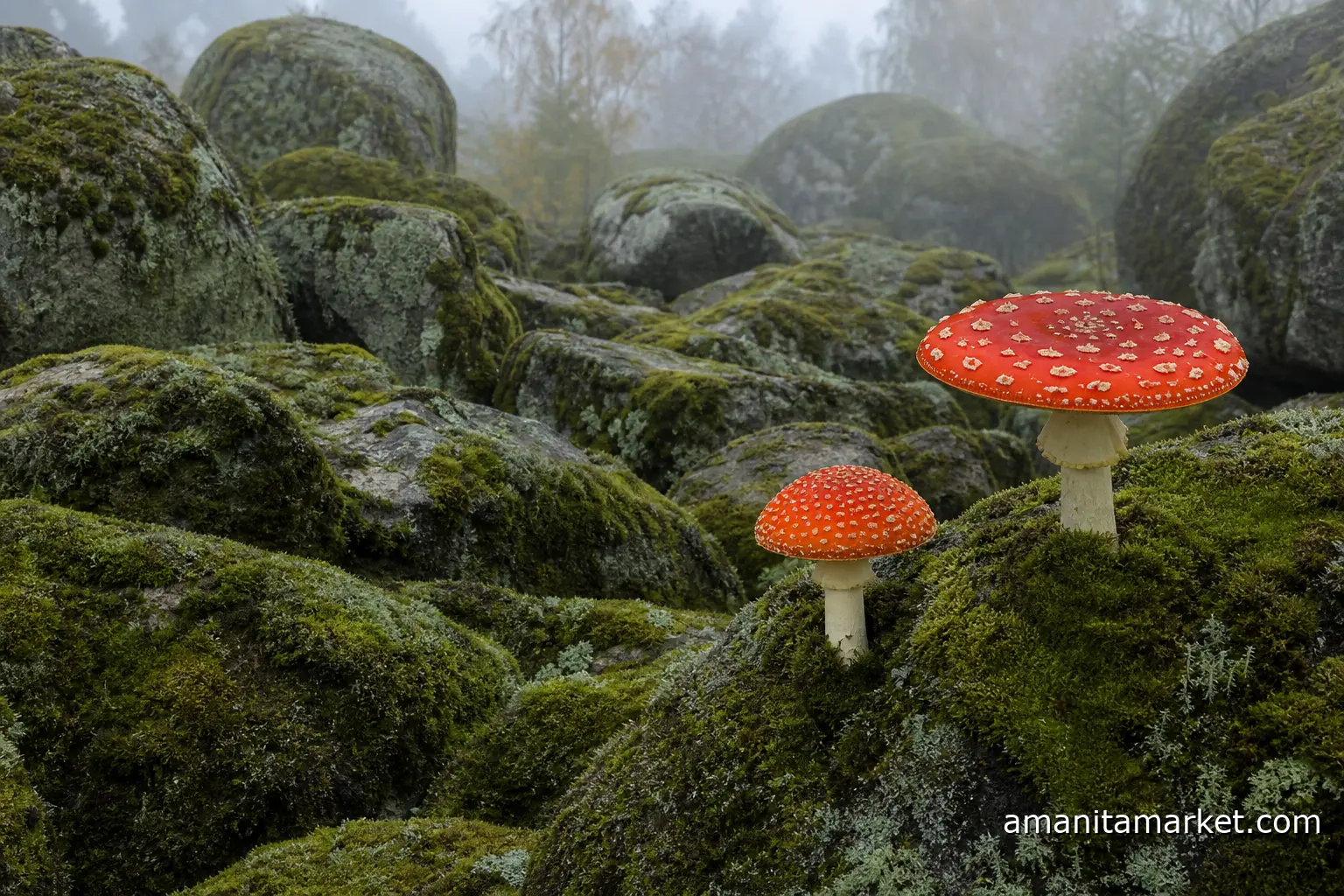
Amanita muscaria is not a single genetic entity — it is a complex of populations that have diverged over millions of years as the species spread across the Northern Hemisphere. Genetic research published in the 2000s revealed that what we call “fly agaric” is actually several cryptic lineages with distinct evolutionary histories, different geographic ranges, and potentially different biochemical profiles. Understanding this genetic diversity helps explain why the mushroom varies so much between regions — and why Baltic-sourced specimens are considered particularly consistent in quality.
The Geml 2006 Study: Rewriting the Distribution Story
The foundational genetic study of Amanita muscaria diversity was published in 2006 by József Geml and colleagues in the journal Molecular Ecology. Using DNA sequence data from specimens collected across the Northern Hemisphere, Geml et al. identified four major genetic lineages within the species, with distinct geographic distributions and apparent evolutionary histories.
The study’s most significant finding was that the four lineages showed patterns consistent with ancient geographic isolation — they had not been in contact with each other for very long periods, suggesting that the common ancestor of modern fly agaric populations spread from multiple refugia following the last Ice Age rather than dispersing from a single origin point. This genetic structure was unexpected given the mushroom’s apparently uniform appearance across its range.
The Four Major Lineages
Geml et al. identified populations falling into four broadly geographic lineages. A Eurasian lineage encompassing populations from Europe, Siberia, and much of northern Asia. A North American lineage associated with eastern North American populations. A third lineage associated with western North American and Pacific coastal populations. And a Beringian/Siberian lineage representing populations from the interface region between Asia and North America.
Each lineage showed slight differences in ITS (internal transcribed spacer) DNA sequences — the standard genetic marker used for fungal species identification. These differences were consistent with long periods of geographic isolation and independent evolution, even though the morphological differences between the lineages are subtle enough to have been overlooked by centuries of naturalists who treated all fly agaric as a single species.
Comparing the Lineages at a Glance
The table below summarises the four broadly geographic lineages, their ranges, and what distinguishes them. It also makes clear why the Eurasian lineage — to which all European and Baltic populations belong — is the one most relevant to the European ethnobotanical market.
| Lineage | Geographic range | Distinguishing note |
|---|---|---|
| Eurasian | Europe, Siberia, northern Asia | Most extensively studied; includes all Baltic populations |
| Eastern North American | Eastern North America | Genetically distinct from Eurasian; separate refugium |
| Western/Pacific | Western North America, Pacific coast | Strong intracontinental structure (Geml 2008) |
| Beringian/Siberian | Asia–North America interface (Alaska, NE Siberia) | Cryptic species occur sympatrically here |
The genetic diversity documented by Geml et al. helps explain why Amanita muscaria varies between regions in compound concentration, colour intensity, and morphological details. Baltic populations sit within the well-studied Eurasian lineage and grow in one of the most productive habitats for the species, with generations of adaptation to specific birch and pine forest ecosystems. This regional consistency is part of why Baltic wild harvest is valued in the ethnobotanical market.
ITS Barcoding: How the Lineages Were Distinguished
The lineages are invisible to the naked eye, so distinguishing them relies on DNA. Geml and colleagues sequenced three molecular markers: the internal transcribed spacer (ITS) and large subunit (LSU) regions of ribosomal DNA, plus the protein-coding beta-tubulin gene. The ITS region in particular is the standard “barcode” for fungi, because it accumulates small differences quickly enough to separate closely related lineages while staying consistent within them.
When the team compared these sequences across hundreds of specimens, the geographic lineages fell out clearly — even though representatives of several clades were found growing side by side in Alaska. That sympatry was the key surprise: lineages that look identical and share habitat can still be genetically isolated cryptic species rather than a single interbreeding population.
Implications for Species Classification
The Geml findings raised the question of whether the four lineages should be treated as separate species rather than varieties of a single species. The current consensus — reflected in major mycological databases — is to maintain Amanita muscaria as a single species while recognising the variety-level distinctions, partly because morphological and ecological criteria for species separation are not sufficiently distinct and partly because the practical implications of reclassification would be complex.
This debate is ongoing in mycology. Some researchers advocate for a more granular taxonomy that would formally recognise the genetic lineages as separate species. Others maintain that the genetic divergence, while real, does not reach the threshold for species-level separation under most species concepts. For an overview of the recognised varieties within the species, see our article on Amanita muscaria varieties and types.
Geographic Range and Climate Change
Understanding the genetic structure of Amanita muscaria has implications for predicting how the species will respond to climate change. Each genetic lineage has been shaped by the specific climate and forest conditions of its range. As temperatures shift and forest composition changes across the Northern Hemisphere, the separate lineages may respond differently — some expanding their range as their optimal conditions move northward or to higher altitudes, others potentially contracting.
This ecological dimension of the genetics research connects directly to conservation considerations for the birch-pine forest ecosystems that Amanita muscaria’s Eurasian lineage depends on. For the mycorrhizal ecology dimension, see our article on fly agaric mycorrhiza and ecology.
What This Means for Sourcing
For anyone buying dried fly agaric, the practical takeaway is that origin matters. Because the lineages differ in habitat and biochemistry, a specimen’s geographic source is a meaningful quality signal — not just marketing. European and Baltic material belongs to the single best-characterised lineage, harvested from the birch and pine forests the Eurasian populations have adapted to for millennia.
That is the standard we hold our own stock to: our dried Baltic fly agaric is wild-harvested from pristine northern forests within the Eurasian lineage, giving consistent colour, size, and quality from a known, traceable origin rather than mixed-provenance material.
Frequently Asked Questions
Is fly agaric one species or several?
Officially it is still classified as one species, Amanita muscaria, but DNA research shows it is a complex of several genetically distinct cryptic lineages. Whether these should be split into separate species is an active debate in mycology.
Does the genetic lineage affect the mushroom’s compounds?
Potentially yes. The lineages differ in habitat and biochemistry, and regional variation in ibotenic acid and muscimol content is documented, though the precise link between lineage and compound concentration has not been fully characterised.
Which lineage is European and Baltic fly agaric?
The Eurasian lineage, which spans Europe, Siberia, and northern Asia. It is the most extensively studied of the four and the one all Baltic populations belong to.
Sources
- Geml et al., 2006 — Beringian origins and cryptic speciation events in the fly agaric (Molecular Ecology)
- Geml et al., 2008 — Strong inter- and intracontinental phylogeographic structure in Amanita muscaria (Molecular Phylogenetics and Evolution)
- Wikipedia — Amanita muscaria: phylogeography and genetic diversity
- Wikipedia — Cryptic species complex: genetic diversity within apparently uniform species
- Wikipedia — Phylogeography: the study of genetic lineages and geographic distribution
Premium Baltic fly agaric — Eurasian lineage, wild-harvested from pristine birch and pine forests. Buy dried Amanita muscaria from a traceable source.