
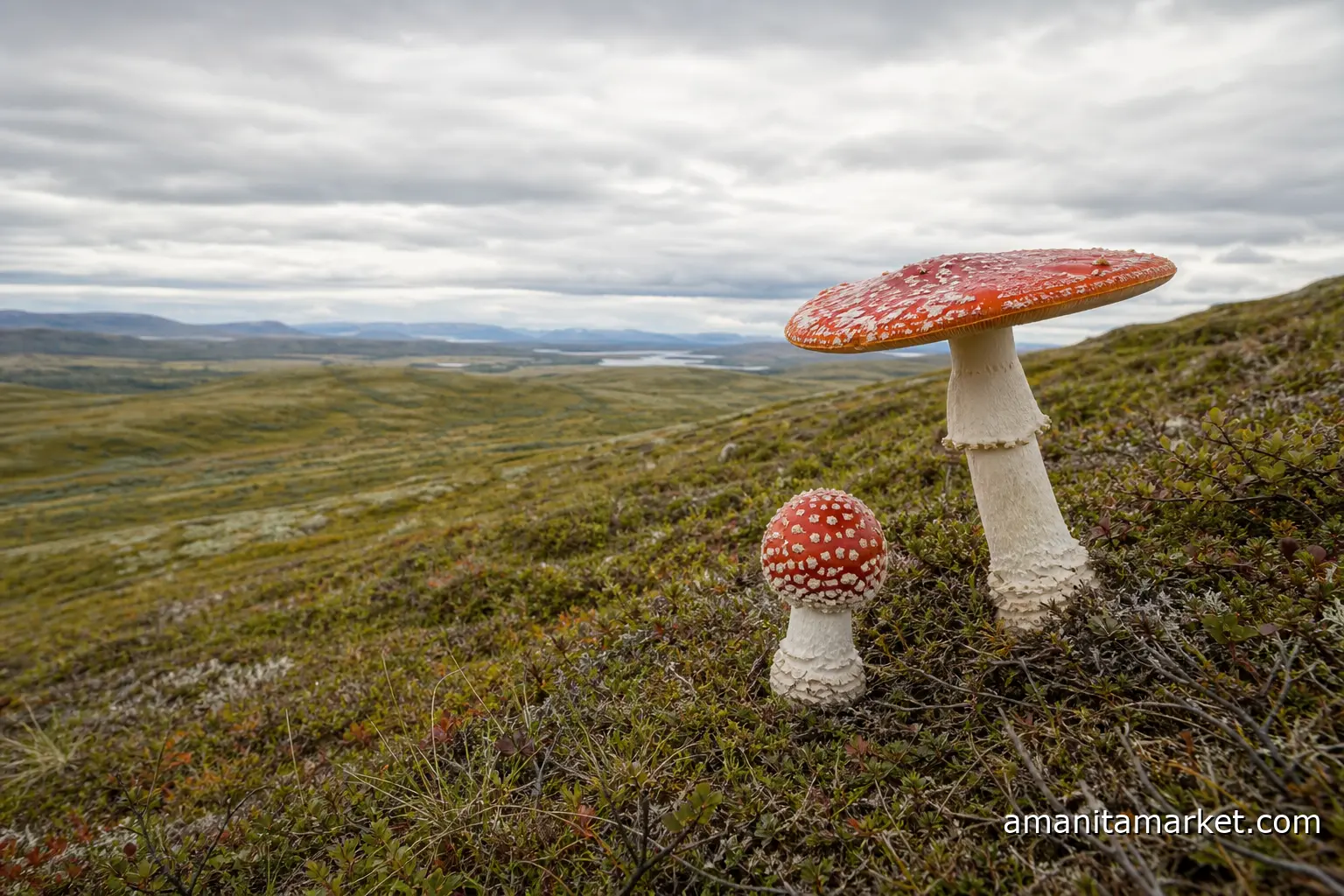
The relationship between reindeer and Amanita muscaria is one of the stranger documented facts in natural history — and one of the more intriguing threads in the cultural history of the fly agaric. Reindeer actively seek out and consume the mushroom, apparently with enthusiasm. This behaviour has shaped how northern peoples understood the mushroom for thousands of years, and it may lie at the root of some of the most enduring mythological imagery in European culture.
Reindeer and Fly Agaric: A Documented Behaviour
The observation that reindeer (Rangifer tarandus) actively seek out Amanita muscaria is not folklore — it is a documented fact in the zoological and ethnographic literature. Reindeer herders across northern Scandinavia, Siberia, and the Kola Peninsula have observed and described this behaviour for centuries. The animals appear attracted to the mushroom’s distinctive scent and will forage specifically for it in season, sometimes at the expense of nearby food sources they would ordinarily prefer.
The behaviour appears not to incapacitate the animals in ways that would prevent foraging. Herders describe reindeer that have consumed fly agaric as moving erratically, making unusual vocalisations, and appearing to experience altered sensory states — but remaining functional. This is consistent with what is known about muscimol’s dose-dependent effects: at moderate doses, locomotor and sensory alterations occur without complete incapacitation.
One detail makes the relationship especially unusual: muscimol passes through the mammalian body in active form. In reindeer that have consumed fly agaric, muscimol is excreted in urine with its pharmacological activity largely intact. Siberian ethnographic accounts describe shamans — and in some accounts, other community members — drinking reindeer urine following the animals’ consumption of fly agaric. Whether this represents a genuine historical practice or ethnographic embellishment has been debated, but the pharmacological mechanism that would make it plausible is real.
The Sami Tradition and the Reindeer Connection
The Sami people of northern Scandinavia are among the world’s most extensively documented reindeer herding cultures, and their observations of reindeer-fly agaric interaction are ethnographically significant. Sami herders have described the behaviour in oral tradition and in accounts collected by ethnographers from the 17th century onward. The connection between the animals’ altered state after consuming fly agaric and the noaidi’s (Sami shaman’s) own altered states during ceremony has not gone unnoticed in the ethnographic literature.
Whether Sami noaidi used fly agaric themselves remains debated — the evidence is circumstantial rather than direct. But the observation of reindeer behaviour almost certainly informed how the mushroom was understood and positioned in Sami cosmology. For the full account of Sami shamanism and fly agaric, see our article on Amanita muscaria and the Sami people.
The Flying Reindeer Connection
The image of flying reindeer — central to the modern Christmas mythology associated with Santa Claus — has been proposed as a cultural memory of the reindeer-fly agaric relationship. The theory, associated primarily with scholars including John Rush and Carl Ruck, runs as follows: Siberian shamans who used fly agaric observed that reindeer actively sought and consumed the mushroom, and that the animals exhibited unusual, seemingly elevated, erratic behaviour afterward. Over centuries and through cultural transmission westward, the image of reindeer associated with a red-and-white-clad figure distributing gifts transformed into the flying reindeer of Christmas mythology.
This is a hypothesis, not established history — the cultural transmission pathway would need to be traced in detail to be confirmed. But it is a hypothesis with genuine ethnographic grounding, not pure speculation. For the full Santa Claus and fly agaric theory, see our article on Amanita muscaria and Santa Claus.
Which Animals Interact with Fly Agaric
Reindeer are not the only animals drawn to Amanita muscaria. The mushroom’s relationship with the animal world is more complex than simple toxicity would predict — for several species it is an attractant rather than a deterrent.
| Animal | Interaction | Notes |
|---|---|---|
| Reindeer | Actively seeks & eats | Altered state; muscimol passes into urine |
| Red squirrel | Caches caps in trees | Deliberate food storage / drying |
| Flies | Attracted to caps | Source of the name “fly agaric” |
| Slugs | Graze regularly | Common woodland consumer |
Whether squirrels seek the pharmacological effects or simply treat the mushroom as a cacheable food source like other fungi is not resolved — but the breadth of animal interest in the species is striking.
Implications for Cultural History
The reindeer-fly agaric relationship represents a rare case where human cultural practice may have been directly informed by observed animal behaviour. If Siberian peoples learned about the mushroom’s effects partly through watching their reindeer, this would place the origin of fly agaric use in a framework of close ecological observation rather than purely human experimentation.
This ecological attentiveness — characteristic of hunter-herder cultures across the circumpolar north — is consistent with what we know about how indigenous botanical knowledge develops. For the broader Siberian shamanic context, see our article on Amanita muscaria and Siberian shamanism. The same wild-harvested mushroom from these northern forests is available today as dried Amanita muscaria powder for collectors.
Frequently Asked Questions
Do reindeer really eat fly agaric?
Yes. It is documented in zoological and ethnographic literature that reindeer actively seek out and consume Amanita muscaria.
Is the reindeer-urine story true?
Pharmacologically it is plausible — muscimol is excreted in active form — but whether it was a widespread historical practice is debated among ethnographers.
Did this inspire the flying reindeer of Santa Claus?
It is a proposed hypothesis with genuine ethnographic grounding, not established history. The transmission pathway has not been firmly traced.
Sources
- Tylš et al., MDPI 2021 — Amanita muscaria: ecology, mythology and cultural history
- Ott, J. (1993): Pharmacotheon: Entheogenic Drugs, Their Plant Sources and History. Natural Products Co.
- Wikipedia — Reindeer: ecology, behaviour and relationship with humans
- Wikipedia — Amanita muscaria: animal interactions and reindeer behaviour
- Wikipedia — Sami people: reindeer herding culture and ethnobotanical knowledge
From the same Baltic forests where reindeer and fly agaric share their ancient relationship — premium dried Amanita muscaria, wild-harvested and carefully processed.