
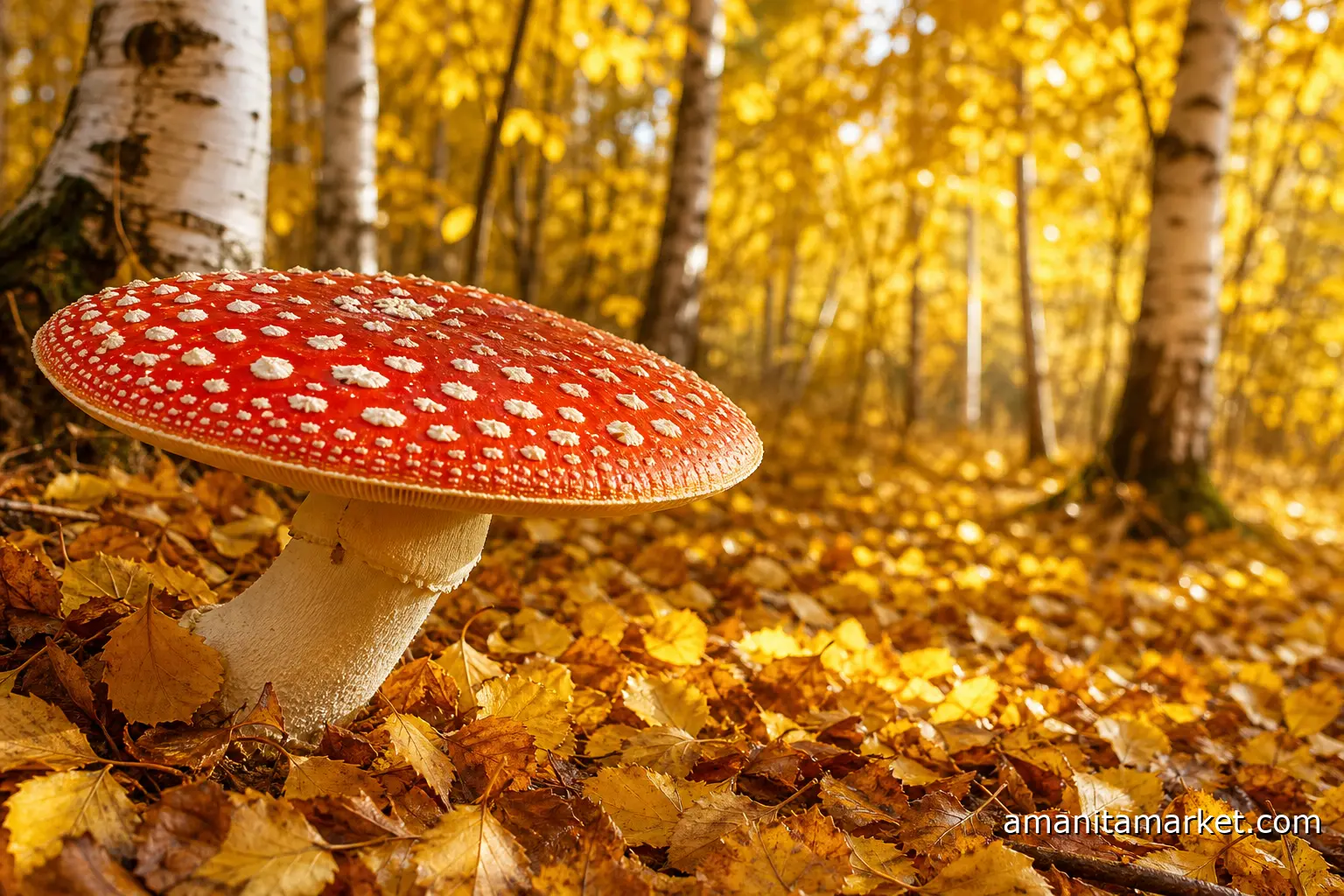
The mushroom in Alice in Wonderland is one of the most recognised images in English literature — a giant fungus on which a hookah-smoking caterpillar sits, pieces of which cause Alice to grow or shrink depending on which side she eats. Whether Lewis Carroll intended a specific reference to Amanita muscaria has been debated for decades. The visual and pharmacological parallels are striking, and the question is more nuanced than either enthusiastic confirmation or flat dismissal suggests.
The Scene in the Text
In Chapter Five of Alice’s Adventures in Wonderland (1865), Alice encounters a blue caterpillar sitting on top of a large mushroom, smoking a hookah. The caterpillar informs her that eating one side of the mushroom will make her grow larger, the other side will make her smaller. Alice subsequently uses the mushroom multiple times to adjust her size throughout the story, and it becomes one of the narrative’s central props.
Lewis Carroll (the pen name of mathematics lecturer Charles Dodgson) does not identify the mushroom species. John Tenniel’s original illustrations — considered the definitive visual interpretation and published with Carroll’s full approval — depicted a rounded, generic mushroom without the vivid red-and-white colouration that would identify it as Amanita muscaria.
The Disney Interpretation
The association between the Wonderland mushroom and Amanita muscaria was significantly reinforced by the 1951 Disney animated film. Disney’s visual interpreters chose to render the mushroom with a red cap and white spots — unmistakably the fly agaric’s visual signature. This design choice, whether deliberate or simply drawn from the most visually distinctive mushroom available, established the red-and-white mushroom in global cultural consciousness as the Wonderland mushroom, regardless of Carroll’s original intentions.
The Disney version has been so influential that subsequent illustrated editions of the book, stage productions, and adaptations almost universally follow the red-and-white design. The Tenniel original — a plain brown mushroom — is largely forgotten outside scholarly circles.
The Wonderland Mushroom Across Versions
Tracing how the mushroom has been depicted across the major versions of the story shows exactly where the fly agaric association entered — and how strong it is in each.
| Version | Mushroom depiction | Fly agaric link |
|---|---|---|
| Carroll text (1865) | Species unspecified | None stated |
| Tenniel illustrations | Plain rounded mushroom | No |
| Disney film (1951) | Red cap, white spots | Strong (visual signature) |
| Modern adaptations | Red-and-white standard | Strong (inherited from Disney) |
What Carroll Knew
The question of Carroll’s botanical knowledge and possible awareness of fly agaric’s properties is genuinely open. Carroll was an Oxford academic writing in mid-Victorian Britain — a period of intense interest in natural history, botany, and the newly emerging field of pharmacology. Mordecai Cooke’s 1860 work The Seven Sisters of Sleep — a popular survey of psychoactive plants including Amanita muscaria — was published five years before Wonderland and was available to educated readers in Britain. Whether Carroll read it, or any of the other mid-Victorian texts discussing the mushroom’s properties, is unknown.
No correspondence or notes by Carroll have been found that explicitly reference Amanita muscaria in connection with the Wonderland mushroom. The absence of documentation, however, does not rule out awareness — Victorian authors often did not document the sources of imaginative material.
Size Alteration and Muscimol Pharmacology
Muscimol’s interaction with GABA-A receptors can produce perceptual distortions including macropsia and micropsia — the perception that objects are larger or smaller than they are. This is a documented feature of Amanita muscaria intoxication accounts in the ethnographic literature. Whether Carroll knew of these effects or encountered relevant literature is not documented, but the pharmacological parallel between the mushroom’s depicted size-altering effects and muscimol’s known perceptual effects is striking — and is the single strongest argument for a genuine, if indirect, connection.
The Psychedelic Reading of Alice in Wonderland
The association between Wonderland and psychedelic experience became culturally fixed in the 1960s counterculture. Jefferson Airplane’s 1967 song “White Rabbit” made the connection explicit, and the psychedelic interpretation of the book became a cultural consensus that has shaped how generations of readers have approached the text. This cultural overlay makes it genuinely difficult to evaluate Carroll’s original intentions separately from subsequent interpretation.
Academic Carroll scholars generally consider the psychedelic reading anachronistic — a projection of 1960s cultural concerns onto a Victorian mathematical fantasy. The mathematics and logic puzzles in the book are seen as more central to Carroll’s intent than any altered-state symbolism. But even sceptical scholars typically concede that the size-altering mushroom is a provocative image whose resonance with psychoactive experience is not coincidental.
The Fly Agaric’s Cultural Journey
Whether or not Carroll intended a fly agaric reference, the Wonderland mushroom has become one of the central pillars of the fly agaric’s modern pop culture presence. Through the Disney film, through the counterculture’s adoption of the imagery, and through subsequent generations of illustration and adaptation, the red-and-white mushroom has been made synonymous with altered perception, magic, and transformation in global visual culture.
This is part of the broader trajectory through which Amanita muscaria has accumulated symbolic charge across different cultures and centuries — from Siberian shamanic ceremonies to Victorian literary imagination to contemporary design. For the full pop culture picture, see our article on Amanita muscaria in pop culture. For the European folklore tradition from which the fairy tale mushroom emerged, see fly agaric in fairy tales and folklore. The same iconic mushroom is available today as a collector’s botanical — our wild-harvested dried Amanita muscaria powder.
Frequently Asked Questions
Was the Alice in Wonderland mushroom a fly agaric?
Carroll never specified a species, and Tenniel drew a plain mushroom. The fly agaric association came mainly from Disney’s 1951 red-and-white design.
Why is it associated with fly agaric?
Two reasons: Disney’s red-cap-white-spot depiction, and the size-altering effects that parallel muscimol’s documented macropsia and micropsia.
Did Lewis Carroll use fly agaric?
There is no evidence he did. Most Carroll scholars regard the psychedelic reading as an anachronistic 1960s projection.
Sources
- Wikipedia — Alice’s Adventures in Wonderland: text, illustrations and interpretations
- Cooke, M. (1860): The Seven Sisters of Sleep. James Blackwood, London.
- Wikipedia — John Tenniel: illustrator and original Wonderland visual design
- Wikipedia — Fly agaric in popular culture: Alice in Wonderland and Disney
- Wikipedia — Muscimol: perceptual effects and macropsia/micropsia documentation
The mushroom that shaped a century of imagination — available as premium dried Amanita muscaria from our Baltic wild harvest.