
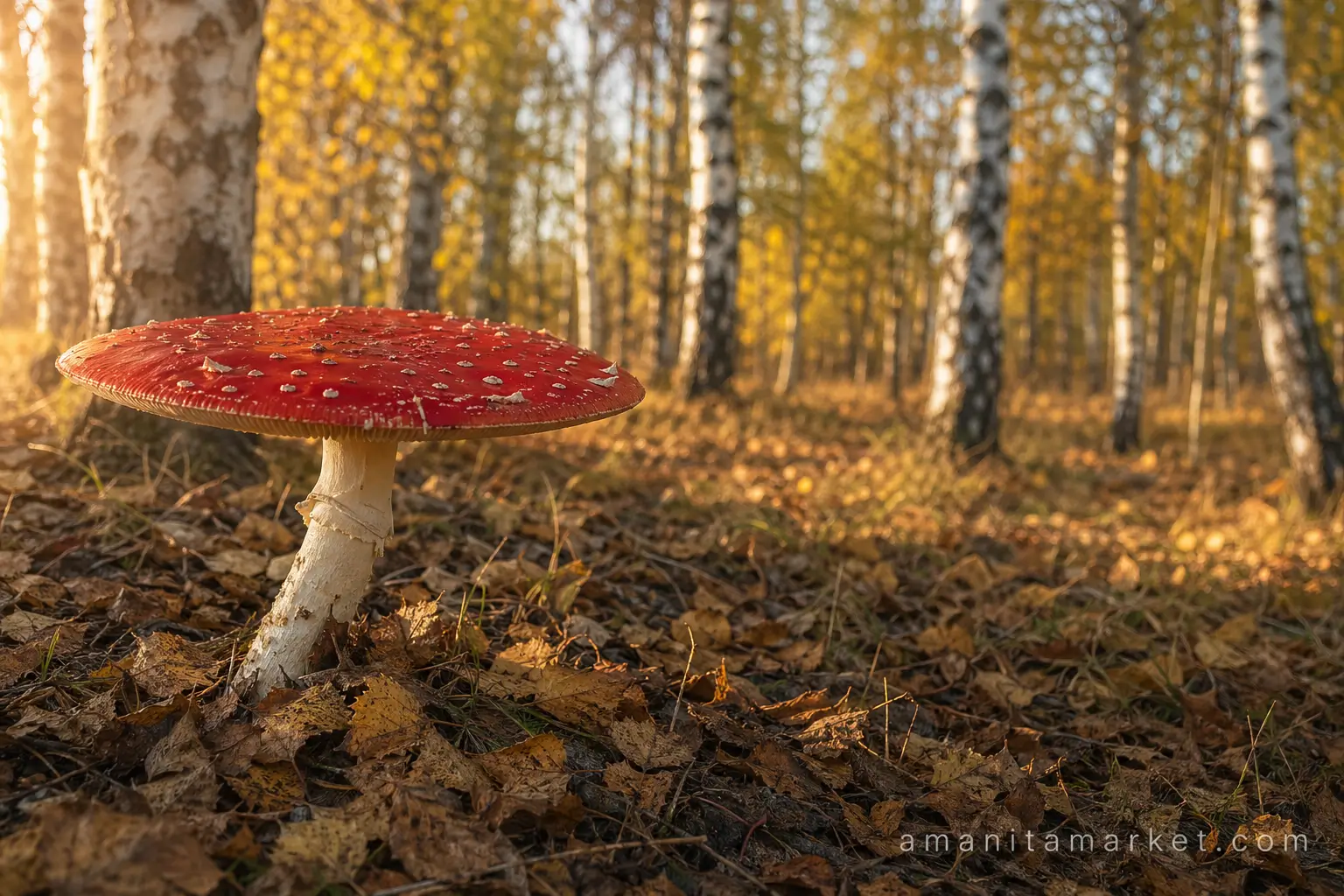
Did Amanita muscaria inspire the myth of Santa Claus? It sounds unlikely — yet the theory has attracted serious scholarly attention for decades. The red-and-white mushroom, the reindeer, the gifts delivered through the chimney, the shaman dressed in red: the parallels between Siberian fly agaric rituals and the Christmas tradition run deeper than most people realise.
The Siberian Shaman and the Winter Solstice
The origin of the Santa Claus theory lies in Siberian shamanism. Among the Koryak, Evenki, and other indigenous peoples of northeastern Siberia, Amanita muscaria played a central role in winter solstice ceremonies. Shamans — the spiritual intermediaries of these cultures — gathered fly agaric from beneath birch trees, dried the mushrooms, and distributed them as ceremonial gifts during midwinter festivals.
The visual parallel is striking. These shamans traditionally wore red robes with white trim, mirroring the red cap and white spots of the fly agaric. They entered dwellings through the smoke hole in the roof — the equivalent of the chimney — often descending a central birch pole that served as the yurt’s structural support and spiritual axis. The birch tree itself was deeply sacred in Siberian cosmology, serving as the shaman’s ladder between worlds.
In traditional Siberian yurts, the central smoke hole served simultaneously as a ventilation opening, a spiritual portal, and the point of entry for ceremonial visits. Shamans descending through this opening with bags of dried mushrooms mirrors the popular image of Father Christmas arriving via chimney with a sack of gifts.
The Reindeer Connection
Reindeer have a well-documented relationship with Amanita muscaria. These animals are known to actively seek out and consume fly agaric, apparently experiencing altered behaviour after doing so. Siberian shamans reportedly observed this behaviour and — according to some ethnographic accounts — collected the urine of reindeer that had eaten fly agaric, as the muscimol passes through the animal’s body in active form.
The reindeer that “fly” in Christmas mythology may be a cultural echo of this real observed behaviour. Animals that consumed fly agaric were sometimes described as appearing to leap and dance erratically — behaviour that could, through cultural transmission across centuries, become the image of flying reindeer pulling a sleigh.
R. Gordon Wasson and the Academic Debate
The connection between Amanita muscaria and Santa Claus was most comprehensively explored by ethnomycologist R. Gordon Wasson, whose 1968 book Soma: Divine Mushroom of Immortality established the foundation for modern ethnomycology. While Wasson himself focused on the Vedic Soma connection, subsequent researchers including John Rush and Carl Ruck expanded the analysis to the Christmas tradition.
John Rush, in his 2011 work on the subject, argued that the Santa Claus figure synthesises elements from Siberian shamanism, Norse mythology, and early Christian saint iconography. The red-and-white colour scheme, the midwinter timing, the gifts distributed from a bag — all can be traced, Rush argues, to the fly agaric-centred shamanic tradition of the circumpolar north.
Norse and Germanic Mythology
The shamanic mushroom tradition of Siberia did not stop at the Ural mountains. Evidence of Amanita muscaria use in ritual contexts extends westward through Norse and Germanic cultures. Odin — the wandering god who descends from the sky, travels between worlds, and gifts knowledge — shares structural similarities with the Siberian shaman archetype.
The Germanic figure of Sinterklaas, which predates the modern Santa Claus figure and merged with it through Dutch cultural transmission to America, wore bishop’s robes — red, with white trim. The mid-December timing of Sinterklaas celebrations aligns precisely with the period when Siberian shamans conducted their mushroom ceremonies.
The Fly Agaric as Winter Symbol
In European folk tradition, Amanita muscaria has long been associated with luck, abundance, and the winter season. In German-speaking countries, the mushroom — known as Fliegenpilz — is a traditional good luck charm displayed at New Year and Christmas. Decorative images of fly agaric appear on Christmas ornaments, greetings cards, and seasonal decorations across Central Europe.
This association is no accident. The mushroom fruits in autumn and early winter, making it visually synonymous with the season in European forest cultures. The timing of its appearance — just before the winter solstice — made it naturally significant in a calendrical and ritual sense.
The cultural legacy of Amanita muscaria runs deep through European and Siberian history. If you’re interested in exploring this iconic botanical, you can buy dried fly agaric from our shop — wild-harvested in the Baltic region. For the wider cultural history of the mushroom across world cultures, see our article on Amanita muscaria and Siberian shamanism.
Conclusion: Myth, Symbol, or History?
The Amanita muscaria / Santa Claus connection sits at the intersection of ethnomycology, comparative mythology, and cultural history. It is neither proven fact nor pure speculation — it is a hypothesis supported by a substantial body of parallel evidence that rewards careful examination. What is certain is that the fly agaric mushroom has been a powerful symbol in human cultures for millennia, and that its influence on the visual and ritual vocabulary of the midwinter season is real, whatever the precise causal pathways may have been.
Sources
Shop our amanita muscaria powder — ethically sourced fly agaric from pristine Baltic forests, carefully dried and shipped across Europe.