
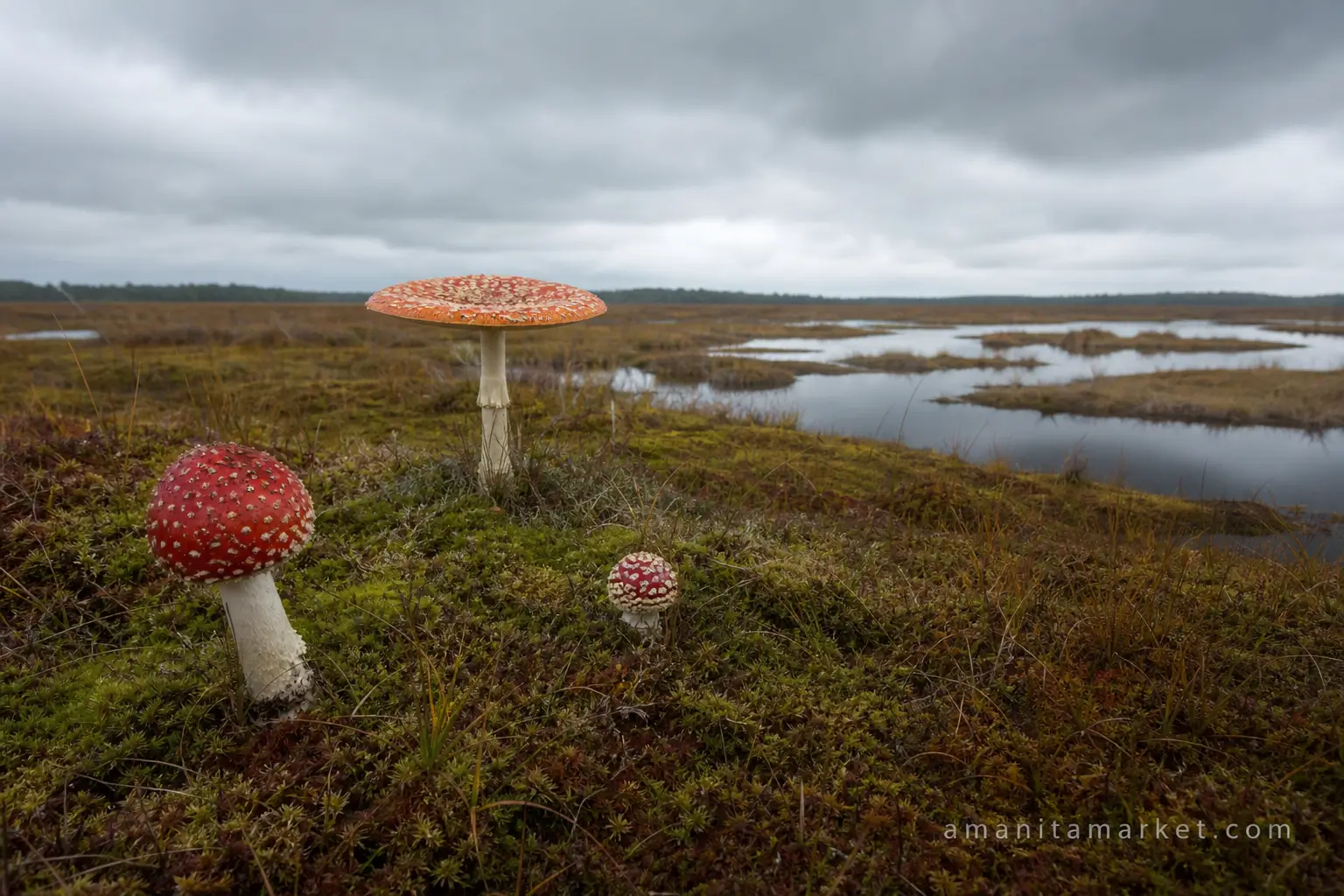
Amanita muscaria has a longer documented history of human use than almost any other psychoactive plant or fungus. At the heart of this history lies Siberia — a vast region of boreal forest where indigenous peoples developed a rich shamanic tradition centred on the fly agaric mushroom. Understanding this tradition is essential to understanding why dried amanita muscaria remains one of the most culturally significant ethnobotanical products available today.
The Shamanic Tradition of Siberia
Siberia is home to dozens of indigenous peoples — the Koryak, Evenki, Yakut, Chukchi, and others — who developed complex spiritual and healing traditions over thousands of years. Central to many of these traditions was the figure of the shaman: a spiritual specialist who could enter altered states of consciousness to communicate with spirits, heal the sick, and navigate between worlds.
Among several of these groups, Amanita muscaria was the primary entheogen — the substance that facilitated shamanic journeys. The mushroom was gathered in autumn from beneath birch and pine trees, dried, and used in winter ceremonies. Ethnographic accounts collected by Russian and European scholars from the 18th century onwards provide detailed descriptions of these rituals.
The term “entheogen” — coined by ethnobotanists Carl Ruck and R. Gordon Wasson — refers to a psychoactive substance used in a religious or spiritual context. It derives from the Greek: “entheos” (inspired by the divine) + “gen” (to generate). Amanita muscaria is considered one of the oldest known entheogens in human history.
R. Gordon Wasson and Ethnomycology
The modern academic study of Amanita muscaria’s shamanic use was largely founded by R. Gordon Wasson, an American banker turned ethnomycologist whose 1968 book Soma: Divine Mushroom of Immortality became one of the most influential works in ethnobotany. Wasson synthesised decades of field research, ethnographic literature, and botanical analysis to argue that fly agaric had played a central role in the spiritual lives of Siberian and Central Asian peoples for millennia.
Wasson’s fieldwork took him across Siberia and into contact with surviving shamanic practitioners. His accounts of Koryak shamans using dried fly agaric in winter ceremonies — singing, drumming, and entering trance states to retrieve information from the spirit world — established the foundational scholarly record of this tradition.
The Role of the Fly Agaric in Shamanic Ceremony
In Koryak and related traditions, the use of Amanita muscaria in shamanic ceremony followed specific protocols that had developed over generations. The mushroom was considered a living spiritual entity — not merely a tool, but a teacher and guide. Shamans received training over years in how to work with it safely and effectively.
The mushroom was typically dried before use — a process that converts ibotenic acid to muscimol, altering its pharmacological profile. Dried caps were either consumed directly or prepared as a tea. Reindeer were also known to consume fly agaric, and some accounts describe shamans collecting reindeer urine after the animals had eaten the mushroom — muscimol passes through the body in active form, a phenomenon unique among known psychoactive substances.
The shamanic session typically involved rhythmic drumming, chanting, and physical movement. The shaman’s task was to maintain coherent intention and navigate the altered state purposefully — distinguishing the shamanic use from recreational or impulsive consumption.
Geographic Spread: Beyond Siberia
The shamanic use of Amanita muscaria was not confined to Siberia. Evidence of ritual and ceremonial use has been documented across a wide geographic arc: from northeastern Siberia westward through Central Asia, into Scandinavia, and possibly into the Baltic and Germanic traditions of Northern Europe.
The Sami people of northern Scandinavia had documented contact with Siberian shamanic traditions through trade routes, and some researchers have proposed that noaidi — Sami shamans — may have used fly agaric in their own ceremonies, though direct evidence is more limited than for Siberian groups. For more on this connection, see our article on Amanita muscaria and the Sami people.
The connection to European Christmas traditions — through the figure of the red-and-white-clad gift-giver, the chimney entry, and the flying reindeer — represents a possible westward transmission of these shamanic themes into European folklore. This theory is explored in detail in our article on Amanita muscaria and Santa Claus.
Amanita Muscaria in Vedic Literature
One of the most debated applications of the Siberian connection is Wasson’s proposal that Soma — the divine ritual drink described in the ancient Indian Rig Veda — was prepared from Amanita muscaria. The Rig Veda, composed approximately 3,500 years ago, contains over a hundred hymns dedicated to Soma: a plant-derived drink that granted divine inspiration, immortality, and ecstatic vision to priests who consumed it.
Wasson argued that the geographic origin of Indo-Aryan culture in the Siberian-Central Asian steppe region — where fly agaric shamanism was already established — made Amanita muscaria the most plausible candidate. The debate continues among scholars today, with alternative candidates proposed, but Wasson’s thesis remains the most widely cited and discussed.
A Living Tradition
Shamanic traditions involving Amanita muscaria did not disappear entirely with modernisation. Ethnographic fieldwork in the 20th and 21st centuries has documented the persistence of these practices in remote communities, alongside growing interest in traditional ecological knowledge and indigenous spiritual practices worldwide.
The cultural significance of fly agaric — as an ethnobotanical product with one of the longest documented relationships with human spiritual practice — is part of what makes it such a compelling object of study and collection. If you are interested in exploring this history through a tangible connection, you can buy dried amanita muscaria powder from our shop, wild-harvested in the Baltic forests where this tradition has its deepest roots.
Sources
- Roczniki Kulturoznawcze 2022 — Koryak people and Amanita muscaria in Kamchatka folk medicine (academic journal)
- Wikipedia — Shamanism in Siberia: documented practices and traditions
- Wikipedia — Koryak people: fly agaric use in winter ceremonies
- Wikipedia — R. Gordon Wasson: Soma — Divine Mushroom of Immortality (1968)
Discover dried fly agaric from the Baltic — amanita muscaria powder, wild-harvested and vacuum-sealed, shipped across Europe.