
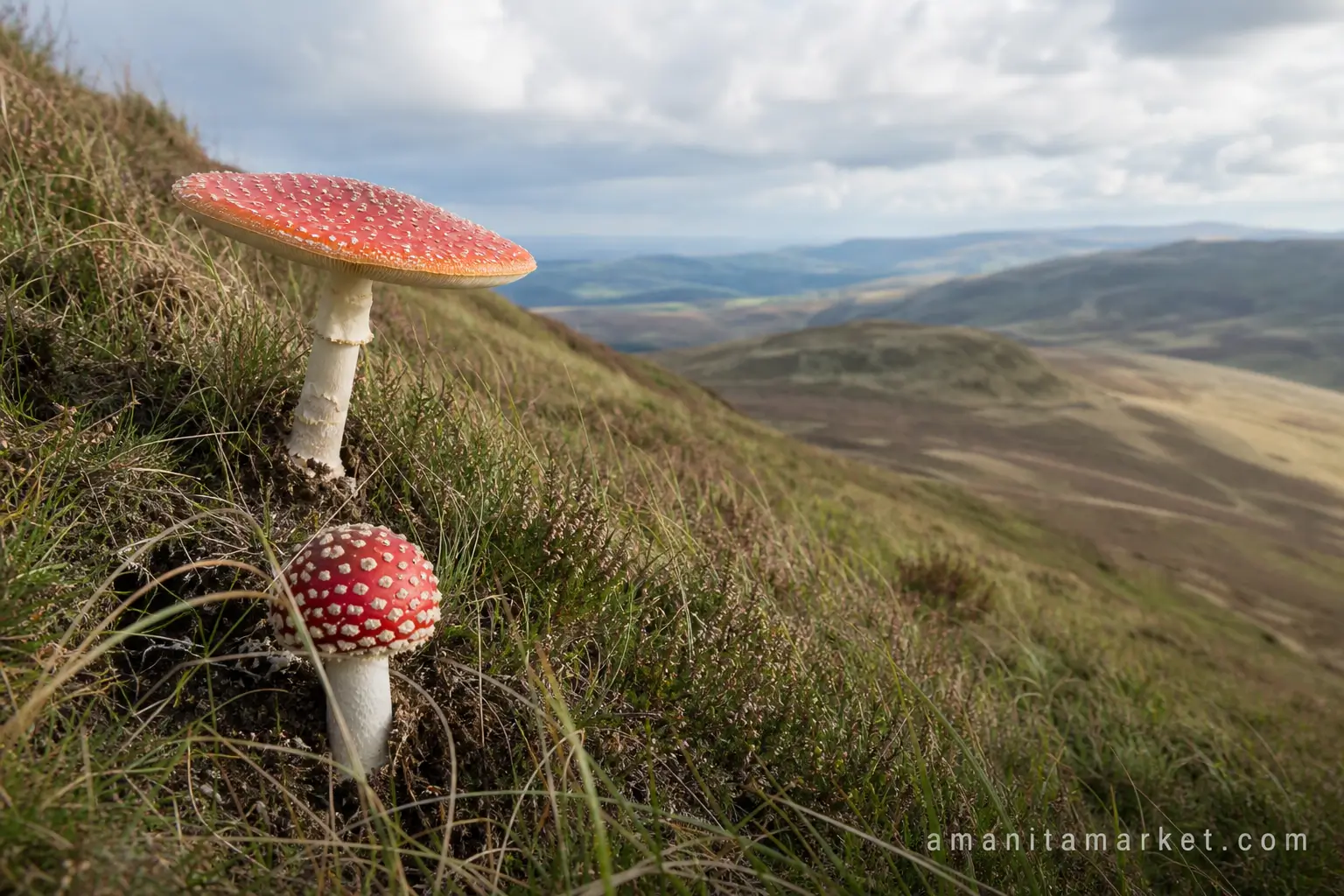
The Germanic peoples — Angles, Saxons, Franks, Goths, Norse, and others — developed one of the world’s most elaborate mythological systems before Christian conversion largely erased the oral tradition. What survives in the Eddas, the sagas, and scattered runic inscriptions suggests a worldview in which Amanita muscaria occupied a meaningful, if not always explicit, place. From the figure of Odin to the berserker warriors, from the Christmas tradition to the Rauhnächte ceremonies, the fly agaric’s presence in Germanic cultural life runs deep.
Odin: The Shamanic All-Father
Odin (Old Norse: Óðinn; Proto-Germanic: *Wōðanaz) is the most complex deity in the Germanic pantheon — simultaneously god of war, wisdom, death, poetry, magic, and wandering. His attributes overlap almost perfectly with the archetype of the Siberian shaman: he travels between worlds, communicates with the dead, performs ecstatic self-sacrifice (hanging on Yggdrasil for nine days to obtain the runes), and employs psychoactive means to achieve altered states.
Odin’s connection to the seiðr — the Norse form of shamanic practice — is well attested in Eddic sources. Völuspá and Hávamál both describe Odin’s acquisition of hidden knowledge through extreme physical ordeal and altered consciousness. Whether fly agaric was specifically part of this practice is not stated, but the structural parallel with Siberian shamanism — which did use Amanita muscaria — is strong enough that several scholars have proposed a direct connection.
Norse seiðr was a form of magic performed primarily by women (vǫlur) and by Odin, involving trance states, spirit journeys, and divination. Historian Neil Price has argued in detail that seiðr represents a survival of the same circumpolar shamanic tradition documented in Siberia — the tradition in which Amanita muscaria played a central role. Whether the psychoactive element crossed with the shamanic practice remains unproven but structurally plausible.
Wotan in Continental Germanic Tradition
In continental Germanic tradition — among the Franks, Alemanni, Lombards, and other tribes — Odin appeared as Wotan or Woden. The Wild Hunt (Wilde Jagd) — a winter storm of spectral riders led by Wotan across the night sky — is one of the most geographically widespread and persistently documented elements of Germanic folk belief. The Wild Hunt passed through the sky during the Rauhnächte — the twelve rough nights between Christmas and Epiphany — the same period associated in German folk practice with incense ceremonies and protective rituals.
The Rauhnächte tradition of burning aromatic plants to cleanse the home and ward off the Wild Hunt’s malevolent aspects includes, in some regional variants, the burning of fly agaric alongside other protective botanicals. This practical ritual connection — fly agaric as one element of a complex incense practice — is documented in 19th-century German ethnographic literature, though it was never universal.
The Rauhnächte and Germanic Botanical Magic
The Rauhnächte ceremonies represent one of the clearest survivals of pre-Christian Germanic practice into the modern era. Performed between December 25th and January 6th, they involve burning bundles of protective herbs and resins through the rooms of the house to drive out evil spirits and invite good fortune in the new year. Regional variations are extensive, but the practice is documented across Bavaria, Austria, Switzerland, Tyrol, and the Alpine zone generally.
The choice of botanical materials varies by region and tradition, but always includes plants with deep cultural resonance — juniper, mugwort, angelica, and in some variants, fly agaric. The mushroom’s visual power and its associations with the forest spirit world made it a natural candidate for inclusion in ceremonies designed to engage those same forces. For more on fly agaric as incense, see our article on fly agaric incense history.
Germanic Folklore: The Hexenpilz
In German folk tradition, Amanita muscaria was sometimes called Hexenpilz — “witch’s mushroom” — alongside the more common Fliegenpilz. This name reflects the mushroom’s association with magical practice, with the forest’s liminal power, and with the figure of the wise woman or witch who mediated between ordinary life and the spirit world.
The dual naming — lucky mushroom and witch’s mushroom — captures the ambivalence at the heart of Germanic folk attitudes toward fly agaric. It was simultaneously a good-luck charm and a symbol of dangerous power. This tension is culturally productive: objects that sit at the boundary between the beneficial and the dangerous carry symbolic charge that purely benign or purely threatening objects lack. For the luck dimension, see our article on fly agaric as a luck symbol.
Germanic Christmas and the Red Mushroom
The most enduring contribution of Germanic mythology to the global fly agaric story is the Christmas tradition. Through the figure of Santa Claus — derived from the Germanic Sinterklaas, filtered through American commercial culture, and exported globally — the red-and-white mushroom became the world’s most widely recognised lucky symbol. For the full account of how Siberian shamanism, Germanic winter mythology, and the fly agaric converged into the modern Christmas narrative, see our article on Amanita muscaria and Santa Claus.
Sources
Get premium dried fly agaric — wild-harvested Amanita muscaria powder, vacuum-sealed and shipped EU-wide from our Baltic source.