
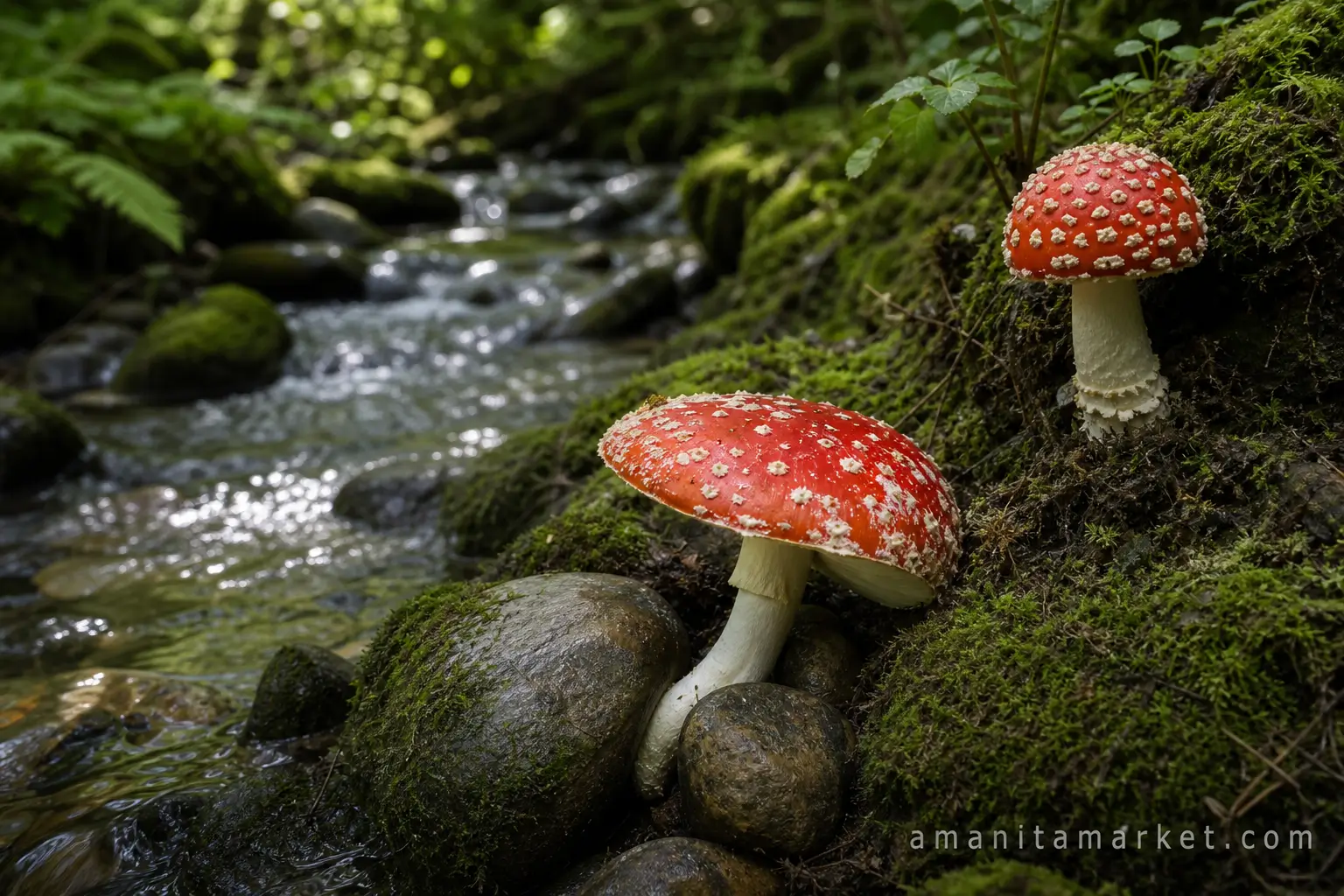
Long before fly agaric became a collector’s botanical or a subject of neuroscience research, it was burned. The use of Amanita muscaria as ritual incense — dried caps placed on coals or heated stones to release aromatic smoke — has roots that extend across thousands of years of human history, from Siberian shamanic lodges to European folk ceremonies. Today, dried fly agaric remains one of the most historically significant ethnobotanical incense plants available.
What Is Ethnobotanical Incense?
Ethnobotanical incense refers to plant and fungal materials burned for their aromatic, ceremonial, or ritual properties — as distinct from modern synthetic air fresheners. This category includes resins (frankincense, myrrh), herbs (sage, mugwort), woods (sandalwood, palo santo), and fungi. Amanita muscaria has occupied a place in this category across multiple cultural traditions, used both as direct incense and as a ceremonial offering accompanying fire rituals.
The use of aromatic smoke in ritual contexts is one of the oldest attested human practices. Archaeological evidence from Neolithic burial sites in Europe and Asia includes charred botanical remains interpreted as ritual offerings. Among these, psychoactive and aromatic fungi have been proposed as candidates in several excavations, though direct attribution to Amanita muscaria requires careful interpretation.
Siberian Shamanic Use: Fire and Smoke
In Siberian shamanic traditions, fire was the central axis of ceremony. The hearth of the yurt — connected to the world above via the smoke hole — was a sacred boundary. Aromatic materials placed on the fire were understood to carry prayers, intentions, and communications upward through the smoke. Amanita muscaria appears in ethnographic accounts not only as a consumed substance but as a burned offering.
Ethnographer Waldemar Jochelson, whose fieldwork among the Koryak in the early 20th century produced some of the richest documentation of Siberian shamanic practice, recorded that dried mushroom material was used in fire ceremonies alongside other botanical offerings. The smoke of fly agaric was considered to have specific spiritual properties — a vehicle for shamanic communication.
In German-speaking Europe, the tradition of Räucherwerk (ritual incense) has deep roots in pre-Christian practice, with some customs persisting into modern folk tradition. The Rauhnächte — the twelve rough nights between Christmas and Epiphany — are traditionally a time for cleansing incense rituals. Fly agaric (Fliegenpilz) appears in some regional variants of this practice as one of the botanical materials burned during these ceremonies.
Christian Rätsch and Ethnobotanical Documentation
The most comprehensive modern documentation of fly agaric’s use as an ethnobotanical incense plant comes from German ethnobotanist Christian Rätsch, whose encyclopaedic work The Encyclopedia of Psychoactive Plants (first published in German, 1998) catalogues hundreds of plants used in ritual and ceremonial contexts worldwide. Rätsch’s entry on Amanita muscaria includes detailed accounts of its incense use across multiple traditions, cross-referencing botanical, chemical, and anthropological sources.
Rätsch situates fly agaric within the broader tradition of psychoactive incense — plants burned to alter consciousness, facilitate vision, or create sacred atmosphere. This tradition appears across virtually every human culture that has left an archaeological or ethnographic record, and Amanita muscaria is one of its most widely distributed and historically attested participants.
Baltic and Northern European Traditions
In the Baltic region — where our wild-harvested fly agaric originates — the mushroom carries deep cultural resonance. Lithuanian, Latvian, and Estonian folk traditions retain traces of pre-Christian nature spirituality in which fungi, particularly the visually striking Amanita muscaria, held symbolic and ceremonial significance. The mushroom appears in folk decorations, woven textiles, and pottery motifs across the region.
The Baltic forests — vast birch and pine woodlands — are among the most abundant fly agaric habitats in Europe. This abundance is not coincidental in cultural terms: proximity, abundance, and visual distinctiveness all contribute to the incorporation of a natural object into cultural symbolism. For the Latvian and Lithuanian peoples, the mushroom was part of the seasonal rhythm of the forest landscape.
Fly Agaric as Incense Today
The contemporary market for dried fly agaric as an ethnobotanical incense product reflects a revival of interest in traditional botanical practices. Across Europe — particularly in Germany, Austria, and the Netherlands — there is growing demand for authentic, quality-dried botanicals with documented cultural histories. Fly agaric occupies a unique position in this market: it is visually iconic, historically significant, legally available in most EU countries, and deeply connected to the European and Siberian cultural heritage.
When used as incense, dried fly agaric caps produce a mild, earthy aroma. The caps burn slowly on charcoal or heated stones, releasing a distinctive fragrance associated with forest environments. For the wider context of Amanita muscaria as an ethnobotanical product, see our guide on amanita muscaria as an ethnobotanical product. For the broader shamanic history that contextualises this use, see our article on Amanita muscaria and Siberian shamanism.
Sources
Premium fly agaric for sale — dried Amanita muscaria caps and powder from the Baltic, shipped across Europe.