
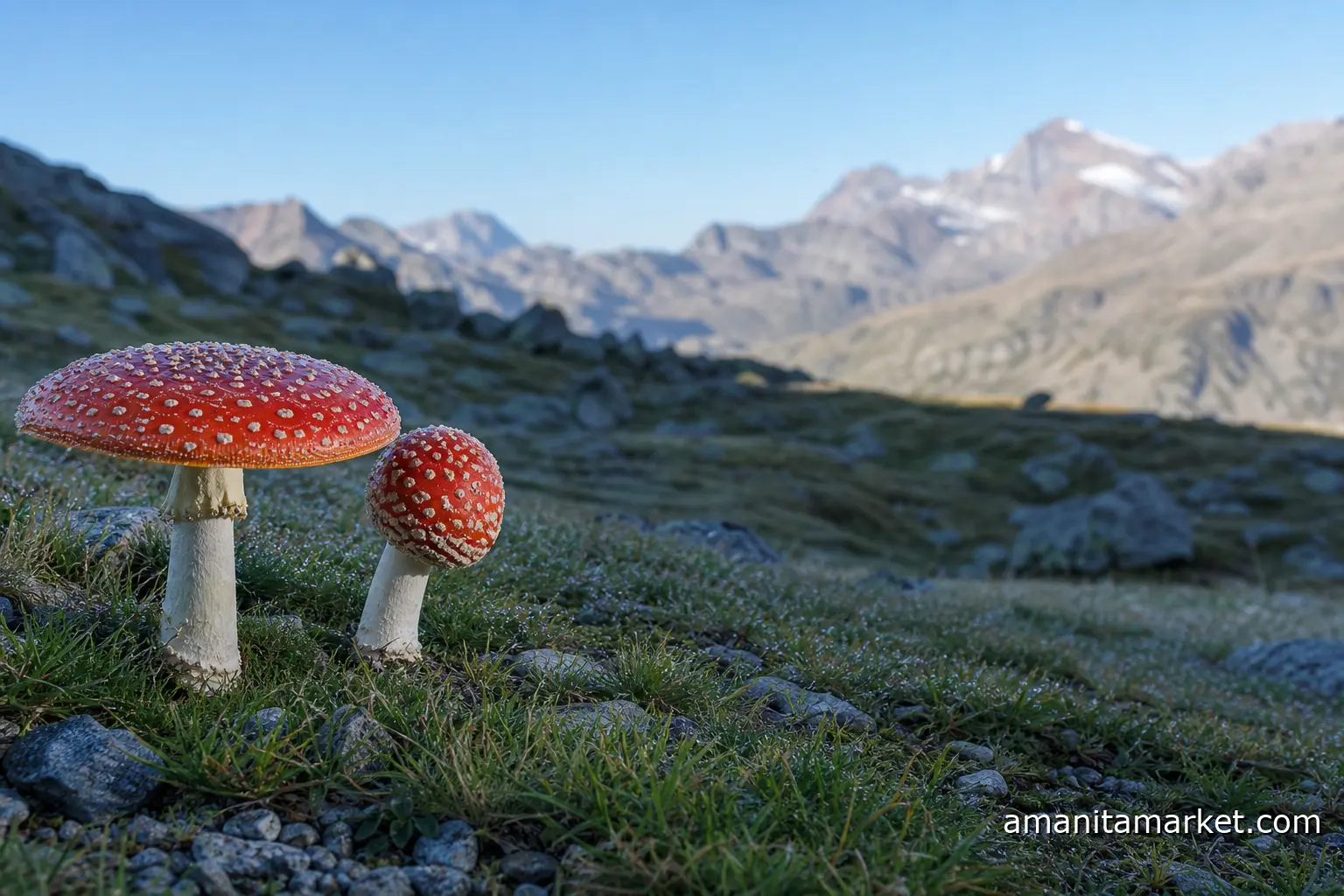
Ibotenic acid and muscimol are the two primary active compounds in Amanita muscaria — but they work in completely opposite ways in the brain. Understanding the difference between them is essential to understanding the fly agaric mushroom’s pharmacological profile, why drying matters, and why dried specimens behave differently from fresh ones. This article presents the science clearly, based on peer-reviewed research.
Two Compounds, Two Opposite Systems
Ibotenic acid and muscimol are both isoxazole derivatives — a structural family of compounds not widely found in nature. Despite their chemical similarity, they act on completely different neurotransmitter systems and produce opposite effects at the neuronal level.
Ibotenic acid is an excitatory compound: it acts as an agonist at ionotropic glutamate receptors, primarily the NMDA (N-methyl-D-aspartate) subtype. Glutamate is the brain’s primary excitatory neurotransmitter, involved in learning, memory formation, and synaptic plasticity. Muscimol, by contrast, is inhibitory: it acts as a potent direct agonist at GABA-A receptors. GABA is the brain’s primary inhibitory neurotransmitter, responsible for reducing neuronal excitability and producing sedative, anxiolytic, and hypnotic effects.
| Property | Ibotenic Acid | Muscimol |
|---|---|---|
| Receptor target | NMDA glutamate receptors | GABA-A receptors |
| Effect type | Excitatory | Inhibitory |
| In fresh mushroom | Dominant compound | Minor compound |
| In dried mushroom | Reduced (converted) | Dominant compound |
| Thermal stability | Unstable — converts to muscimol | Stable |
| Research use | Neurotoxin tool in brain mapping | GABA-A pharmacology |
The Decarboxylation Process: Why Drying Changes Everything
The chemical relationship between ibotenic acid and muscimol is direct: ibotenic acid decarboxylates into muscimol. Decarboxylation is a chemical reaction in which a carboxyl group (–COOH) is removed from the molecule as carbon dioxide (CO₂). In the case of ibotenic acid, this reaction is accelerated by heat and also occurs slowly at room temperature over time. The overall conversion is: ibotenic acid (C₅H₆N₂O₄) → muscimol (C₄H₆N₂O₂) + CO₂.
The practical consequence is that fresh Amanita muscaria is biochemically different from dried fly agaric. A 2019 study by Tsujikawa et al. in Forensic Science International (PubMed 30782612) systematically analysed commercial dried samples and fresh specimens, finding significantly higher muscimol-to-ibotenic acid ratios in dried material. The extent of conversion depended on drying temperature and duration — higher temperatures and longer drying times produced more complete conversion.
How Drying Temperature Affects the Ratio
Because the reaction is temperature-dependent, the drying method directly shapes the final compound profile. The table below summarises the general pattern reported in the literature.
| Drying temperature | Conversion to muscimol | Resulting profile |
|---|---|---|
| 35–45°C (gentle) | Slow, partial | More ibotenic acid retained |
| 50–60°C (moderate) | Moderate | Mixed ratio |
| 70°C+ (high) | More complete | Muscimol-dominant |
In practice, commercially dried fly agaric contains both compounds in varying ratios — never exclusively one or the other. This is why the drying process has always been significant in cultures that used fly agaric ritually. The Siberian shamanic tradition of drying mushrooms before use was not arbitrary — it was a practical processing step that shifted the profile from more excitatory (fresh) to more inhibitory (dried).
Ibotenic Acid as a Research Tool
Independent of its presence in fly agaric, ibotenic acid has an established role in neuroscience research. Its ability to produce selective neuronal lesions when injected into specific brain regions made it valuable for brain mapping research in the 1970s and 1980s. By injecting ibotenic acid into defined areas, researchers could eliminate specific neuronal populations and observe the functional consequences — a technique that contributed to understanding of memory systems, motor control, and sensory processing.
This research use is purely preclinical and does not involve the mushroom product. It does, however, confirm ibotenic acid’s potent biological activity at the cellular level and explains why toxicologists treat it as a compound of concern in poisoning contexts.
Muscimol: The More-Studied Compound
Muscimol has received considerably more research attention than ibotenic acid, primarily because of its GABA-A receptor activity. The GABAergic system is a major pharmacological target — benzodiazepines, barbiturates, and Z-drugs all act on GABA-A receptors — which makes any novel GABA-A agonist of scientific interest.
Preclinical research has examined muscimol in the contexts of sleep regulation, anxiety, neuropathic pain, and seizure activity — all areas where GABAergic pharmacology is relevant. A 1996 study by Lancel and Faulhaber (PubMed 8797193) demonstrated that muscimol administration increased non-REM sleep in animal models. These studies use isolated pharmaceutical-grade muscimol, not dried mushroom material. For specific research areas, see our articles on muscimol sleep research and muscimol effects overview.
Why This Distinction Matters for Products
The ibotenic acid/muscimol ratio in any given dried fly agaric product is not fixed — it varies with processing. This variability is one reason why quality, transparent sourcing, and documented drying methods matter when selecting ethnobotanical fly agaric products. For a guide to assessing product quality, see our fly agaric powder guide. Our wild-harvested Baltic amanita muscaria powder is low-temperature dried to preserve the mushroom’s natural characteristics.
Frequently Asked Questions
What is the main difference between ibotenic acid and muscimol?
Ibotenic acid is excitatory (acts on NMDA glutamate receptors); muscimol is inhibitory (acts on GABA-A receptors). They are chemically related but functionally opposite.
Why does drying matter?
Drying decarboxylates ibotenic acid into muscimol. The temperature and duration of drying determine the final ratio of the two compounds.
Is dried fly agaric mostly muscimol or ibotenic acid?
Dried material is generally more muscimol-dominant than fresh, but always contains both compounds in varying ratios — never exclusively one.
Sources
- Tsujikawa et al., 2019 — Ibotenic acid and muscimol in Amanita muscaria: drying effects (PubMed 30782612)
- Michelot, D. & Melendez-Howell, L.M. (2003): Amanita muscaria: chemistry, biology, toxicology and ethnomycology. Mycological Research 107(2).
- Wikipedia — Ibotenic acid: chemistry, NMDA receptor mechanism and research uses
- Wikipedia — Muscimol: GABA-A receptor pharmacology
- Wikipedia — Decarboxylation: the chemical process converting ibotenic acid to muscimol
Wild-harvested Baltic fly agaric powder — low-temperature dried to preserve the natural compound profile of Amanita muscaria.