
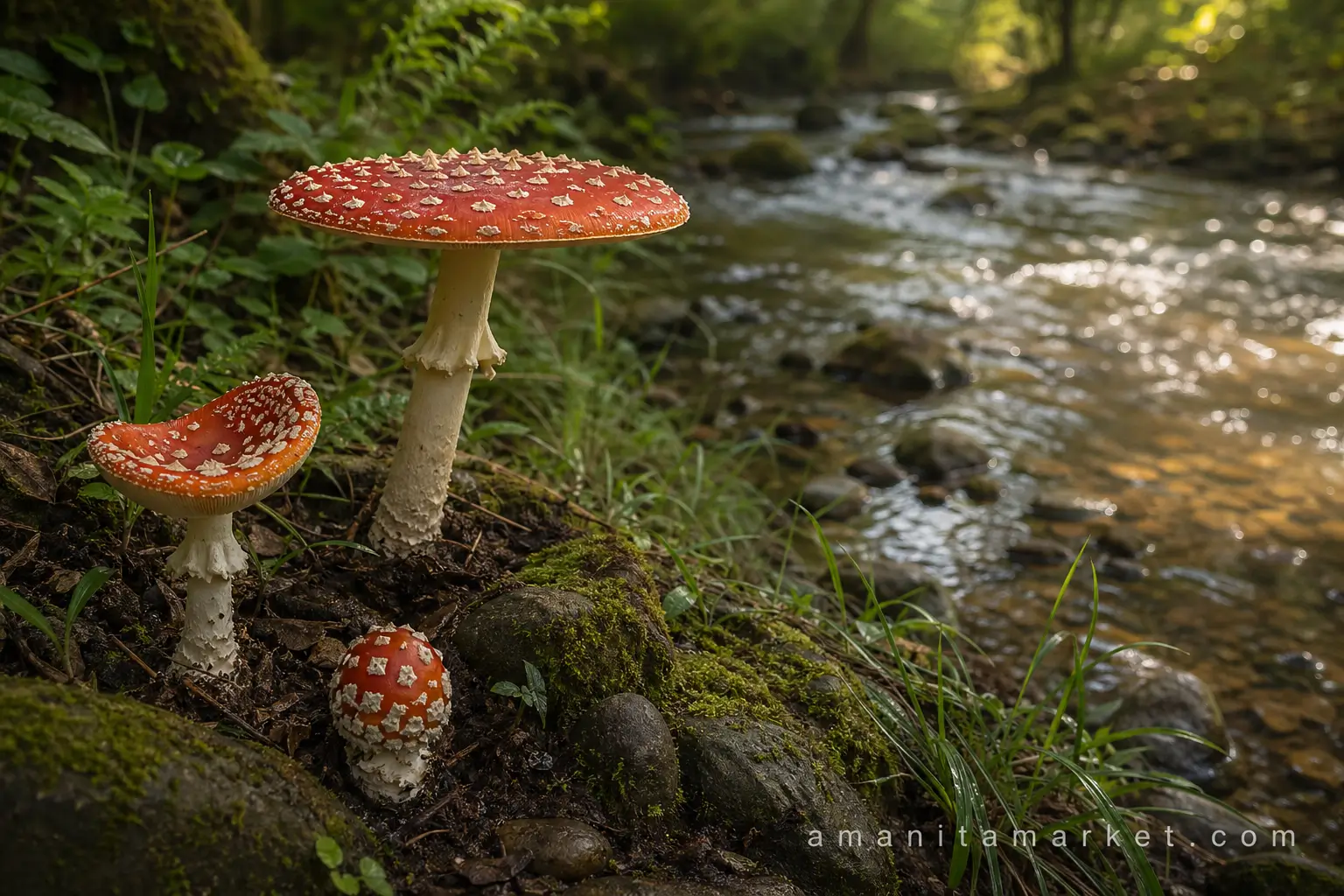
Fly agaric powder is the dried, ground form of Amanita muscaria caps — one of the most widely recognised ethnobotanical products in Europe. Whether you are new to this traditional botanical or looking to refine your knowledge, this guide covers everything: what quality dried fly agaric powder looks like, how it is made, how to store it, and what to look for when you buy amanita muscaria powder online.
Quality fly agaric powder is cap-only, low-temperature dried (35–45 °C), and from a named wild-harvest region (the Baltic states are the benchmark) — sold as an ethnobotanical incense material and collector’s specimen. You can buy fly agaric powder directly from our Baltic wild-harvest range.
What Is Fly Agaric Powder?
Fly agaric powder is produced by drying whole Amanita muscaria caps and grinding them to a fine or coarse powder. The caps — the red, white-spotted part of the mushroom — are used exclusively, as the stem contains a different chemical profile and less of the compounds associated with traditional use. High-quality powder retains the mushroom’s natural colour: a warm ochre to pale brown, depending on drying temperature and cap maturity at harvest.
The drying process is critical. Amanita muscaria caps must be dried at low temperatures — typically between 35°C and 45°C — to preserve the active constituents while reducing moisture to below 10%. Higher temperatures degrade ibotenic acid and muscimol and can result in a dull, dark powder with diminished quality. Our amanita muscaria powder is dried at low temperatures using controlled airflow drying.
Premium fly agaric powder uses caps only — not stems. The cap contains the highest concentration of the mushroom’s characteristic compounds. Always check the product description before purchasing to confirm you are buying cap-only powder.
How Is Fly Agaric Powder Made?
The production of quality dried fly agaric follows a clear sequence: wild harvesting at peak maturity, cleaning, low-temperature drying, sorting, grinding, and vacuum sealing. Each step affects the final product’s quality and shelf life.
Wild harvesting is done by hand in autumn — from late August through October in the Baltic region. Mushrooms are selected at the right stage of maturity: fully open caps with intact white warts. They are cleaned of debris and soil before entering the drying process. After drying, caps are sorted to remove any substandard specimens, then ground to the desired granularity and immediately vacuum-sealed to prevent moisture reabsorption.
Powder vs. Whole Dried Caps — What to Choose?
Both forms have their place, but powder offers practical advantages: it is easier to portion, stores more compactly, and disperses more evenly when used as incense. Whole caps, on the other hand, allow visual verification of quality — you can assess the colour, texture, and wart integrity directly.
If you are purchasing fly agaric for the first time, powder is generally the more practical choice. It is consistent in composition and ready to use without further preparation. For those who prefer to inspect the material before use, whole dried caps are available in our shop. For a detailed comparison, see our article on fly agaric powder vs caps.
How to Assess Powder Quality
Several visual and practical indicators help assess the quality of dried fly agaric powder:
Colour: Good quality powder ranges from pale golden-ochre to light brown. Very dark brown or grey powder typically indicates over-drying or use of stems. Bright orange powder may indicate immature caps or the var. formosa variety.
Smell: A mild, earthy mushroom aroma. Musty or sour odours suggest improper drying or storage. No smell at all may indicate very old stock.
Texture: Fine, dry, and free-flowing. Clumping indicates moisture exposure and compromised shelf life.
Origin transparency: Reputable suppliers disclose the harvest region and year. Baltic region — particularly Lithuania, Latvia, and Estonia — is widely considered the premium source for wild fly agaric due to the region’s extensive birch and pine forests.
Store fly agaric powder in an airtight glass or ceramic container, away from light and moisture, at room temperature. Under these conditions, properly dried powder retains its quality for up to 2 years. For more detail, see our guide on how to store fly agaric.
Where Does Quality Fly Agaric Come From?
The Baltic states — Lithuania, Latvia, and Estonia — are the primary source of premium wild-harvested Amanita muscaria in Europe. The region’s vast birch and pine forests, clean soils, and long foraging tradition produce mushrooms of exceptional quality. Harvesting is done by experienced foragers who know the terrain and the seasonal patterns.
Unlike farmed mushrooms, Amanita muscaria cannot be cultivated — it requires living tree roots to form its mycorrhizal bond. This means all fly agaric powder on the market is genuinely wild-harvested. However, quality still varies enormously depending on harvest timing, drying method, and storage practices. If you want to buy fly agaric of dependable quality, source transparency is everything.
Fly Agaric Powder as an Ethnobotanical Product
In Europe, dried fly agaric powder is sold and purchased as an ethnobotanical product — a botanical with deep cultural and historical significance. It is used as incense, as a collector’s specimen, and as a traditional botanical for those interested in European and Siberian cultural history. It is not classified as a narcotic in Germany, Austria, the Netherlands, or most EU member states.
The mushroom’s rich cultural heritage — from Siberian shamanism to European Christmas symbolism — makes it one of the most culturally significant botanical products available. For the full background, see our article on what is Amanita muscaria.
Sources
Our dried fly agaric powder is wild-harvested in the Baltic forests — caps only, low-temperature dried, vacuum-sealed. Available in sizes from 50g to 500g with shipping across Europe.