
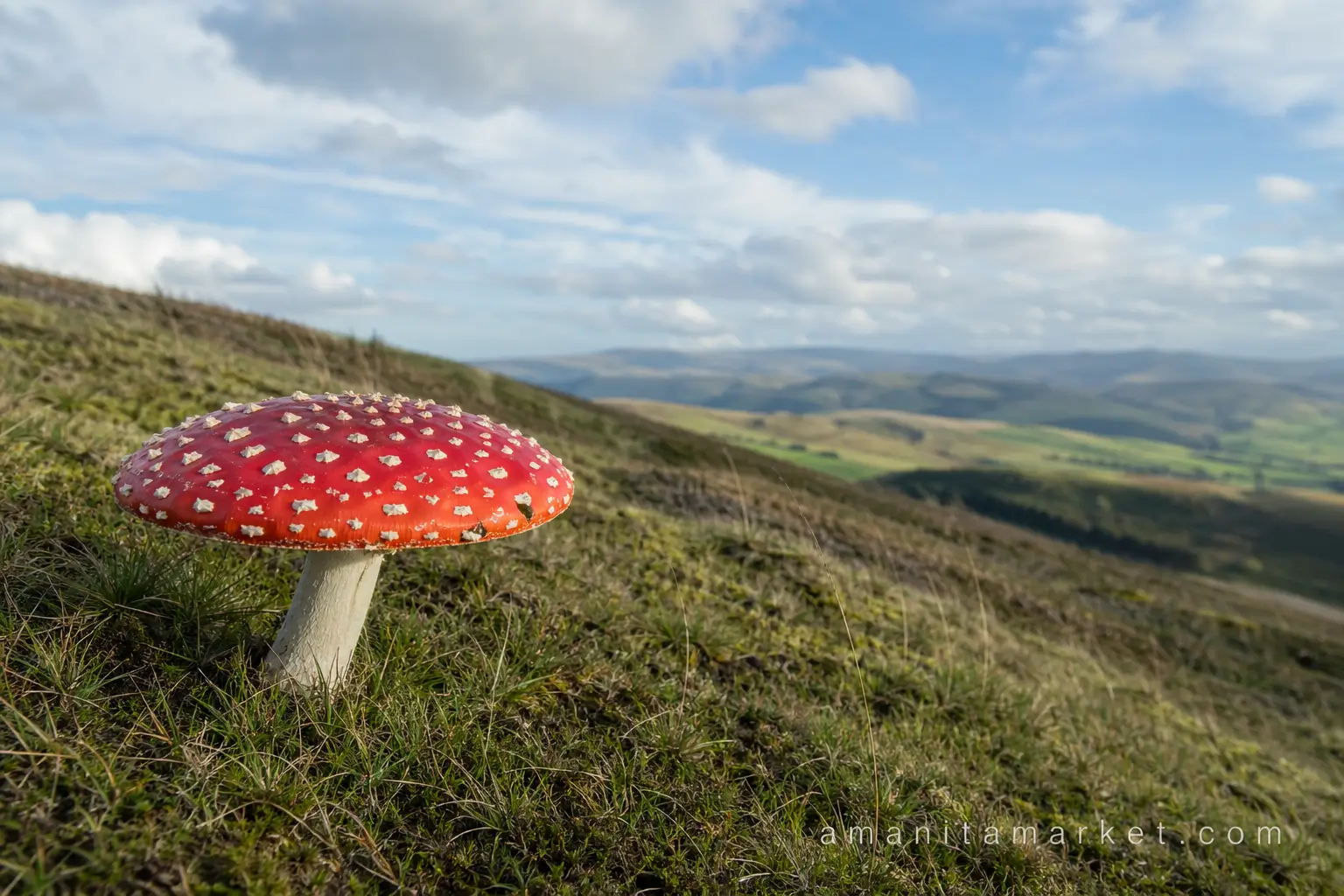
Sleep research has become one of the most active frontiers in neuroscience, and muscimol — the primary active compound in Amanita muscaria — has emerged as a molecule of interest due to its direct interaction with the GABA-A receptor system. This article presents a factual overview of the current peer-reviewed research examining muscimol’s relationship to sleep regulation.
The GABA System and Sleep
To understand why muscimol is of interest to sleep researchers, it is necessary to understand the role of GABA in sleep regulation. GABA (gamma-aminobutyric acid) is the brain’s primary inhibitory neurotransmitter. GABAergic signalling plays a central role in initiating and maintaining sleep — particularly non-REM (NREM) sleep, the restorative phase associated with slow-wave brain activity.
The majority of pharmaceutical sleep aids — benzodiazepines (diazepam, temazepam) and non-benzodiazepine “Z-drugs” (zopiclone, zolpidem) — work by modulating GABA-A receptor function. They do not directly activate the receptor but enhance its sensitivity to GABA. Muscimol, by contrast, is a direct agonist — it binds to the GABA-A receptor at the same site as GABA itself and activates it directly.
Benzodiazepines and Z-drugs are GABA-A modulators — they require GABA to be present to work. Muscimol is a direct agonist — it activates GABA-A receptors independently. This distinction is important in pharmacological research, as direct agonists typically have different dose-response curves and tolerance profiles than modulators.
| Property | Muscimol | Benzodiazepines / Z-drugs |
|---|---|---|
| GABA-A mechanism | Direct agonist — activates the receptor itself | Modulator — enhances sensitivity to GABA |
| Requires GABA present? | No — acts independently | Yes — requires GABA to work |
| Binding site | Same site as GABA itself | Separate allosteric site |
| Primary sleep-stage effect (preclinical) | Increased NREM, reduced REM at higher doses | Well-characterised NREM increase, REM suppression |
| Human clinical evidence | None (no controlled human sleep trials as of 2025) | Extensive clinical literature |
Preclinical Research: What the Studies Show
Several preclinical studies have examined muscimol’s effects on sleep architecture in animal models. A key study published in the journal Pharmacology Biochemistry and Behavior (indexed on PubMed) investigated the dose-dependent effects of muscimol administration on sleep-wake cycles in rodents. The findings indicated that muscimol at moderate doses increased the duration of non-REM sleep and reduced sleep-onset latency — the time taken to fall asleep.
A separate body of research has focused on specific brain regions involved in sleep regulation. The preoptic area of the hypothalamus — a key sleep-promoting region — contains dense populations of GABA-A receptors. Microinjection studies in rodents have shown that muscimol administered to this region reliably promotes sleep, providing mechanistic support for the broader sleep effects observed in systemic administration studies.
Research by Gottesmann (2002), published in Progress in Neurobiology, reviewed the role of GABA and GABA-A agonists across different sleep stages, including the relationship between GABAergic tone and REM sleep suppression — another area of muscimol research interest.
Muscimol and Sleep Architecture
Sleep is not a uniform state. It consists of distinct phases — light NREM sleep (N1, N2), deep slow-wave sleep (N3), and REM sleep — that cycle throughout the night in predictable patterns. The distribution of these phases matters: deep slow-wave sleep is associated with physical restoration and memory consolidation, while REM sleep is associated with emotional processing and dreaming.
Preclinical muscimol research suggests effects primarily on NREM sleep, with some studies reporting reduced REM sleep at higher doses. This pattern is consistent with the known pharmacology of direct GABA-A agonism and mirrors the sleep-stage effects of benzodiazepines, which are well-characterised in clinical literature. The significance of these findings for human sleep remains to be established through clinical trials.
Limitations: What the Research Cannot Tell Us
It is essential to contextualise the existing research honestly. Virtually all muscimol sleep research to date has been conducted in rodent models. The pharmacokinetics, receptor density, and sleep architecture of rodents differ from humans in important ways, and results from animal studies do not translate automatically to human outcomes.
No adequately powered, double-blind, placebo-controlled clinical trials examining muscimol’s effects on human sleep have been published as of 2025. The preclinical evidence provides a mechanistic rationale for further investigation, but it does not constitute clinical evidence. This distinction is not merely a legal disclaimer — it is a scientific reality that should inform any interpretation of this research.
Ibotenic Acid and Drying: Relevance to Research
An important nuance for understanding muscimol research in the context of Amanita muscaria products: research typically uses isolated, pharmaceutical-grade muscimol, not dried mushroom material. Dried fly agaric contains muscimol alongside ibotenic acid (in varying ratios depending on drying conditions), muscarine, muscazone, and numerous other compounds. The pharmacological profile of the whole dried mushroom is more complex than that of isolated muscimol and has not been studied systematically.
For a broader overview of the compounds in fly agaric and their research context, see our article on muscimol effects research. For the relationship between drying and compound conversion, see our guide on what is Amanita muscaria.
Ethnobotanical Context
The connection between Amanita muscaria and sleep is not only a modern scientific curiosity — it appears in traditional accounts of the mushroom’s use. Siberian shamanic reports consistently describe the use of fly agaric as inducing deep, vivid dream states rather than the open-eye visual phenomena associated with serotonergic psychedelics. This is consistent with GABA-A agonism producing hypnotic and oneirogenic effects rather than classic psychedelic ones.
Our products are sold as dried ethnobotanical material — amanita muscaria powder for sale as a traditional botanical with documented cultural history, not as a sleep product. The scientific research presented in this article is for informational purposes only.
Frequently Asked Questions
Does muscimol work the same way as a sleeping pill?
Not exactly. Benzodiazepines and Z-drugs are GABA-A modulators that require GABA to be present, whereas muscimol is a direct GABA-A agonist that activates the receptor independently. Direct agonists typically show different dose-response and tolerance profiles than modulators.
Are there human clinical trials on muscimol and sleep?
No. As of 2025, no adequately powered, double-blind, placebo-controlled clinical trials on muscimol’s effects on human sleep have been published. Virtually all existing research is preclinical, conducted in rodent models, which do not translate automatically to humans.
Is dried fly agaric the same as the muscimol used in research?
No. Research uses isolated, pharmaceutical-grade muscimol. Dried fly agaric contains muscimol alongside ibotenic acid, muscarine, muscazone and other compounds in variable ratios, so its pharmacological profile is more complex and has not been studied systematically.
Sources
- Lancel & Faulhaber, 1996 — Role of GABAA receptors in sleep regulation: muscimol vs midazolam (PubMed)
- Lancel, 1999 — GABAA receptors and sleep: agonists promote NREM sleep (PubMed)
- Wikipedia — Non-REM sleep: physiology and GABAergic regulation
- Michelot & Melendez-Howell, 2003 — Amanita muscaria pharmacology (PubMed)
Amanita muscaria powder — wild-harvested fly agaric from Baltic forests, carefully dried and shipped to your door across Europe.