
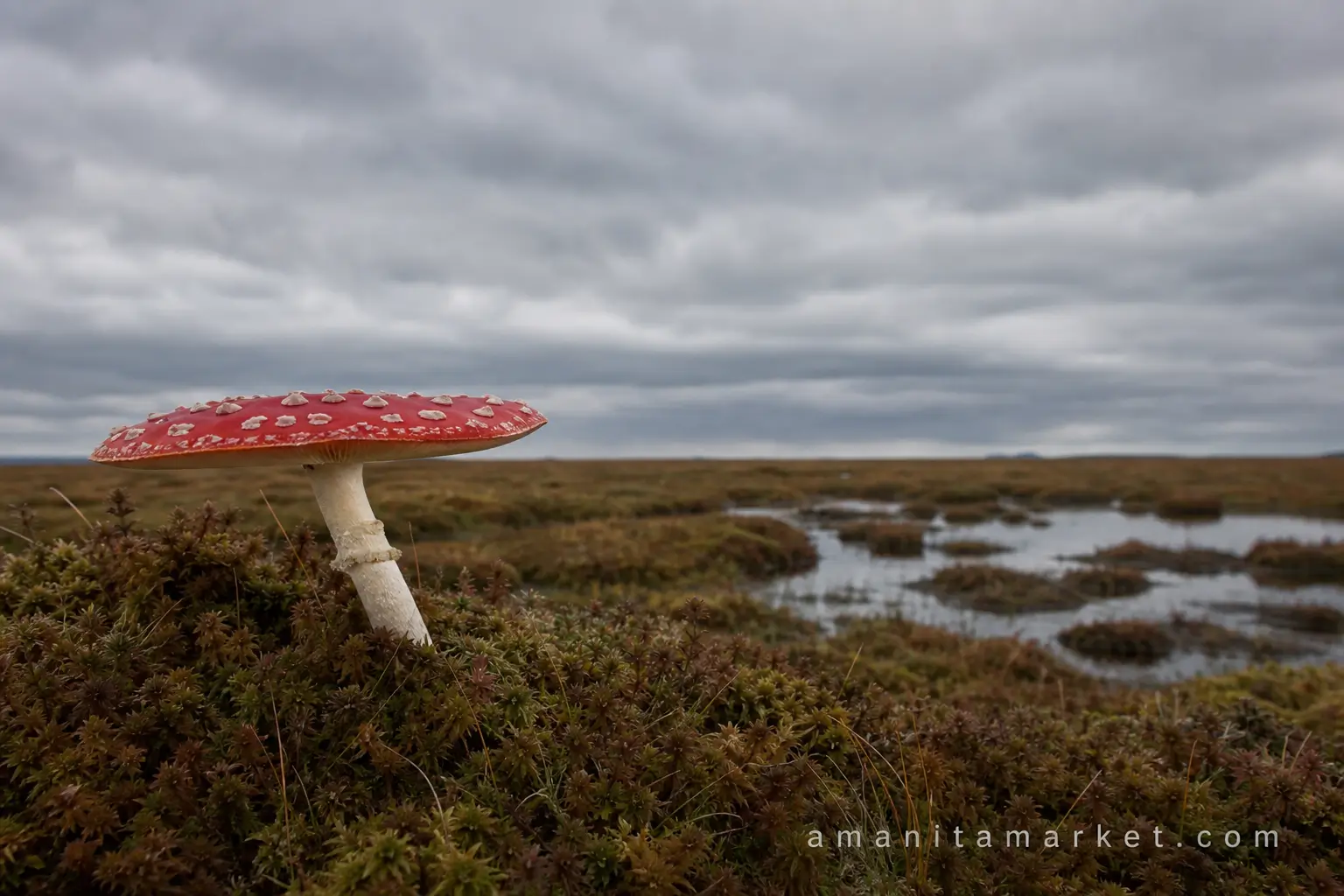
Japan has one of the world’s richest relationships with fungi — a country where mushrooms appear in art, literature, cuisine, and folklore in a way found almost nowhere else in the world. Amanita muscaria — known in Japanese as beni-tengu-take — occupies a fascinating position in this tradition: simultaneously a toxic species well-known to foragers and a mythologically charged symbol connected to some of Japan’s most enigmatic supernatural figures.
Japan’s Mushroom Culture
Japanese is one of the few languages that has a single word — kinoko — that encompasses the full cultural weight of mushrooms as a category, and the country’s foraging tradition runs deep. Regional varieties of matsutake, shiitake, and dozens of wild species are harvested seasonally across the country’s mountain and forest zones. Mycological knowledge is widely distributed in Japanese rural culture, and toxic species are generally well-known and respected.
Amanita muscaria grows naturally across Japan’s temperate and subalpine forest zones — in birch, pine, and mixed conifer woodlands from Hokkaido in the north to the mountain ranges of Honshu. It is a familiar sight to Japanese hikers and foragers, recognised without difficulty and understood to be inedible or dangerous. Unlike in Siberia, where the mushroom was consumed in specific ceremonial contexts, mainstream Japanese tradition treats it firmly as a toxic species to avoid.
Beni-Tengu-Take: The Red Tengu Mushroom
The Japanese name for Amanita muscaria — beni-tengu-take — translates literally as “red tengu mushroom.” The tengu (天狗) is one of Japanese mythology’s most complex supernatural figures: a mountain-dwelling spirit depicted as a human-bird hybrid with a long nose, sometimes in red robes, associated with martial arts, hidden mountain wisdom, and the ability to traverse between the human world and the spirit realm.
The association between fly agaric and the tengu is not arbitrary. Tengu are forest and mountain beings, often depicted living in cedar forests on steep peaks. They are connected to esoteric knowledge — the kind that cannot be learned from books but only through direct encounter with the numinous. In Shugendo — Japan’s mountain ascetic tradition — tengu were sometimes depicted as the guardians or transmitters of hidden teachings. The red mushroom, conspicuous in the mountain forest, carries a visual resonance with the red-clad, otherworldly tengu figure.
Tengu appear in Japanese art from the Heian period (794–1185) onward. The great swordsman Miyamoto Musashi was said to have trained with a tengu in the mountains. In folk belief, entering the mountains and encountering a tengu could result in gaining supernatural martial ability — or in disappearing entirely. The tengu is simultaneously a trickster and a teacher, operating in the ambiguous space between worlds — much like the mushroom associated with it.
Shugendo and the Mountain Ascetic Tradition
Shugendo — a syncretic Japanese mountain practice combining Buddhist, Shinto, and folk religious elements — involves ascetics (yamabushi) undertaking extended mountain retreats involving physical hardship, isolation, ritual fasting, and altered states of consciousness. The tengu is deeply embedded in Shugendo iconography as a forest spirit connected to these transformative experiences.
Some ethnobotanical researchers, including Christian Rätsch in his encyclopaedic work on psychoactive plants, have proposed that Amanita muscaria may have played a role in certain Shugendo contexts — not as a mainstream practice but as part of the broader tradition of using extreme or unusual experiences to facilitate spiritual transformation in mountain retreat. This remains speculative and lacks direct historical documentation comparable to the Siberian ethnographic record.
Japanese Folklore: The Kasa-Ko and Mushroom Spirits
In Japanese folk tradition, mushrooms occupy a liminal space — they appear overnight from nowhere visible, grow in dark and mysterious places, and include both delicious food and lethal poison. This uncanny quality made them natural candidates for supernatural association. Kasa-ko — small umbrella spirits — appear in some regional folklore traditions, and the mushroom’s umbrella-like shape was not lost on folk imagination.
Amanita muscaria’s dramatic appearance — red cap, white spots, emerging from the forest floor with extraordinary speed — made it a natural focus for supernatural interpretation. In some regional folk accounts, finding fly agaric in the forest was interpreted as a sign of supernatural presence in the vicinity — a marker of the boundary between ordinary and numinous space.
Modern Japan: Art and Popular Culture
In contemporary Japan, Amanita muscaria has entered popular culture primarily through its global visual profile — the red-and-white mushroom appears as a design element in Japanese games, animation, and illustration, drawing on both the international Christmas imagery and the domestic tengu-take tradition. The mushroom appears as a background element in numerous anime set in forest or fantasy environments, and is widely used in Japanese graphic design as a visual shorthand for magic, forest, and the uncanny.
The mushroom also features in Japanese botanical art traditions, where its striking appearance has made it a recurring subject for sumi-e (ink wash painting) and botanical illustration. For the global picture of fly agaric across world cultures — of which Japan is one fascinating chapter — see our article on fly agaric in world cultures. Or explore the shamanic traditions from which many of these cultural threads originate at Amanita muscaria and Siberian shamanism.
Sources
- Wikipedia — Tengu: Japanese mountain spirits and their cultural associations
- Wikipedia — Shugendo: Japanese mountain asceticism and ecstatic practice
- Wikipedia — Japanese mythology: supernatural beings and the natural world
- Wikipedia — Mycophilia: Japan’s exceptional cultural relationship with fungi
Our dried fly agaric ships to most of Europe — 100g of premium Baltic amanita muscaria powder, vacuum-sealed and ready to order online.