
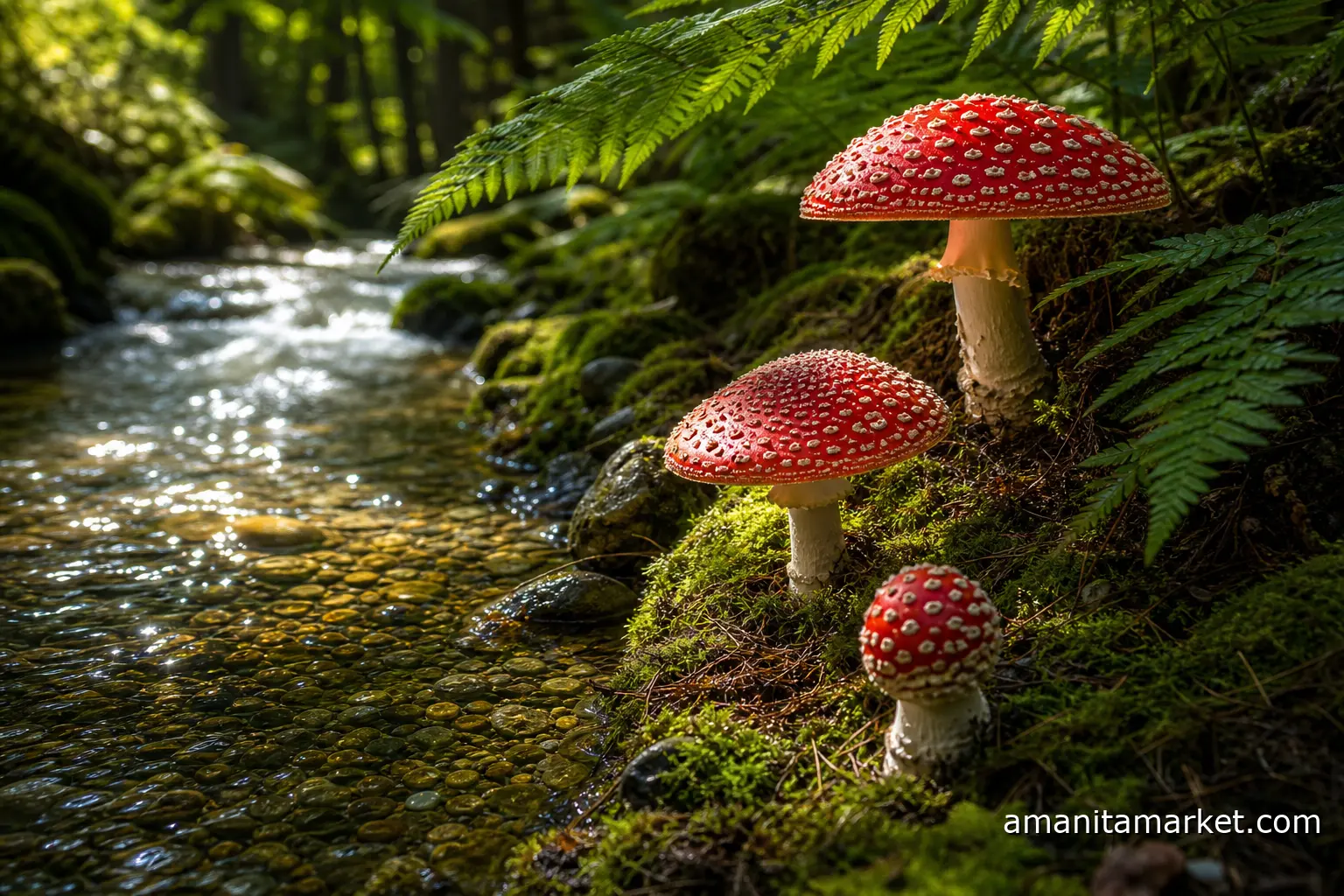
Every autumn, collectors and naturalists across Northern Europe photograph Amanita muscaria alongside other wild fungi — but it is the fly agaric that most consistently stops people in their tracks. What makes this mushroom so photographically compelling? And how has the modern age of nature photography and social media changed the fly agaric’s cultural presence? This is a story about biology, aesthetics, and the unexpected relationship between mycology and visual culture.
Why Fly Agaric Photographs So Well
Several biological features of Amanita muscaria combine to make it exceptionally photogenic. The high contrast between the vivid red cap and white spots creates a natural visual anchor — the eye goes to it immediately in any forest setting. The mushroom’s size — cap diameters regularly reaching 15–20cm in mature specimens — means it fills a photographic frame well without requiring extreme macro photography.
The relationship between the mushroom and its background is also unusually favourable for photography. Fly agaric consistently appears against the muted greens, browns, and greys of the forest floor, providing natural colour contrast without effort. The mushroom also holds its form well — unlike many fungi that collapse or shrivel within hours of emerging, a mature fly agaric can remain in excellent photographic condition for several days under the right weather conditions.
Golden Hour and the Quality of Light
The most celebrated fly agaric photographs consistently share one characteristic: they were taken in the low, angled light of morning or evening golden hour, when the red of the cap takes on an almost luminescent quality against a dark forest background. The warm colour temperature of golden-hour light (roughly 2,500–4,000K) enhances red and orange tones while adding warmth to the surrounding environment, producing a naturally dramatic result that studio lighting struggles to replicate.
Overcast days work surprisingly well too. Soft, diffuse cloud light removes harsh shadows and lets the cap’s colour read evenly across the frame — which is why many forest photographers actively prefer a grey, damp morning to bright midday sun, when contrast becomes harsh and highlights blow out on the glossy cap.
Camera Settings and Conditions
You do not need professional equipment to photograph fly agaric well, but a few choices reliably improve results. The table below summarises what experienced forest photographers reach for.
| Factor | Why it matters | Practical tip |
|---|---|---|
| Light | Warm, low light flatters the red cap | Shoot at golden hour or under soft overcast |
| Aperture | Controls how much is in focus | f/8–f/11 for a sharp cap; f/2.8–f/4 to blur the background |
| Angle | Low angles feel immersive | Get to ground level, level with the cap |
| Background | Contrast makes the subject pop | Place muted forest floor or birch trunks behind |
| Weather | Moisture deepens colour | Shoot after rain, when caps look richest |
Social Media and the Fly Agaric Aesthetic
The rise of Instagram, Pinterest, and other visually-driven social media platforms coincided with a significant increase in public awareness of and interest in Amanita muscaria as a photographic subject. Searches for fly agaric imagery have grown consistently through the 2010s and 2020s. The mushroom’s visual distinctiveness makes it highly shareable — a quality that translates directly into discoverability on visually-oriented platforms.
This social media presence has had a feedback effect: more photographs drive more interest, which drives more people into forests to find and photograph the mushroom, which produces more photographs. The fly agaric has become one of the most photographed organisms in temperate forests, a status its visual qualities entirely deserve.
Macro Photography and Fungal Detail
The emergence of accessible macro photography equipment has opened up a new dimension of fly agaric visual culture: close-up images showing the extraordinary detail of the cap surface, the wart texture, the gills beneath the cap, and the stem structures in resolution that reveals aspects of the mushroom invisible to the naked eye. The velum remnants — the white warts — are revealed under macro photography to have complex three-dimensional texture, varying significantly between young and mature specimens.
Macro work also rewards a little technique: a small aperture or focus stacking keeps the whole wart texture sharp, and a beanbag or small tripod steadies the camera at ground level. Scientific macro photography of Amanita muscaria has even contributed to the taxonomic literature, helping researchers document morphological variation between populations and growth stages. The boundary between scientific documentation and aesthetic photography is blurred for this species — both are served equally well by high-quality imaging.
The Autumn Forest Context
Fly agaric photography is inseparable from the context that makes it most compelling: the autumn forest. The mushroom’s fruiting season aligns with the most photographically rewarding period in temperate forests — the weeks when deciduous trees turn gold and amber before dropping their leaves, creating a background palette that complements the red-and-white of the fly agaric with extraordinary effectiveness.
Birch forest in particular — the fly agaric’s primary host tree — provides a context that is simultaneously the mushroom’s ecological home and its most photogenic setting. The white trunks of birch, the golden autumn leaves, and the vivid red mushroom create a colour combination that is both botanically authentic and visually spectacular. For more on when this window opens, see our fly agaric season guide on the Baltic harvest period.
Photographing Responsibly
Because fly agaric has become so popular a subject, it is worth photographing it with care. Avoid trampling surrounding vegetation or other, rarer fungi to get the shot; photograph the mushroom where it grows rather than picking or repositioning it; and remember that the mushroom is poisonous, so wash your hands after handling and keep it away from children and pets. Leaving specimens in place lets them complete their role in the forest ecosystem — and lets the next person enjoy them too.
Frequently Asked Questions
When is the best time to photograph fly agaric?
During the autumn fruiting season, ideally at golden hour or on a soft overcast morning, and especially just after rain when the cap colour is deepest.
What camera settings work best?
A low angle, a low ISO, and an aperture around f/8–f/11 keep the cap sharp; open up to f/2.8–f/4 to soften the background. A macro lens reveals the wart detail.
Where can I find fly agaric to photograph?
In birch and pine forests across temperate and boreal regions, appearing from late summer through autumn near its host trees.
Sources
- Wikipedia — Amanita muscaria: visual characteristics and cultural presence
- Woodland Trust — Fly Agaric: autumn identification and habitat
- Wikipedia — Macro photography: close-up imaging in natural history
- Wikipedia — Focus stacking: extending depth of field in macro images
- Wikipedia — Golden hour photography: light quality and colour enhancement
The world’s most photographed wild mushroom — available as premium dried Amanita muscaria from Baltic forests. Wild-harvested at peak season, carefully dried and vacuum-sealed. Buy dried fly agaric from a traceable source.