
Between the documented shamanic traditions of Siberia and the speculative connections to ancient Greece lies a vast geographical middle ground: Central Asia. It was across this zone — the Eurasian steppe, the Iranian plateau, the mountains of Bactria and Sogdia — that cultures developed which may represent the missing link in Amanita muscaria’s journey from its Siberian heartland into the mythologies of the ancient world. The Scythians, the Zoroastrians, and the cultures of the Bactria-Margiana Archaeological Complex all offer tantalising threads.
The Scythians: Steppe Warriors and Ritual Specialists
The Scythians were an Iranian-speaking nomadic people who dominated the Eurasian steppe from approximately the 9th century BCE to the 4th century CE. Their territory stretched from the Black Sea coast through the northern Caucasus and across the Central Asian steppe to the borders of China. They were in regular contact with both the Greek world to their west and the Iranian and Indian worlds to their south and east — making them a plausible vector for the transmission of ritual practices across this vast geographic arc.
Herodotus — our primary ancient Greek source on Scythian culture — provides a famous account of Scythian purification rituals in which hemp seeds were thrown onto heated stones to produce intoxicating smoke, which participants inhaled in enclosed tent structures. This passage has attracted enormous interest from ethnobotanists, but it also demonstrates that the Scythians practiced ritual inhalation of psychoactive plant materials — a cultural framework within which other plants and fungi might also have played a role.
In Book IV of the Histories, Herodotus describes Scythian purification ceremonies involving heated stones and aromatic plant material in tent structures that produced vapours causing participants to “howl with pleasure.” Whether Amanita muscaria was involved alongside or instead of hemp is not stated, but the ritual framework — enclosed space, heated stones, aromatic inhalation, altered consciousness — is structurally compatible with fly agaric use documented in Siberian contexts.
Haoma: The Iranian Counterpart to Soma
The Vedic Soma finds its direct counterpart in Iranian religion as haoma — a sacred ritual drink described in the Avesta, the primary texts of Zoroastrianism, in terms closely parallel to the Vedic Soma hymns. Like Soma, haoma is both a deity and a drink prepared from a plant pressed and filtered to yield a sacred liquid. Like Soma, its botanical identity has been debated for over a century.
The most widely accepted candidate for haoma in contemporary scholarship is ephedra — a shrub with stimulant alkaloids that grows across the Iranian plateau and Central Asia, and whose pressed juice has been found in association with ritual sites in the BMAC culture. However, some researchers have argued that the haoma tradition, like the Vedic Soma tradition, may have originally involved psychedelic compounds — with Amanita muscaria as one proposed candidate for the original substance, before ephedra became the standard substitute in more accessible lowland environments.
The BMAC: A Bronze Age Bridge
The Bactria-Margiana Archaeological Complex — named for the ancient regions of modern Afghanistan and Turkmenistan — was a Bronze Age urban culture that flourished from approximately 2400 to 1900 BCE. It occupies a crucial geographical and chronological position: contemporary with and geographically adjacent to both the Indus Valley Civilisation and the southern edge of the Eurasian steppe zone from which Indo-Aryan peoples were migrating.
Excavations of BMAC ritual sites have produced remarkable finds: compartmentalised vessels containing botanical residues, ceramic strainers associated with ritual liquid preparation, and figurines with iconographic associations to ritual intoxication. Analysis of botanical residues from some sites has identified ephedra and cannabis — and in some controversial cases, proposed that other psychoactive materials may have been present, though this remains contested in the archaeological literature.
The significance of the BMAC for Amanita muscaria’s cultural history is primarily geographical: it represents the zone through which Indo-Aryan peoples and their ritual practices (including the Soma/haoma complex) passed on their way from the steppe to the Indian subcontinent. Whether fly agaric was carried through this cultural corridor — as Wasson proposed — or whether it was already being replaced by steppe-accessible alternatives before the migration south, remains an open question.
Zoroastrian Texts and the Mushroom Question
The Avesta — the sacred texts of Zoroastrianism compiled over several centuries — contains extensive references to haoma and its preparation, but does not name the plant in terms that allow unambiguous botanical identification. Some Avestan passages have been interpreted by minority researchers as potentially compatible with mushroom use, but mainstream Zoroastrian scholarship identifies haoma with ephedra or a mixture of plants including ephedra, and the mushroom interpretation has not gained significant traction in this specific field.
What the Zoroastrian material does demonstrate is the cultural importance of the pressed sacred drink as a ritual medium across a vast swath of the ancient Iranian world — from the Caucasus to the Hindu Kush — and the depth of the practice across time. Whether the specific botanical identity of that drink was consistent across this entire geography and time period, or whether different plants were used in different regions and periods, is a question the texts cannot definitively answer.
The Steppe Connection: A Geographic Logic
Perhaps the strongest argument for Amanita muscaria’s role in Central Asian ritual traditions is simply geographical logic. The mushroom grows abundantly across the birch-pine forest zones of Siberia and the northern steppe — precisely the landscape inhabited by the nomadic peoples who moved goods, ideas, and practices between east and west across the ancient world. The Silk Road’s northern branch ran through exactly this zone. Shamanic practices from Siberia, traded objects from China, and religious ideas from Iran all moved through this corridor.
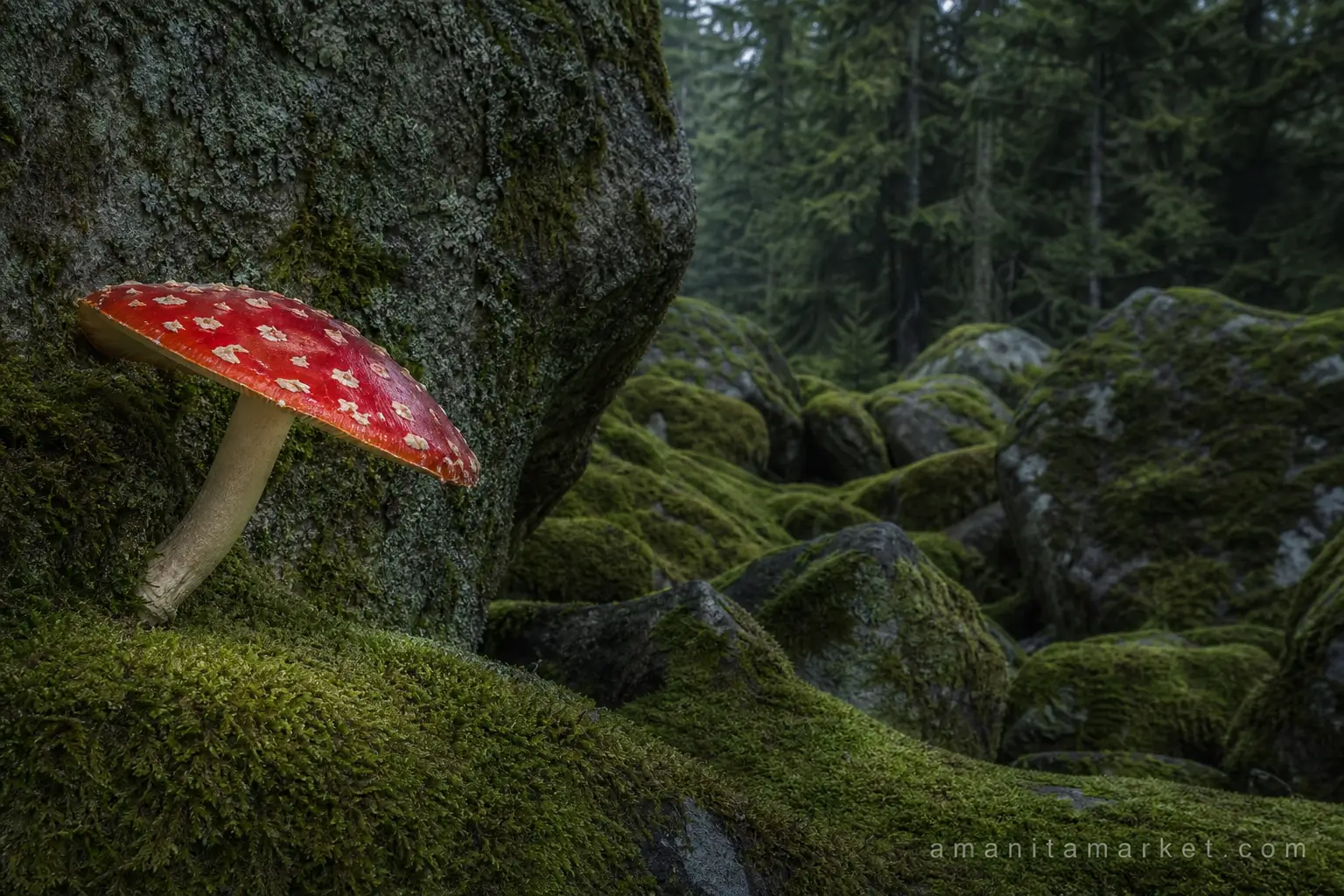
Amanita muscaria was not a rare or exotic substance in this landscape — it was a conspicuous, abundant, and culturally charged natural object in an environment where humans had lived and developed spiritual practices for thousands of years. Its absence from Central Asian ritual practice would be more surprising than its presence. For the Siberian traditions that represent the most documented use, see our article on Amanita muscaria and Siberian shamanism. For the Vedic Soma connection that is the most developed version of the mushroom-in-ancient-religion argument, see Amanita muscaria and the Vedic Soma.
Sources
- Wikipedia — Scythians: steppe culture, ritual practices and Herodotus accounts
- Wikipedia — Haoma: Zoroastrian ritual drink and botanical identity debate
- Wikipedia — Bactria-Margiana Archaeological Complex (BMAC): Bronze Age ritual culture
- Wikipedia — Zoroastrianism: Avestan texts and the sacred plant tradition
Explore the world’s most culturally storied mushroom — our dried amanita muscaria powder is wild-harvested in the Baltic forests and ships across Europe.