
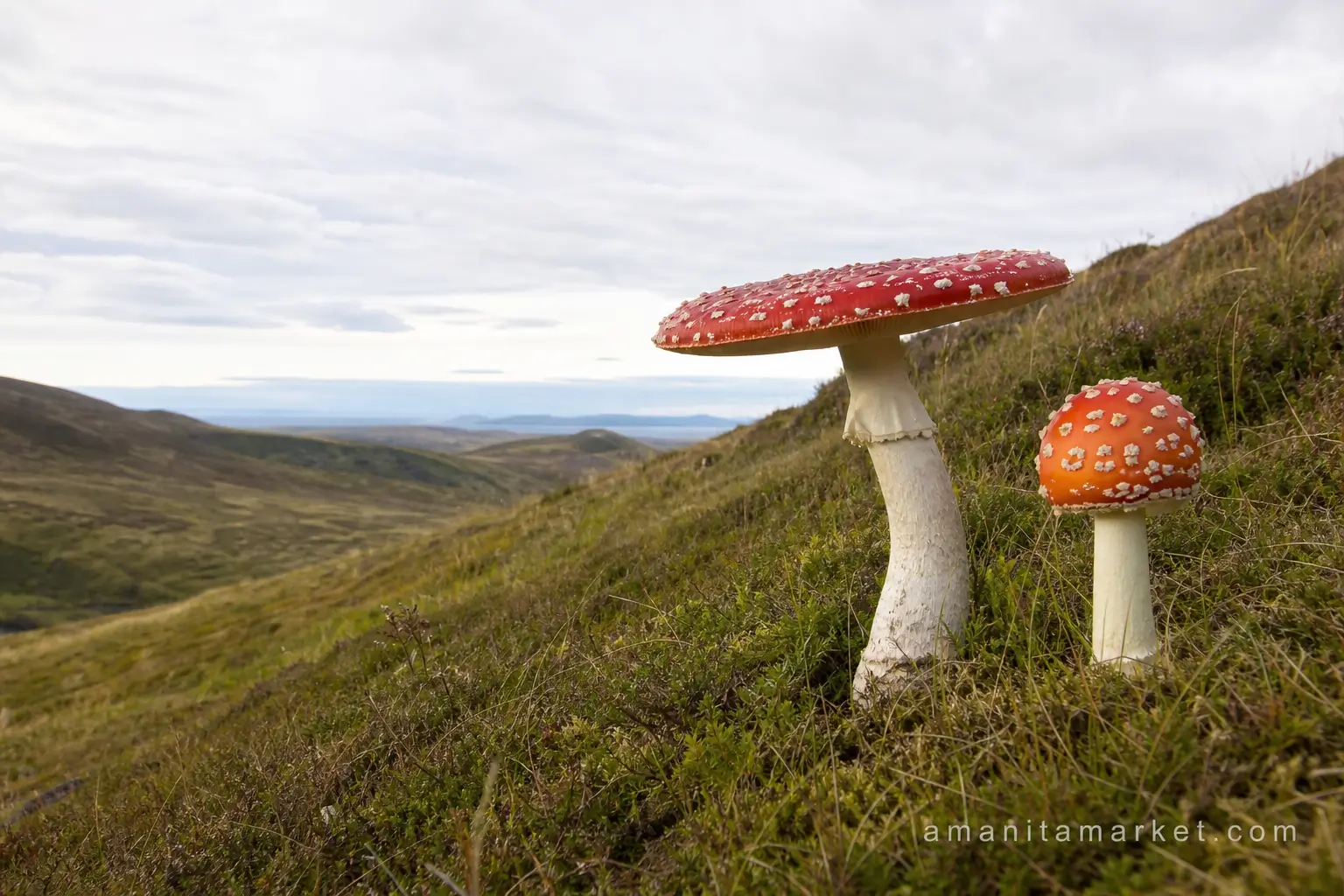
Amanita muscaria appears in European fairy tales, folk stories, and seasonal folklore with a frequency that no other mushroom can match. It is the fairy tale mushroom — the one that fairies sit on, the one that appears in enchanted forest clearings, the one depicted in children’s illustrations from the Victorian era to the present day. But the fly agaric’s presence in folk narrative runs deeper than Victorian illustration: it connects to pre-Christian European mythological frameworks that are genuinely ancient.
The Fairy Tale Mushroom: Where It Started
The association between fly agaric and fairies in English and Northern European tradition begins to appear consistently in the visual record from the mid-19th century onward. Victorian illustrators — working in an era of intense interest in fairies, folklore, and the supernatural as cultural counterpoints to industrial modernity — found in the fly agaric an ideal visual prop: vivid, recognisable, otherworldly in appearance, and already associated in folk tradition with the uncanny.
Richard Doyle’s 1870 illustrated book In Fairyland is among the early examples, depicting fairies among oversized red-and-white mushrooms in a lush woodland setting that established a visual vocabulary used in children’s illustration for the next century and a half. The fly agaric’s appearance in fairy-tale contexts subsequently became so standard that it is now difficult to imagine a European fairy tale forest without one.
Fairy rings — circles of mushrooms in grassland or woodland that appear to grow overnight — have been associated with supernatural activity across European cultures for centuries. While fairy rings are produced by many mushroom species, the fly agaric — which can form partial or complete rings around birch trees in suitable habitat — was one of the species associated with this phenomenon. The rings were variously described as places where fairies danced, as portals to the fairy world, or as places of danger where humans who stepped inside might be carried away to the otherworld.
German Fairy Tales: The Brothers Grimm and the Forest Mushroom
The Brothers Grimm, in their systematic collection of German folk tales in the early 19th century, documented a body of narrative set overwhelmingly in forest environments where supernatural beings — dwarves, witches, elves, and spirits — inhabit a landscape that would have been recognisable to any reader familiar with the Central European forest. While fly agaric does not appear by name in the Grimm canon, the symbolic furniture of the enchanted forest that their tales inhabit includes the visually distinctive mushroom as part of its implicit iconography.
The witch’s house in the forest, the dwarves’ underground realm, the enchanted clearing where time passes differently — all of these narrative settings belong to a folklore tradition that predates the Grimm collection by centuries and encodes a pre-Christian cosmology in which the forest was genuinely liminal space. The fly agaric, as the forest’s most spectacular and uncanny inhabitant, fits naturally into this symbolic geography.
Slavic Folklore: The Mushroom Spirit
In Slavic folklore, the fly agaric’s connection to supernatural narrative is more explicitly documented. The Leshy — the shapeshifting forest spirit of Russian and broader Slavic tradition — is the lord of the forest and everything that grows in it, mushrooms included. Encounters with fly agaric in the forest, in some regional folk accounts, were interpreted as markers of the Leshy’s presence. The mushroom’s sudden appearance, vivid colour, and toxic properties all made it a natural vehicle for supernatural attribution.
In Czech and Slovak folk tradition, the association between red-capped fungi and the otherworld is preserved in regional folk narratives that predate Christian influence. The forest in Slavic cosmology was simultaneously a resource and a danger — a place where transformative encounters with the non-human world were possible. The fly agaric, as the forest’s most visually dramatic inhabitant, was part of the symbolic vocabulary through which this danger and transformation were expressed. For the full account of Slavic tradition, see our article on fly agaric in Slavic mythology.
Nordic Folklore: Nixies, Elves, and the Red Mushroom
In Scandinavian and North Germanic folk tradition, the natural world was populated with beings — nisse, tomte, elves, and various spirits — whose relationship to humans was complex and often dangerous. The forest specifically was associated with huldrefolk (hidden folk) and other beings whose appearance could signal good fortune or disaster depending on one’s conduct.
The fly agaric appears in Nordic folk art from the medieval period onward, particularly in contexts associated with midwinter, the forest, and the liminal boundary between the human world and the hidden world. In some regional traditions, the mushroom’s appearance near a farmstead or home was considered a sign of the presence of helpful spirits; in others, it signalled the approach of dangerous ones. The ambiguity reflects the broader ambivalence in Nordic folk cosmology about the relationship between humans and the non-human natural world.
Twentieth Century and Modern Folklore
The fly agaric’s penetration into modern popular culture through fairy tale illustration, children’s books, and eventually video games and digital media represents the latest chapter in a folkloric tradition that stretches back through recorded history. The Nintendo mushroom, the Smurfs’ houses, the fairy tale toadstools of animated film — all draw on the visual vocabulary established in the Victorian and Edwardian fairy tale tradition, which was itself drawing on genuine folk belief.
What is remarkable is how coherent this tradition is across its timeline. The visual qualities that made fly agaric a fairy tale mushroom in the 21st century are the same qualities that made it a supernatural marker in pre-Christian European folk belief: vivid colour, sudden appearance, uncanny beauty, and pharmacological power that confirmed its otherworldly nature to those who encountered it. For more on the pop culture dimension, see our article on Amanita muscaria in pop culture. For the luck symbol tradition that runs alongside the fairy tale one, see fly agaric as a luck symbol.
Sources
- Wikipedia — Fairy ring: European folk tradition and supernatural associations
- Wikipedia — Brothers Grimm: German fairy tale collection and forest symbolism
- Wikipedia — Fairy tale: European narrative tradition and natural world symbolism
- Woodland Trust — Fly Agaric: British folklore and cultural associations
Own a piece of Europe’s most mythologised mushroom — dried amanita muscaria powder, wild-harvested in Baltic forests and shipped across the EU.