
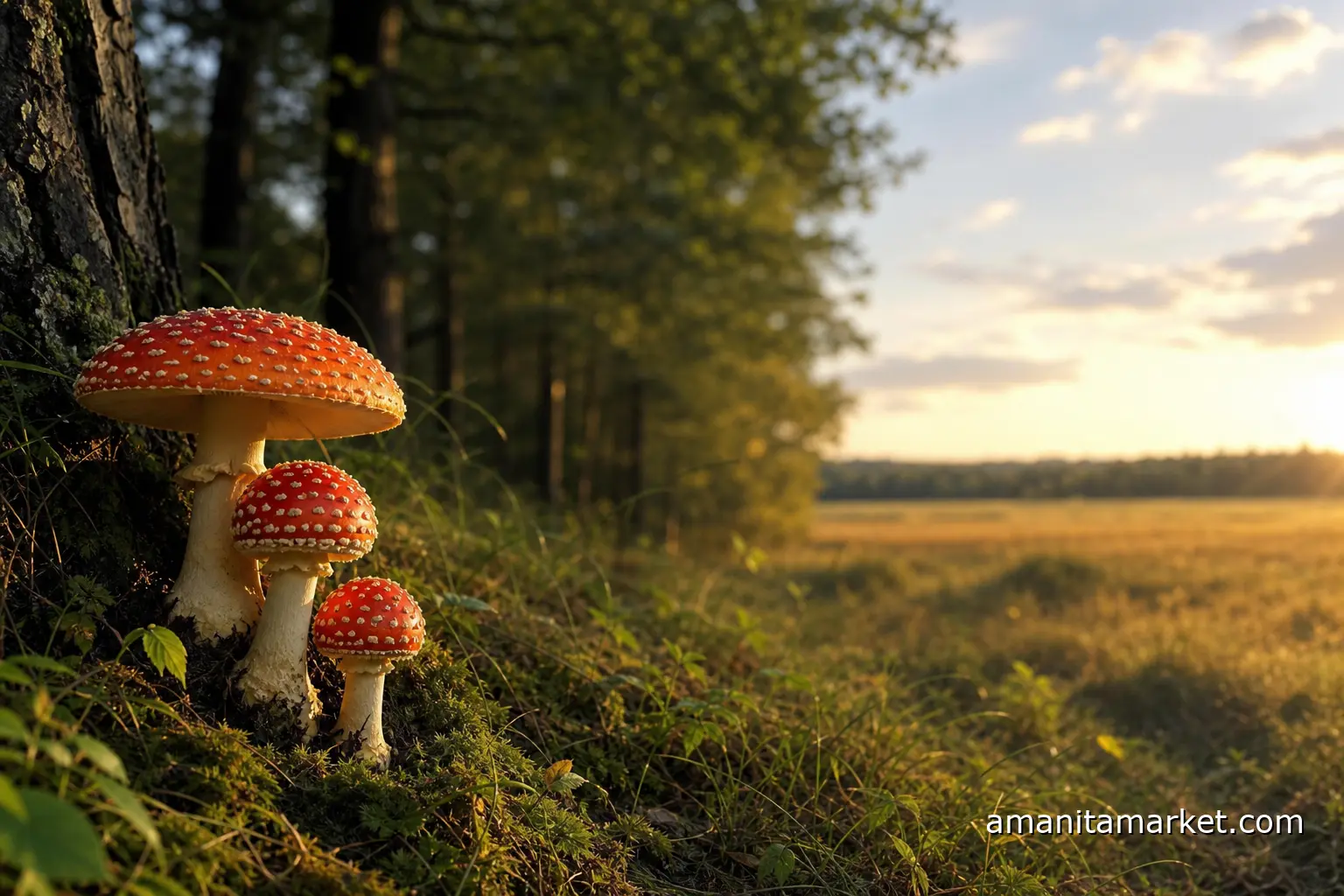
Amanita muscaria is overwhelmingly a Northern Hemisphere species — its documented range, cultural history, and commercial harvesting are all concentrated above the equator. But Africa presents a fascinating edge case: the continent has its own indigenous Amanita flora, and some fly agaric populations have been introduced to Africa through European plantation forestry. This article examines what is known about Amanita muscaria and the African continent.
Native Amanita Species in Africa
Africa has a substantial native Amanita flora — dozens of species found across the continent’s diverse forest zones, from the Congo Basin rainforest to the Cape Floristic Region of South Africa. Several of these native species are edible and are harvested for food by local communities, representing an important source of protein and income in rural areas. African Amanita species have attracted increasing scientific attention in recent years as mycologists recognise the continent’s fungal diversity was historically understudied.
The native African amanitas are ecologically distinct from Amanita muscaria — they form mycorrhizal associations with African trees rather than the birch and pine partnerships that define fly agaric’s ecology. They have their own cultural relationships with local peoples, though the ethnomycological documentation of African fungal traditions remains far less developed than for European or Asian cultures.
Introduced Fly Agaric: Following the Pines
Amanita muscaria is not native to Africa but has been introduced to several African countries through European plantation forestry. In South Africa, the introduction of European pines (Pinus radiata, Pinus sylvestris, and other species) for timber production from the 19th century onward created new mycorrhizal habitat for European fungi. Fly agaric, carried in the root systems of imported seedlings, has naturalized in South African pine plantations, particularly in the Western Cape, KwaZulu-Natal, and other pine-growing regions.
Similar introductions have occurred wherever European conifers have been planted in Africa — in parts of East Africa, notably Kenya and Tanzania at altitude, and in other plantation contexts. In all cases, the introduced fly agaric populations are genetically related to their European source populations, as confirmed by the phylogeographic research of Geml et al. (2006, PubMed 16367842).
Native vs Introduced: Two Different Stories
It is worth being precise about the two distinct ways amanitas relate to the African continent — the native flora and the introduced fly agaric are entirely separate phenomena. The table below contrasts them.
| Aspect | Native African Amanita | Introduced A. muscaria |
|---|---|---|
| Origin | Indigenous to Africa | European, via plantation forestry |
| Tree partners | Native African trees | Introduced European pines |
| Range | Congo Basin to Cape region | Pine plantations (S. Africa, E. Africa highlands) |
| Edibility | Several species edible, eaten locally | Toxic, not a food species |
| Cultural status | Integrated into local food systems | Largely undocumented |
A Biological Introduction
Introduced Amanita muscaria in the southern hemisphere represents an unintentional biological introduction that is now well-established in plantation ecosystems. The mushroom’s mycorrhizal biology — its dependence on specific tree partners — means it is effectively contained within planted pine areas rather than spreading into native vegetation. However, as it establishes in introduced conifer habitats, it competes with native mycorrhizal fungi for root colonisation, potentially affecting the ecology of introduced forest ecosystems. This same plantation-driven spread has been documented in Australia, New Zealand and South America, making it one of the clearest examples of a fungus travelling the world alongside commercial forestry.
African Ethnomycology: An Emerging Field
The ethnomycological documentation of African cultures’ relationships with fungi is at an early stage compared to European, Asian, or American traditions. This reflects both a research resource gap and the historical marginalisation of African botanical knowledge in Western scientific literature. What emerging work suggests is that several African cultures have sophisticated relationships with specific fungi — particularly edible species that are integrated into seasonal food systems and local trade economies.
Whether any African cultural tradition has developed a specific relationship with the introduced fly agaric (recognising it as distinct from native species) is not well documented. Given the mushroom’s visually distinctive appearance — it does not resemble any common native African edible mushroom — it is likely noticed and identified by foragers in areas where it occurs, but its cultural status in these contexts has not been recorded in the ethnobotanical literature.
The Global Context
The African dimension of the fly agaric story is primarily one of ecological range extension rather than deep cultural engagement — unlike the Siberian, European, and Japanese traditions where the mushroom has centuries of documented cultural significance. But it illustrates the mushroom’s remarkable ecological adaptability and the unintentional spread of European forest fungi across the globe through the vehicle of plantation forestry.
For the full global picture of fly agaric’s cultural distribution, see our article on fly agaric in world cultures. For the genetic dimension of its global spread, see Amanita muscaria genetic diversity.
Frequently Asked Questions
Is fly agaric native to Africa?
No. Amanita muscaria is a Northern Hemisphere species. It reached Africa only through European pine plantations, where it naturalised in the root systems of imported seedlings.
Does Africa have its own Amanita mushrooms?
Yes — a rich native Amanita flora across the continent, including several edible species eaten locally. These are ecologically and culturally separate from the introduced fly agaric.
Is there an African fly agaric tradition?
Not in the documented sense. African ethnomycology is an emerging field, and no specific cultural relationship with the introduced fly agaric has been recorded in the literature.
Sources
- Geml et al., 2006 — Beringian origins and introduced southern hemisphere populations (PubMed)
- Wikipedia — Amanita muscaria: introduced populations and global distribution
- Wikipedia — Ethnomycology: the study of human-fungal relationships globally
- Wikipedia — Amanita genus: global diversity and African species
From its Baltic home to your shelf — premium wild-harvested Amanita muscaria, the world’s most widely distributed ethnobotanical mushroom.