
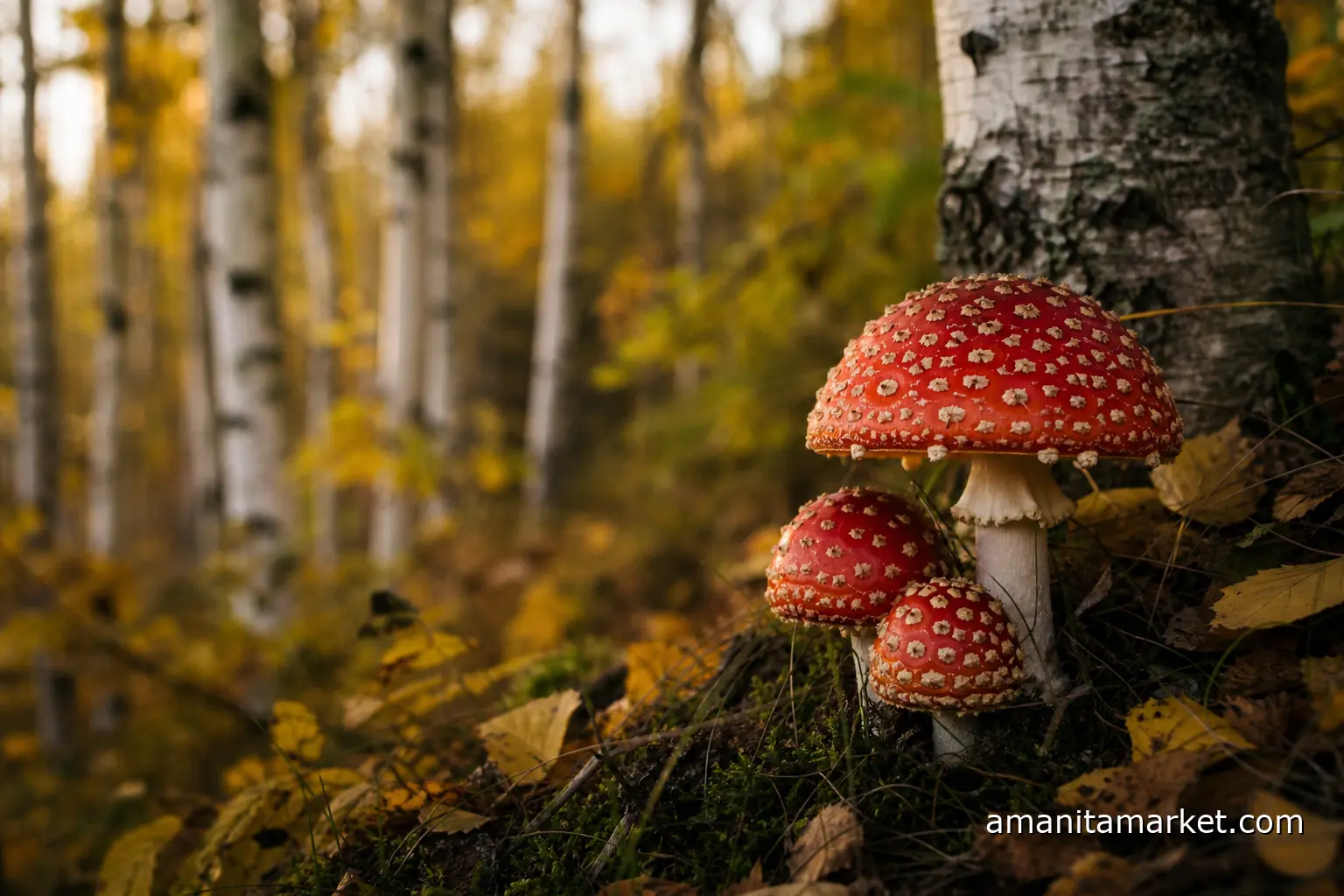
Amanita muscaria undergoes one of the most dramatic seasonal transformations of any common woodland organism. From the first white eggs pushing through the soil in late summer to the fully expanded flat caps of peak autumn and the collapsed, frost-darkened remnants of late season, the fly agaric’s annual life cycle is a condensed story of emergence, maturity, and decay that plays out across a few months in the northern forest. Understanding this cycle matters for foragers, photographers, and anyone interested in how the mushroom develops.
Stage One: The Egg
The fly agaric’s life above ground begins as a white or cream-coloured egg — an oval structure covered entirely by the universal veil, the membrane that encloses the developing fruiting body. At this stage, the mushroom bears no resemblance to its mature form. It pushes through the leaf litter as a smooth, rounded body 3–5cm across, similar in appearance to a small puffball. Slicing an egg vertically reveals the outline of the future mushroom inside — the folded red cap, the developing stem, the future gills.
The egg stage is ecologically significant: this is when the mushroom is most nutritionally valuable to animals that consume it, and when it is most likely to be predated by red squirrels, slugs, and insects before it has dispersed any spores. The rapid transition from egg to mature cap — sometimes occurring within three to five days under optimal conditions — is an adaptation that minimises predation risk during the vulnerable pre-sporulation stage.
Stage Two: The Hemispherical Stage
As the universal veil tears, the red cap surface becomes visible. The cap expands rapidly, passing through a hemispherical stage in which it is dome-shaped, bright red, and densely covered with white wart remnants. This is the stage most frequently depicted in illustrations — the classic “fairy tale mushroom” profile. The white spots at this stage are most intact and most densely distributed.
The ring (annulus) — the remnant of the partial veil that covered the gills — is visible around the upper stem, white and pendant. The gills are white and tightly packed under the still-domed cap. The stem is firm and white, with the characteristic swollen base enclosed in the remains of the universal veil (the volva).
The White Spots: What They Really Are
The white spots (warts) on the fly agaric cap are not part of the cap surface. They are fragments of the universal veil — the membrane that enclosed the entire mushroom when it was in the egg stage. As the cap expands, the veil tears unevenly, leaving irregular patches on the cap surface. These patches vary in size, density, and distribution — no two specimens have identical spot patterns. They can be washed off by rain, leaving a plain red cap that is still identifiably fly agaric from its other features.
Stage Three: The Mature Flat Cap
At peak maturity, the fly agaric cap flattens and opens — sometimes dramatically so. A large mature cap can reach 15–20cm in diameter and become almost plate-flat or even slightly upturned at the edges. This is the stage at which the mushroom is actively releasing spores — the gills, now fully exposed beneath the flat cap, release white spores that disperse by air and water.
The white spot remnants at this stage are often partially abraded or washed off, giving the cap a less dramatically spotted appearance than the hemispherical stage. The colour may also fade slightly from the vivid scarlet of young specimens to a more muted red-orange at the cap’s centre. The stem is fully elongated, sometimes reaching 20cm, and the ring may have torn and slipped downward.
Stage Four: Decline
After sporulation, the cap begins to soften, collapse, and lose colour. The edges may curl upward as moisture is lost; the surface darkens from red to orange-brown; the white spots disappear or become brown-stained. Insect larvae and slugs consume the tissue from below, leaving characteristic irregular patterns of damage. In wet conditions, bacterial decomposition accelerates; in dry conditions, the cap may desiccate and partially mummify.
For the purposes of harvesting quality specimens, the transition from mature flat cap to early decline is a narrow window — typically three to seven days for any individual specimen under good weather conditions. This is why experienced foragers visit productive sites repeatedly during peak season rather than making a single trip. For the full seasonal and habitat guide, see our article on fly agaric season. For identification features across growth stages, see fly agaric identification guide.
The Four Stages at a Glance
The table below summarises the full life cycle, with the diagnostic features and approximate timing of each stage.
| Stage | Appearance | Cap shape | Spores |
|---|---|---|---|
| 1. Egg | White oval, fully veiled, puffball-like | Hidden inside veil | Not yet forming |
| 2. Hemispherical | Bright red dome, densely white-spotted | Dome-shaped | Maturing under gills |
| 3. Mature flat cap | Flat to upturned, 15–20cm, spots fading | Flat / plate-like | Actively released |
| 4. Decline | Collapsing, darkening, insect-damaged | Curling, soft | Spent |
Frequently Asked Questions
How fast does fly agaric grow?
Very fast — the transition from white egg to mature cap can take just three to five days in good conditions. The whole window from emergence to decline is typically under two weeks per specimen.
Why do the white spots disappear?
The spots are fragments of the universal veil, not part of the cap. As the cap expands and rain falls, they are abraded and washed off, so older caps often look plainer than young ones.
Which stage is best for harvesting?
The mature flat-cap stage, just before decline, offers the largest, fullest caps. This window is short — about three to seven days — which is why foragers revisit sites through peak season.
Sources
Harvested at peak maturity — our dried Amanita muscaria captures the mushroom at its finest. Wild-harvested Baltic fly agaric, available now.