
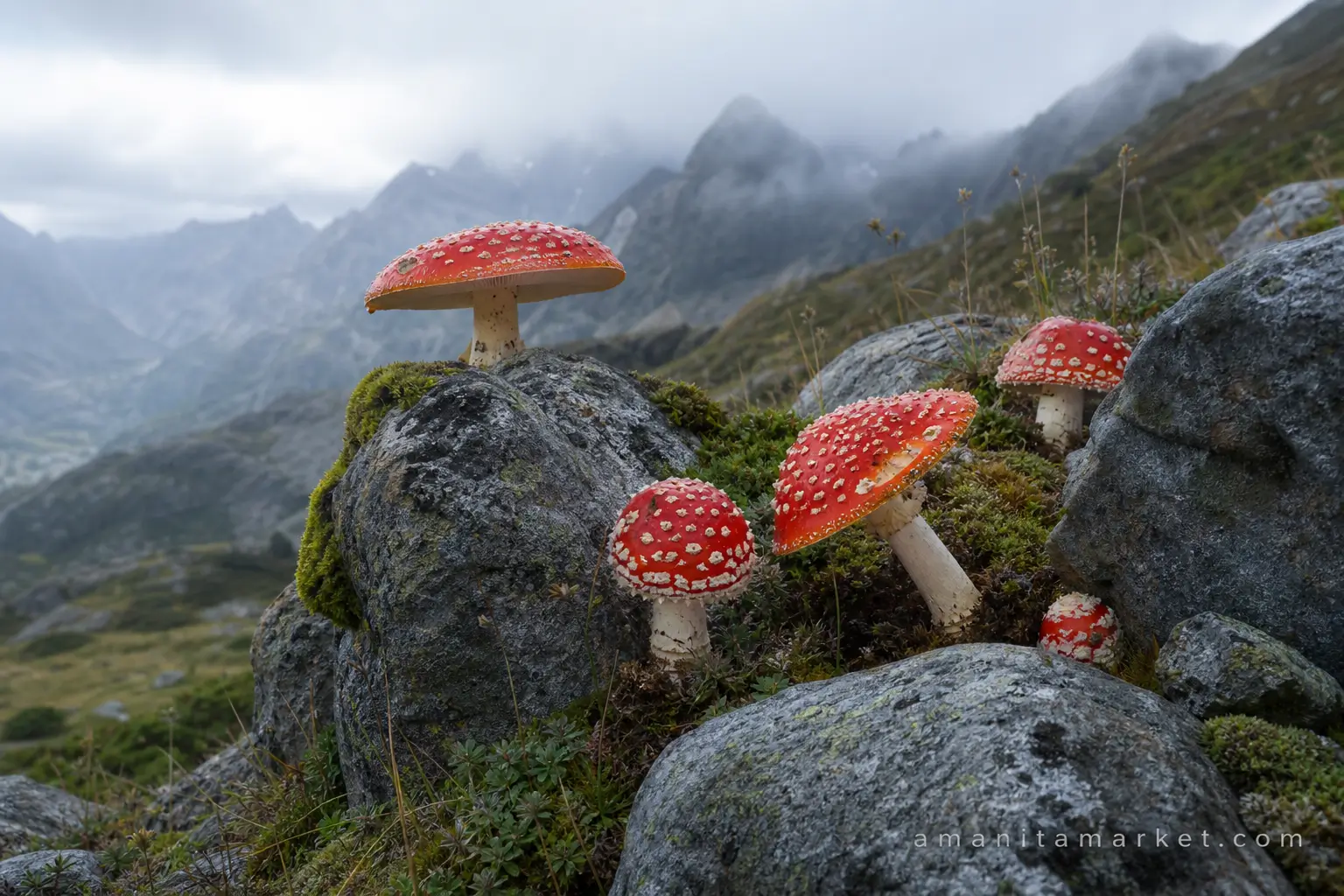
Amanita muscaria is not just a visually striking mushroom — it is a keystone species in forest ecosystems across the Northern Hemisphere. Through its mycorrhizal partnership with trees, fly agaric plays a role in forest health that goes far beyond anything visible on the surface. Understanding this ecological relationship is one of the more fascinating chapters in the biology of the world’s most recognisable fungus.
What Is Mycorrhiza?
Mycorrhiza — from the Greek mykes (fungus) and rhiza (root) — describes a symbiotic relationship between fungi and plant roots. In a mycorrhizal partnership, fungal threads (hyphae) penetrate or surround the root cells of a host plant, creating a physical connection through which nutrients and carbon are exchanged in both directions. Roughly 90% of all plant species form some type of mycorrhizal association — making this one of the most widespread biological relationships on Earth.
Amanita muscaria forms ectomycorrhiza: its hyphae wrap around the outside of root cells rather than penetrating them, forming a characteristic sheath called the Hartig net. This type of mycorrhiza is typical of temperate and boreal forest trees and is the dominant mycorrhizal strategy in ecosystems where Amanita muscaria occurs.
The Exchange: What Each Partner Gets
The mycorrhizal exchange is not charity — both partners gain something they could not easily obtain alone. The tree provides the fungus with carbohydrates, primarily sugars produced through photosynthesis. Amanita muscaria, like all mycorrhizal fungi, cannot photosynthesize and depends entirely on plant-derived carbon for its energy needs. It is not parasitic, however — the tree benefits substantially from the arrangement.
What the tree receives in return is access to soil minerals — primarily phosphorus and nitrogen — through the fungal network. The hyphal threads of Amanita muscaria extend far beyond the reach of the tree’s own roots, exploring a vastly larger volume of soil. The surface area of fungal hyphae can exceed that of the root system by several orders of magnitude, dramatically increasing the tree’s effective reach into the mineral-rich soil.
Mycorrhizal networks — sometimes called the “wood wide web” — can connect multiple trees of the same or different species through a shared fungal network. Carbon, water, and mineral nutrients can move through these networks between trees. Seedlings growing in the shade of established trees have been shown to receive carbon through mycorrhizal connections with their neighbours — a form of resource sharing mediated entirely by the fungal network.
Amanita Muscaria’s Host Trees
Amanita muscaria is not indiscriminate in its partnerships. It forms associations primarily with specific tree genera: birch (Betula), pine (Pinus), spruce (Picea), fir (Abies), and occasionally oak (Quercus) and beech (Fagus). This host specificity explains the mushroom’s distribution pattern — it is abundant in birch-pine forests and absent from treeless landscapes, regardless of other conditions.
The Baltic region — the source of our wild-harvested fly agaric — is dominated by exactly these tree communities. Vast birch-pine forests with centuries-old mycorrhizal networks produce the ideal conditions for abundant, high-quality Amanita muscaria fruiting. The mushrooms that appear in autumn are the reproductive structures of a subterranean organism that may have been living in the same forest soil for decades.
Ecology of Fruiting: Why Autumn?
The timing of Amanita muscaria’s fruiting — late summer through autumn — is not coincidental. As trees prepare for winter dormancy, they begin reducing carbohydrate transfer to their roots. This reduction in supply triggers the mycorrhizal fungus to shift energy toward reproduction, producing the above-ground fruiting bodies (mushrooms) that carry spores. The mushroom is, in this sense, the forest’s way of reproducing itself.
A landmark 2015 study by Kohler et al., published in Nature Genetics, provided the first genomic comparison of mycorrhizal and saprotrophic (decomposing) fungi, confirming that the transition to mycorrhizal lifestyle involved the loss of key decomposition enzymes and the acquisition of specialised nutrient transport proteins. Amanita muscaria was included in this analysis, confirming its obligate mycorrhizal nature at the genomic level.
Why Amanita Muscaria Cannot Be Cultivated
The practical consequence of Amanita muscaria’s mycorrhizal lifestyle is that it cannot be cultivated in the way that saprotrophic mushrooms can. Species like oyster mushrooms and shiitake are grown on sterilised substrate — they decompose organic matter without needing a live tree partner. Fly agaric requires a living host tree, established soil conditions, and a functioning mycorrhizal network that takes years to develop.
This means that all fly agaric powder available commercially — including ours — is genuinely wild-harvested. There is no cultivated alternative. The harvest comes from real forests, at specific times, by experienced foragers who know where and when to find specimens of the right quality. For more on how wild specimens are identified and selected, see our fly agaric identification guide.
Conservation and Sustainability
Because Amanita muscaria is an ecological keystone — supporting the health of the trees it partners with — sustainable harvesting practices matter. Responsible collection removes fruiting bodies without disturbing the mycelial network in the soil. The vast majority of the organism remains underground, unaffected by above-ground harvesting, and will continue to produce mushrooms in subsequent years. In the abundant Baltic forests, sustainable wild harvest is entirely feasible and has been practised for generations.
If you’d like to explore more of the biology of this fascinating species, see our articles on what is Amanita muscaria and Amanita muscaria varieties. Or browse our range of dried fly agaric from 50g — sustainably harvested from Baltic forests.
Sources
- Wikipedia — Mycorrhiza: types, ecology and forest nutrient cycling
- Wikipedia — Ectomycorrhiza: the specific partnership of Amanita muscaria
- Kohler et al., Nature Genetics 2015 — Convergent losses of decay mechanisms in mycorrhizal fungi
- Woodland Trust — Fly Agaric: mycorrhizal ecology and host trees
Wild-harvested amanita muscaria powder — sustainably collected in Baltic birch and pine forests. Try our 50g starter pack, shipped across Europe.