
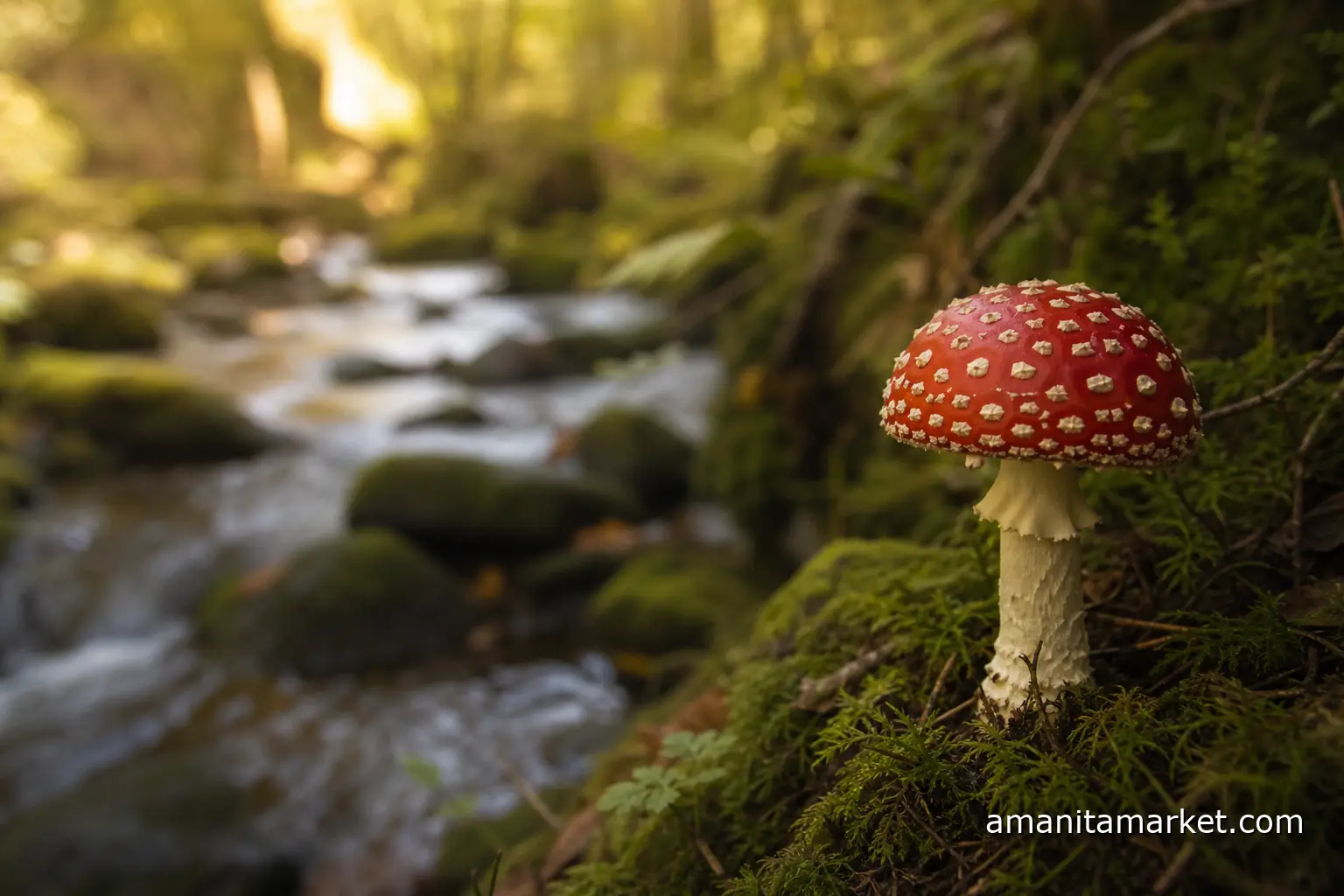
The term “king fly agaric” appears occasionally in the ethnobotanical market — sometimes as a quality descriptor for particularly large Amanita muscaria specimens, sometimes as a reference to a genuinely distinct species: Amanita regalis. The distinction matters. This article clarifies what the term means, who the real king is, and what buyers should know when they see “kings fly agaric” in product listings.
Amanita Regalis: The True King Fly Agaric
Amanita regalis — literally “regal” or “royal” amanita — is a real, taxonomically recognised species distinct from Amanita muscaria. First formally described in 1838, it is the only species in the genus that bears a close enough resemblance to fly agaric to cause genuine confusion. The species is found primarily in subalpine and boreal conifer forests of northern Europe and Scandinavia, often at higher altitudes than the common fly agaric.
Its most immediately recognisable feature is its cap colour: not red, but brown to yellowish-brown, often with an orange tint in younger specimens. The white wart remnants are present but may have a yellowish tinge. The stem, ring, and volva are similar to Amanita muscaria. The gills are white. In habitat and growth habit the two species are very similar — both mycorrhizal, both associated with conifers, both fruiting in autumn.
How Amanita Regalis Differs from Amanita Muscaria
The biochemical similarity between Amanita regalis and Amanita muscaria is substantial — both contain muscimol and ibotenic acid as primary active compounds. However, studies including work by Geml et al. (2006) on Amanita muscaria’s genetic diversity have noted that the two species, while closely related, have separate evolutionary histories and potentially different compound profiles.
The practical implication for buyers: if a product is labelled “king fly agaric” or “Königsfliegenpilz” and refers to Amanita regalis, it is a different species from standard Amanita muscaria — with a different appearance and potentially a different compound ratio. A reputable supplier will clearly specify which species they are selling. Ambiguity on this point is a reason to ask for clarification.
Identification at a Glance
The two species are easy to tell apart once you know the key feature — cap colour. The table below contrasts them side by side.
| Feature | Amanita muscaria | Amanita regalis |
|---|---|---|
| Cap colour | Scarlet to deep red | Brown to yellowish-brown (not red) |
| Wart remnants | White | Yellowish to white |
| Gills | White | White |
| Habitat | Conifer/birch, widespread | Subalpine/boreal conifer, montane |
| Fruiting | Autumn | Autumn |
If a product claims to be “king fly agaric” and shows red caps in its images, the supplier is using the term as a quality descriptor for large Amanita muscaria — not as a species identification.
“King Fly Agaric” as a Commercial Quality Term
In the ethnobotanical market, “king fly agaric” or “Königs-Fliegenpilz” is frequently used not as a species identification but as a commercial quality descriptor — implying particularly large, well-formed, or carefully selected Amanita muscaria specimens. This is a marketing term with no standardised definition. It does not guarantee that Amanita regalis is involved, and it does not guarantee superior quality over products not using the term.
When you encounter this terminology, the key questions remain the same as for any fly agaric product: what species is it (Amanita muscaria or Amanita regalis)? Where was it harvested? What was the drying method? Are these caps only? A product that cannot answer these questions clearly is not well-positioned regardless of what it calls itself.
Amanita Regalis in the Ethnobotanical Market
Genuine Amanita regalis products are available in the ethnobotanical market but less common than Amanita muscaria. The species has a more restricted range (primarily Scandinavian montane zones) and is generally less abundant than the common fly agaric. Collectors and ethnobotanical enthusiasts who specifically want Amanita regalis should verify the species identification carefully.
For those interested in the variety within Amanita muscaria itself — including the orange-yellow var. formosa found in parts of Europe — see our article on Amanita muscaria varieties and types. For guidance on identifying quality dried products, see our fly agaric powder guide.
Frequently Asked Questions
Is “king fly agaric” a real species?
It can be. Amanita regalis is a genuine species sometimes called king fly agaric — but the term is also used as a marketing label for large red Amanita muscaria. Check the species and the cap colour.
How do I tell Amanita regalis from Amanita muscaria?
The clearest difference is cap colour: A. regalis is brown to yellowish-brown, never the scarlet red of A. muscaria. Both share white gills and conifer habitat.
Is Amanita regalis chemically different?
Both contain muscimol and ibotenic acid, but the two species have separate evolutionary histories and potentially different compound ratios. A reputable supplier states clearly which species you are buying.
Sources
Classic Baltic Amanita muscaria — clearly identified, wild-harvested, low-temperature dried. No ambiguity, no marketing terms — just quality fly agaric.