
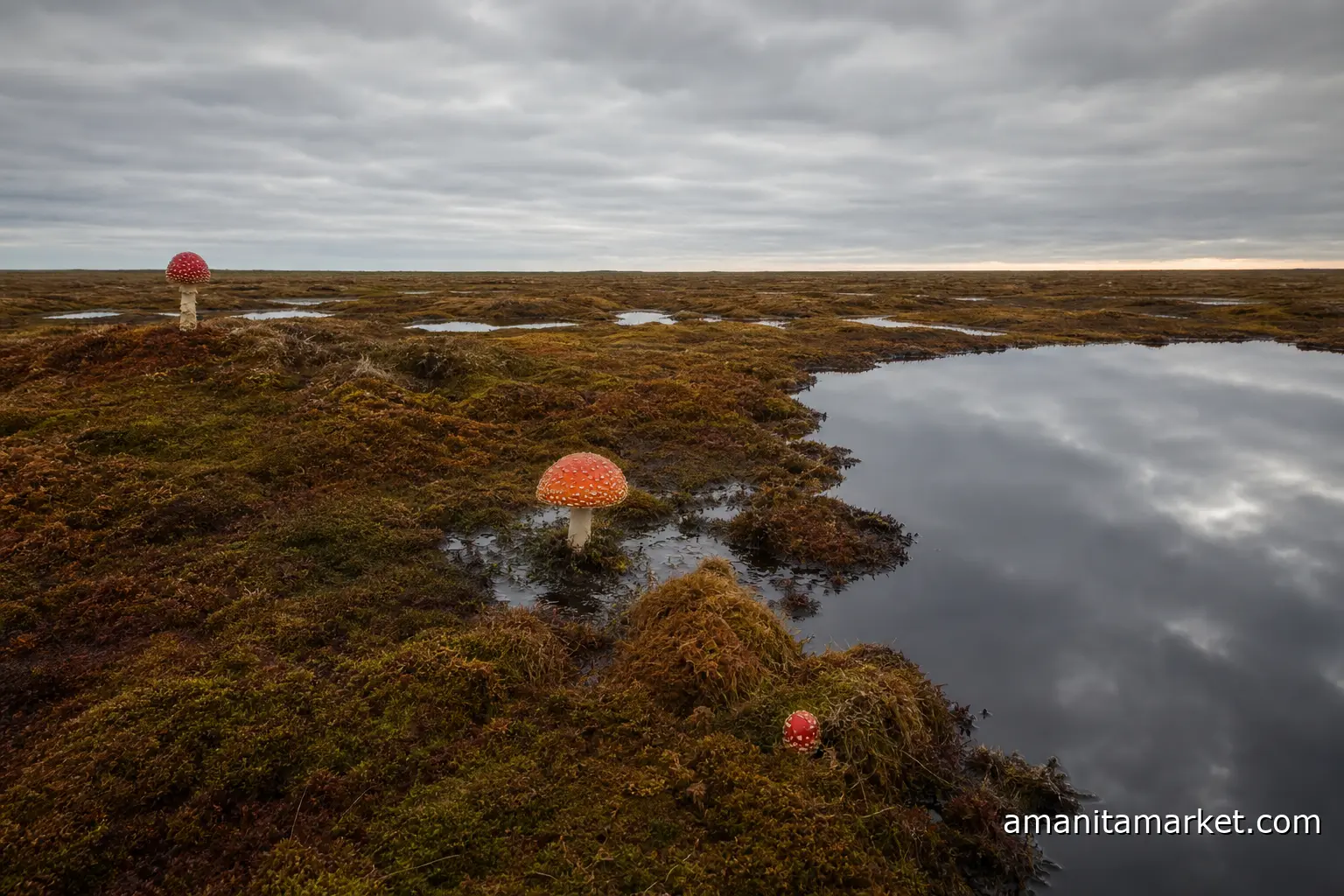
Amanita muscaria grows across the temperate and boreal forest zones of North America, from Alaska and Canada through the northern United States. Whether North American indigenous peoples used the mushroom in ritual or ceremonial contexts — as their counterparts in Siberia clearly did — is a question that ethnobotanists have examined with limited but suggestive results. The evidence is fragmentary and geographically uneven, but it is not absent.
Distribution: The Mushroom Was There
The prerequisite for indigenous use is presence. Amanita muscaria is native to North America across a wide boreal and temperate arc, growing in association with birch, pine, fir, and spruce forests that stretch from the Aleutian Islands through Alaska, Canada, and into the northern United States. These are precisely the landscapes inhabited by indigenous peoples with documented shamanic and botanical traditions.
In the Pacific Northwest, the Great Lakes region, and the subarctic zones, fly agaric would have been a consistent and conspicuous presence in the forest environment. Its visual distinctiveness — the red cap, white spots — makes it impossible to overlook, and difficult to imagine was simply ignored by peoples with extensive botanical knowledge systems.
Documented Cases: The Ojibwe Connection
Among the better-documented cases of North American indigenous awareness of Amanita muscaria is a reference in anthropological literature to Ojibwe (Anishinaabe) knowledge of the mushroom. Ethnobotanical surveys of Great Lakes woodland peoples collected in the late 19th and early 20th centuries include references to fly agaric as a plant with specific cultural significance, though the nature of that significance — medicinal, ritual, avoidance taboo — varies by source and is not consistently characterised.
The Ojibwe occupied territory extending from what is now Michigan and Wisconsin into Ontario and Manitoba — all within the range of Amanita muscaria’s North American distribution. The depth of their botanical knowledge systems, documented extensively by ethnographers including Frances Densmore and Huron Smith, makes their awareness of fly agaric’s properties highly plausible.
Evidence by Region
The strength of the evidence varies sharply depending on which part of the continent is examined. The table below summarises the picture across the main regions.
| Region / people | Nature of evidence | Strength |
|---|---|---|
| Great Lakes (Ojibwe) | Ethnobotanical references to cultural significance | Moderate |
| Subarctic peoples | Beringian diffusion hypothesis; shamanic parallels | Circumstantial |
| Pacific NW (Haida, Tlingit) | Abundant mushroom, sparse documentation | Weak / uncertain |
The Documentation Problem
North American indigenous botanical knowledge was systematically suppressed, disrupted, and underrecorded through colonisation. The ethnobotanical literature on North American indigenous mushroom use is significantly thinner than on plant use, partly because fungi were less systematically collected in early botanical surveys and partly because oral traditions were disrupted before full documentation was achieved. Absence of documentation is not absence of practice — a caution that applies throughout this topic.
The Siberian Connection: Cultural Diffusion Across Beringia
The ancestors of all indigenous North American peoples migrated from northeastern Siberia across the Bering land bridge — the last major crossing occurring between approximately 15,000 and 12,000 years ago. Siberian shamanic traditions, including fly agaric use, were well established by this period. Some researchers have proposed that knowledge of Amanita muscaria’s properties was carried across Beringia and preserved in residual form among cultures descended from the original migrants.
This hypothesis is supported by structural parallels between Siberian and certain North American indigenous shamanic traditions — the use of drums, the three-world cosmology, the role of the shaman as intermediary. Whether these parallels represent direct cultural transmission or independent development of similar practices in similar ecological contexts remains debated among specialists.
Pacific Northwest: The Amanita-Rich Landscape
The Pacific Northwest coast — from northern California through Oregon, Washington, and British Columbia — is one of the richest fungal environments in North America, and Amanita muscaria is abundant in the Douglas fir and mixed conifer forests of the region. Indigenous peoples of this coast, including the Haida, Tlingit, Coast Salish, and many others, developed extraordinarily sophisticated material cultures and knowledge systems.
Ethnographic accounts of Pacific Northwest botanical knowledge include references to various psychoactive or ceremonially significant plants and fungi, though fly agaric is not prominently featured in the most widely cited sources. Some researchers have proposed that taboo or deliberate concealment may account for gaps in the documented record — a phenomenon well-documented for other sensitive ritual knowledge in these cultures.
Fly Agaric in the Americas: A Summary
The picture that emerges from the available literature is one of regional variation and incomplete documentation. Some North American indigenous peoples clearly knew Amanita muscaria and assigned it cultural significance. Whether that significance reached the level of active shamanic use comparable to Siberian traditions is uncertain. The evidence suggests awareness, possible use in some communities, and a documentary gap that may be partly real and partly artefactual.
For the Siberian traditions that provide the most documented comparative context, see our article on Amanita muscaria and Siberian shamanism. For the broader world cultural picture, see fly agaric in world cultures. The same iconic mushroom is offered today as a collector’s botanical — our wild-harvested dried Amanita muscaria powder.
Frequently Asked Questions
Did Native Americans use fly agaric?
The evidence is fragmentary. Some awareness is documented (notably among the Ojibwe), but active shamanic use comparable to Siberia is uncertain.
Why is there so little record?
Colonial disruption of oral traditions, combined with fungi being underrecorded in early botanical surveys, left a thin documentary record.
Is there a link to Siberian shamanism?
The Beringian migration hypothesis and shared shamanic structures suggest a possible link, but direct cultural transmission remains unproven.
Sources
- Smith, H.H. (1932): Ethnobotany of the Ojibwe Indians. Bulletin of the Public Museum of the City of Milwaukee.
- Wikipedia — Amanita muscaria: North American distribution and indigenous use
- Wikipedia — Beringia: land bridge and migration of peoples and cultural practices
- Wikipedia — Anishinaabe (Ojibwe): Great Lakes indigenous peoples and botanical traditions
- Tylš et al., MDPI 2021 — Amanita muscaria: global cultural distribution
Explore the most culturally significant mushroom in the world — premium Baltic fly agaric powder, ethically wild-harvested and available in our shop.