
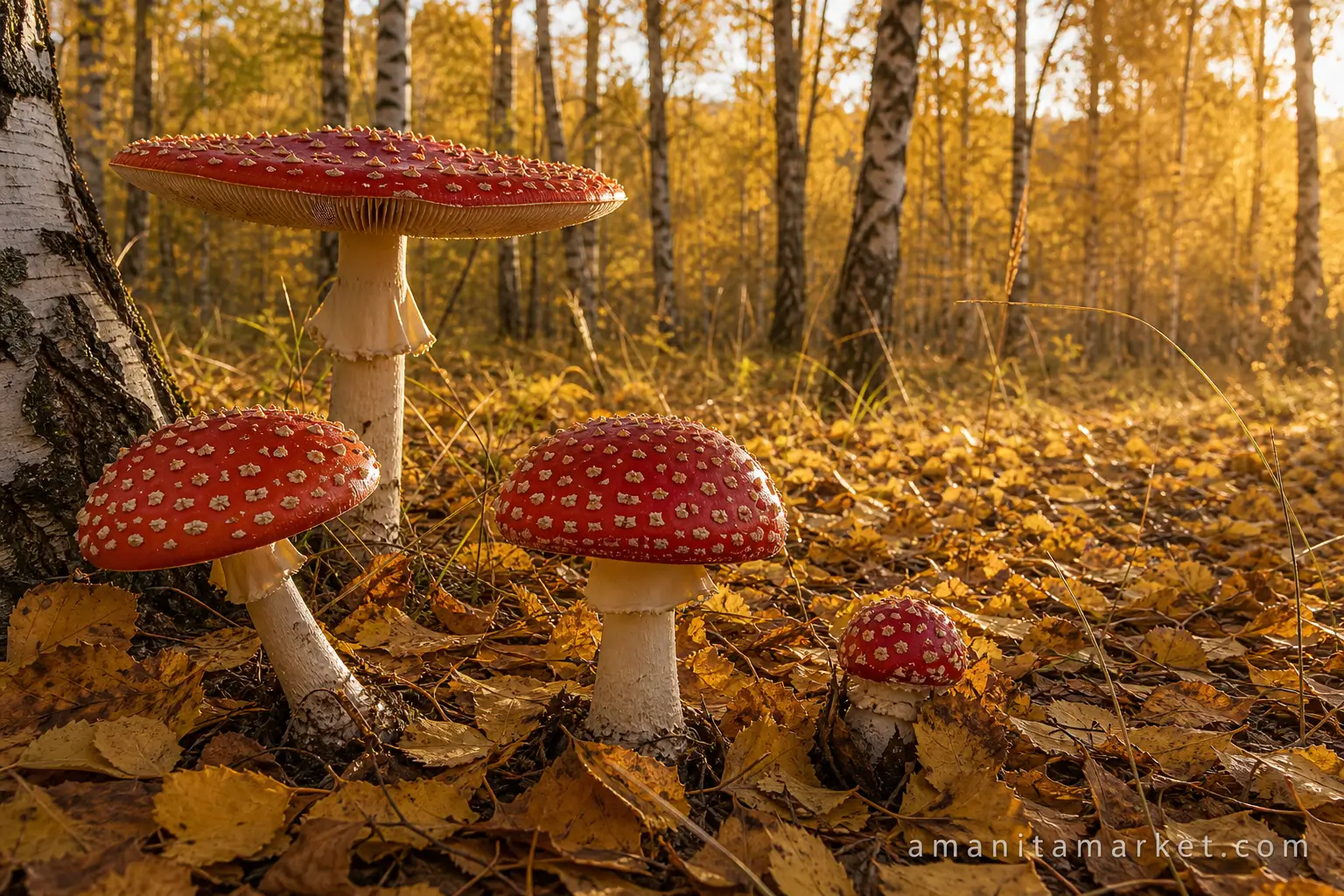
Few natural objects have made the leap from ancient shamanic tradition to global pop culture as completely as Amanita muscaria. The red-and-white mushroom appears in video games, animated films, advertising, streetwear, and digital art with a frequency that no other fungus can approach. This is not a recent phenomenon — the fly agaric has been building its pop culture presence for well over a century, and the trajectory is one of the more interesting stories in the relationship between natural history and visual culture.
The Victorian Foundation
The fly agaric’s journey into mainstream visual culture began in earnest in the Victorian era, when a combination of factors made the mushroom visually and culturally irresistible. The Arts and Crafts movement’s interest in natural forms, the Pre-Raphaelites’ taste for botanical detail, and the broader Victorian fascination with fairy worlds and enchanted nature all converged on the fly agaric as an ideal visual subject.
By the 1890s and early 1900s, the mushroom had become a standard prop in fairy illustration, appearing in greetings cards, book illustrations, and decorative arts across Europe and Britain. The German tradition of the Glückspilz — the fly agaric as a New Year’s luck symbol — was by this time producing vast quantities of postcards, ceramic figurines, and chocolate moulds featuring the recognisable red-and-white cap. The visual vocabulary of the fly agaric was being standardised and distributed at industrial scale for the first time.
Between roughly 1900 and 1940, the fly agaric appeared on hundreds of millions of European Christmas and New Year greetings cards. German, Austrian, Czech, and Scandinavian card manufacturers depicted the mushroom alongside chimney sweeps, four-leaf clovers, horseshoes, and pigs as part of the standard New Year’s luck iconography. Many of these cards are now collected antiques, and they document the extraordinary scale at which the fly agaric had entered mainstream visual culture by the early 20th century.
Alice in Wonderland and the Caterpillar’s Mushroom
Lewis Carroll’s 1865 Alice’s Adventures in Wonderland features a scene in which Alice encounters a hookah-smoking caterpillar sitting on top of a large mushroom — eating pieces of which causes her to grow or shrink. John Tenniel’s original illustrations did not depict the mushroom as a fly agaric specifically, but subsequent illustrated editions and adaptations — particularly the 1951 Disney film — gave the mushroom a distinctive red-and-white appearance that aligned it visually with Amanita muscaria.
Whether Carroll intended a reference to fly agaric is debated. The size-altering properties Carroll assigns to the mushroom are loosely consistent with folk accounts of fly agaric’s perceptual effects, and Carroll’s mathematical and logical inversions throughout the book share structural similarities with altered state experiences. But no documentary evidence confirms a deliberate fly agaric reference, and the connection may be as much a product of subsequent visual interpretation as of Carroll’s original intent.
Nintendo and the Global Mushroom
The single most significant event in Amanita muscaria’s pop culture history may be the release of Nintendo’s Super Mario Bros. in 1985. The Super Mushroom — a red mushroom with white spots that causes Mario to grow — is unmistakably based on Amanita muscaria’s visual profile, though Nintendo has never officially confirmed the reference. The game has sold hundreds of millions of copies across decades, and the Super Mushroom has become one of the most recognised graphic symbols in global popular culture.
The irony of the world’s most famous toxic mushroom becoming the primary power-up in a children’s video game is not lost on mycologists. But it is entirely consistent with the fly agaric’s broader cultural history: across traditions and centuries, it has been simultaneously dangerous and beneficial, toxic and magical, a warning and a gift. The Mario mushroom is, in this sense, the latest expression of a symbolic logic that has been operating since Siberian shamans first distributed dried fly agaric as ceremonial gifts in midwinter.
The Counterculture and Psychedelic Art
The 1960s counterculture — with its interest in altered consciousness, Eastern religion, and indigenous practices — discovered Amanita muscaria through the same ethnomycological literature that was reaching academic audiences. R. Gordon Wasson’s work on Soma and shamanic mushroom use was widely read in counterculture circles, and the fly agaric became a visual symbol of the broader psychedelic project even though muscimol’s effects are quite different from the serotonergic psychedelics that defined the era.
Psychedelic art from the late 1960s onward frequently depicts fly agaric — in poster art, album covers, and decorative contexts — as a visual shorthand for altered consciousness and the enchanted natural world. This visual tradition continues in contemporary digital art and the aesthetics associated with festival culture, where the fly agaric functions as a symbol of the interface between the ordinary and the extraordinary.
Contemporary Pop Culture: From Streetwear to TikTok
In recent years, Amanita muscaria’s cultural presence has accelerated rather than diminished. Growing interest in ethnobotany, functional mushrooms, and traditional plant medicine has brought the fly agaric into contemporary wellness and lifestyle culture. Streetwear brands have used the mushroom’s imagery. Social media has created communities of collectors and enthusiasts. Documentary filmmaking about psychedelic research — though focused primarily on psilocybin — has given the broader mushroom-and-consciousness topic increased mainstream visibility.
The result is that the fly agaric is now simultaneously a children’s fairy tale motif, a gaming icon, a traditional folk symbol, a contemporary collectors’ botanical, and an object of growing scientific and cultural interest. For the complete history that underlies this pop culture presence, see our article on fly agaric in world cultures, and for the shamanic roots, Amanita muscaria and Siberian shamanism.
Sources
- Wikipedia — Fly agaric in popular culture: comprehensive overview
- Wikipedia — Super Mario Bros.: the Super Mushroom and Amanita muscaria visual parallel
- Wikipedia — Alice’s Adventures in Wonderland: Tenniel’s mushroom and subsequent red-spotted depictions
- Wikipedia — Psychedelic art: counterculture imagery and the fly agaric motif
The most iconic mushroom in the world — now available as premium dried fly agaric powder. Wild-harvested Baltic amanita muscaria, shipped across Europe.