
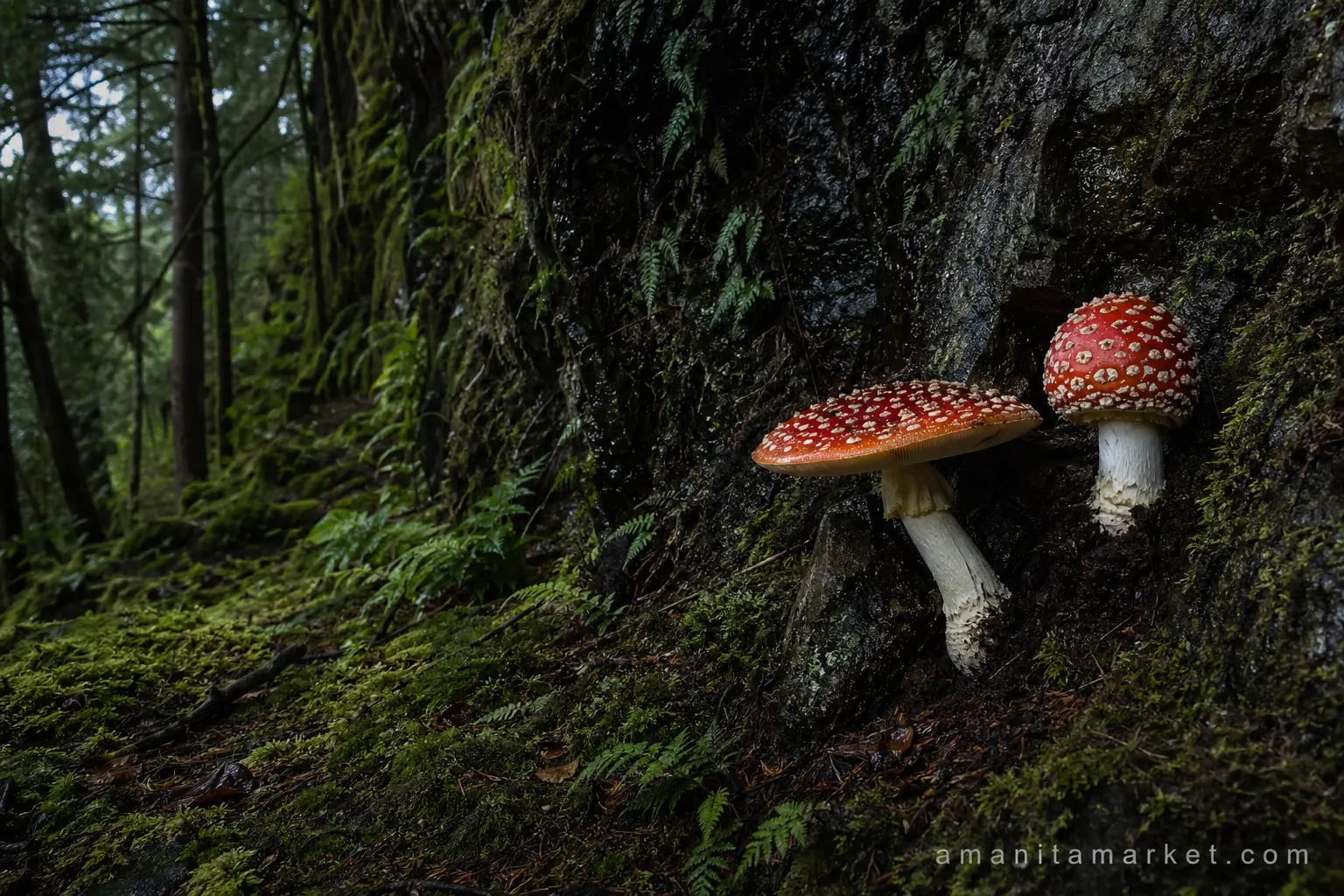
Amanita muscaria is one of the most distinctive mushrooms in the world — and one of the easiest to identify once you know what to look for. Its iconic red cap with white spots makes it instantly recognisable. Yet there are lookalikes and regional variations that every forager and collector should be aware of. This guide covers reliable identification of fly agaric in the field.
The Classic Appearance of Amanita Muscaria
At peak maturity, Amanita muscaria presents with a vivid scarlet-red to orange-red convex cap ranging from 8 to 20 centimetres in diameter, covered with irregular white warts — the remnants of the universal veil that enclosed the entire mushroom when it was young. The gills are white, densely packed, and free from the stem. The stem is white, 5–20 cm tall, with a prominent ring (annulus) and a distinctive bulbous base enclosed in a white volva.
The flesh is white throughout, firm, and does not change colour when cut. The spore print is white. The smell is mild and faintly mushroomy — not strongly distinctive.
✓ Red to orange-red cap (scarlet, not brown) · ✓ White warts on cap surface · ✓ White gills, free from stem · ✓ White stem with ring and bulbous base · ✓ Found under birch, pine, or spruce · ✓ Autumn fruiting (August–November)
The White Warts: What They Are and When They Disappear
The white spots on the cap of Amanita muscaria are not part of the cap itself — they are fragments of the universal veil, a membrane that encloses young specimens completely (resembling a white egg at the button stage). As the cap expands, the veil tears, leaving irregular white patches on the surface.
These warts are not permanent features. Heavy rain can wash them off entirely, leaving a plain red cap that superficially resembles a red russula or a colourful waxcap. If you encounter a red mushroom without spots in autumn woodland, always check the other features — gill attachment, stem base, and habitat — before drawing conclusions. A rain-washed fly agaric will still have its free white gills, ring, and volva base intact.
Growth Stages: From Egg to Full Cap
Amanita muscaria passes through several distinct visual stages. The button stage — a white or pale cream egg-shaped body pushing through the soil — is easily overlooked and can be confused with puffballs at a glance. Slicing a button vertically reveals the outline of the future mushroom inside, confirming identity.
As the cap expands, it passes through a hemispherical stage where the red surface becomes visible but the cap is still domed. At full maturity, the cap flattens and may even curve upward at the edges. Old, degraded specimens become soft, discoloured, and difficult to identify reliably — fresh, intact specimens are far easier to work with.
Habitat: Where to Find Fly Agaric
Amanita muscaria is a mycorrhizal fungus — it grows in association with specific trees. In Europe, the primary hosts are birch (Betula species), Scots pine (Pinus sylvestris), and Norway spruce (Picea abies). You will almost never find fly agaric in the absence of these trees.
Look for it in the leaf litter or short grass immediately beneath or near these tree species. It often grows in loose fairy rings or clusters around the base of a single tree. In the Baltic states and Scandinavia — the primary habitat for the wild-harvested specimens used in our shop — fly agaric is extraordinarily abundant in birch and mixed birch-pine forests from late August through October.
Varieties and Colour Variants
Not all Amanita muscaria specimens are red. The species includes several recognised varieties with different cap colours. A. muscaria var. muscaria is the classic red form. A. muscaria var. guessowii — found primarily in North America — has a yellow-orange cap. A. muscaria var. formosa has an orange-yellow cap and is found in Europe. A. muscaria var. alba is an unpigmented white form, rare and easily confused with other white Amanita species.
For our purposes — collecting or purchasing dried fly agaric as an ethnobotanical product — the classic red var. muscaria is the standard, and the form used in quality dried products. For more on varieties, see our dedicated article on Amanita muscaria varieties and types.
Potential Lookalikes
The classic red, spotted Amanita muscaria has few serious lookalikes, but several species deserve attention. Amanita caesarea — Caesar’s mushroom — has an orange-red cap but yellow gills and a distinctive yellow stem, and lacks the white warts (or has yellowish ones). It is an edible species found in southern Europe.
Russula emetica — the sickener — has a red cap but lacks the ring, volva, and free gills of Amanita. It grows in different habitats and has a peppery taste. Waxcap species (Hygrocybe) can show red or orange colouring but are typically much smaller and found in unimproved grassland rather than woodland.
The most dangerous confusion in the Amanita genus is not with muscaria but within the genus itself — Amanita phalloides (death cap) and Amanita virosa (destroying angel) are deadly, but they are pale/white in colour and bear no resemblance to the red fly agaric. If you plan to forage, consult our upcoming guide on fly agaric foraging.
Fly Agaric as a Collector’s Botanical
For most people encountering fly agaric today, the context is not foraging but collecting and purchasing as an ethnobotanical product. Premium dried fly agaric — caps only, low-temperature dried, vacuum-sealed — is available commercially throughout Europe. Knowing what the mushroom looks like in the field, and understanding the identification features, deepens appreciation of the product’s origin and quality.
Sources
Want to buy dried fly agaric mushroom powder? Our amanita muscaria is wild-harvested in Baltic forests, caps only, and ships across Europe.