
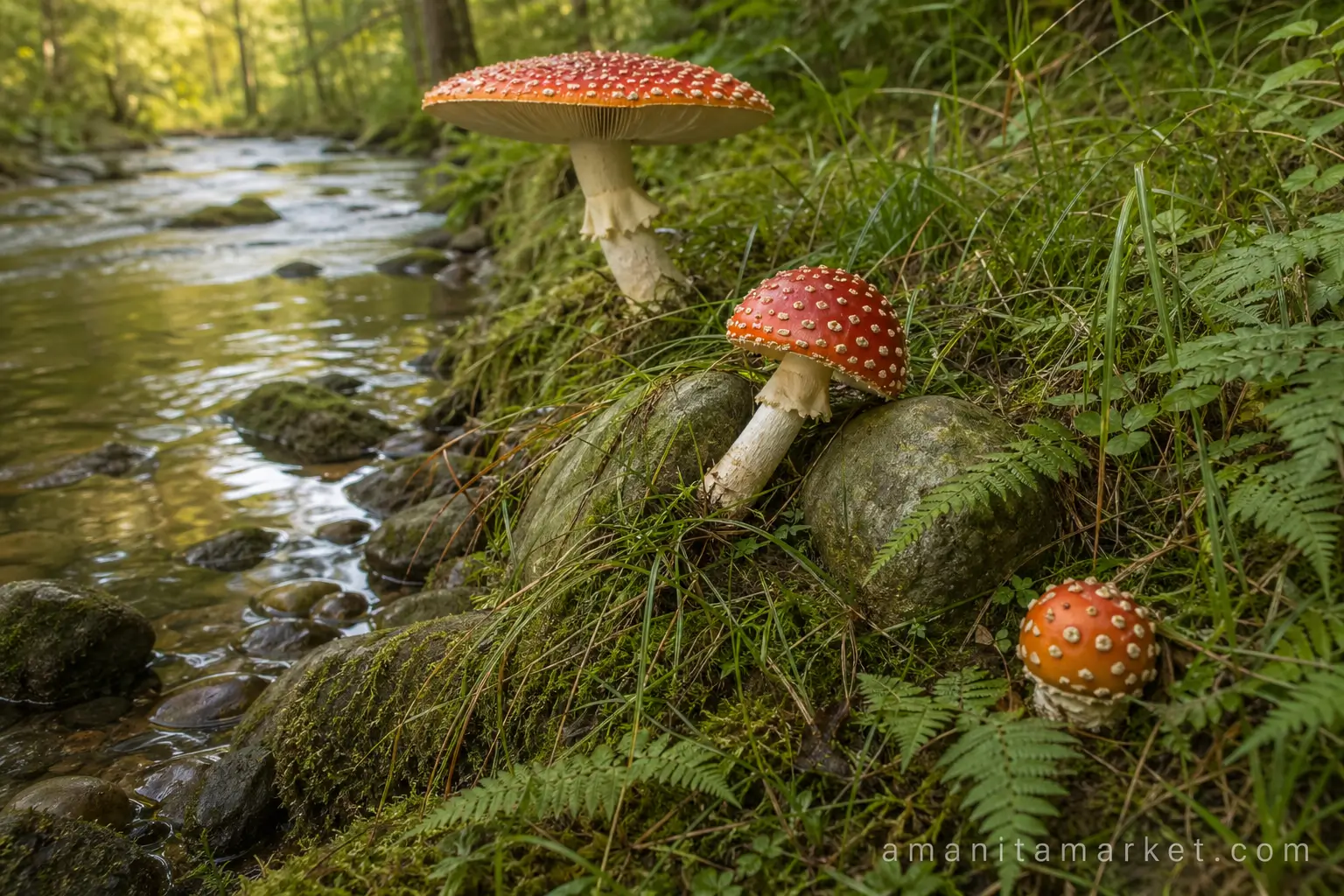
Amanita muscaria is one of the most abundant wild mushrooms in Northern Europe, and in the right forests it can be found in extraordinary numbers during the autumn season. For foragers with good botanical knowledge and a feel for the landscape, collecting fly agaric can be a genuinely rewarding activity. This guide covers where to look, when to go, how to identify specimens worth collecting, and the practical considerations around responsible harvesting.
When to Go: The Fly Agaric Calendar
Amanita muscaria is strictly seasonal — you will not find quality specimens outside its fruiting window. In the Baltic states and Scandinavia, the season typically opens in late August, peaks through September and October, and closes by November. In Central Europe — Germany, Austria, the Czech Republic — peak season is usually October. In Scotland and northern England, September and October are most reliable.
The trigger for fruiting is cooling soil temperatures combined with adequate autumn rainfall. After a dry late summer, the season can start slowly even if temperatures are right. After heavy September rains following a warm August, fly agaric can appear in spectacular numbers almost overnight. Experienced foragers watch the weather patterns from late July onward — a wet, cool August almost always precedes an excellent September.
The two to three days after significant autumn rainfall, when temperatures have dropped below 15°C, are typically the most productive foraging window. Fly agaric grows fast — caps can expand from button to full size in three to five days under good conditions. Visit productive sites every few days during peak season rather than making a single annual trip.
Where to Look: Habitat and Landscape
The single most reliable rule for finding fly agaric is to follow the birch and pine. Amanita muscaria is mycorrhizal — it cannot exist without a live tree partner. In practice, this means birch woodland, pine forest, mixed birch-pine landscapes, and the transitional zones between forest and open land are where you will find it.
Within these habitats, certain microhabitats are consistently more productive. The edges of forest paths, where soil has been slightly disturbed and light reaches the ground more readily, often produce excellent fruiting. North-facing slopes retain moisture longer and can produce earlier and more abundant crops than south-facing exposures. Look in the leaf litter and grass immediately beneath birch or pine canopy — the mushroom grows from the root zone of its host tree, typically within a few metres of the trunk.
Identification in the Field
Amanita muscaria is one of Europe’s easiest mushrooms to identify at a glance — but a glance is not enough. The full identification should always check: scarlet to deep red cap (not brown, not orange-yellow, not pale); white wart remnants on the cap surface (may be absent after heavy rain — check other features); white gills, free from the stem; white stem with a pendant ring (skirt) and a bulbous base with white volva remnants. The mushroom grows on soil, never on wood.
The varieties most likely to cause confusion are rain-washed mature specimens (red cap, no warts) and the orange-yellow var. formosa (sometimes confused with other orange-capped species). For any specimen where full identification features are not clearly visible, err on the side of leaving it alone. For the complete identification guide including lookalikes and growth stages, see our dedicated article on fly agaric identification.
Selecting Quality Specimens
Not every fly agaric you find is worth collecting. The best specimens are those at the right stage of maturity: the cap fully expanded but not yet over-mature and softening, the surface still firm and vivid, the wart remnants intact. Very young button-stage specimens are not yet fully developed; very old specimens are soft, collapsing, and may smell unpleasant — avoid both.
The ideal collection window for each individual mushroom is roughly three to seven days after it has fully opened — when the cap is flat or nearly flat, the colour is vivid, and the texture is still firm. After this window, specimens degrade relatively quickly, especially in wet weather. Collecting at the right time matters as much as finding the right location.
Responsible Harvesting Practices
Responsible foraging means taking what you need without damaging the ecosystem that produces it. For Amanita muscaria specifically, this means leaving the majority of specimens in any given location, cutting or twisting carefully to avoid disturbing the soil and mycelium, and never stripping a site bare. The mycelial network beneath the surface is the long-term organism — the mushrooms are its annual reproductive output, and removing all of them does not harm the network, but maintaining good fruiting sites year after year depends on not over-collecting any single location.
Carry your harvest in an open basket or bag rather than sealed containers — this allows spores to disperse during transport, potentially seeding new sites. Clean your basket between sites to avoid transferring soil or organic matter that could carry unwanted organisms. And follow local regulations regarding mushroom collection — some forests in European countries have quantity limits or require landowner permission for collection on private land.
Processing After Harvest
Collected caps should be processed promptly. Clean off soil and debris in the field if possible, and begin drying as soon as practical after harvest — fresh caps deteriorate quickly at room temperature. For full guidance on drying methods and temperatures, see our article on how to dry fly agaric. For those who prefer to purchase ready-dried material, our 50g starter pack is a good way to start exploring the product.
Sources
- Woodland Trust — Fly Agaric: foraging, identification and responsible harvesting
- Wikipedia — Mushroom hunting: foraging traditions and responsible practices
- Deutsche Gesellschaft für Mykologie (DGfM) — Responsible mushroom collection guidelines
- Wikipedia — Mycorrhiza: why sustainable harvest preserves the mycelial network
Not ready to forage yourself? Our wild-harvested fly agaric is collected by experienced Baltic foragers and dried at source. Try our 50g pack to start.