
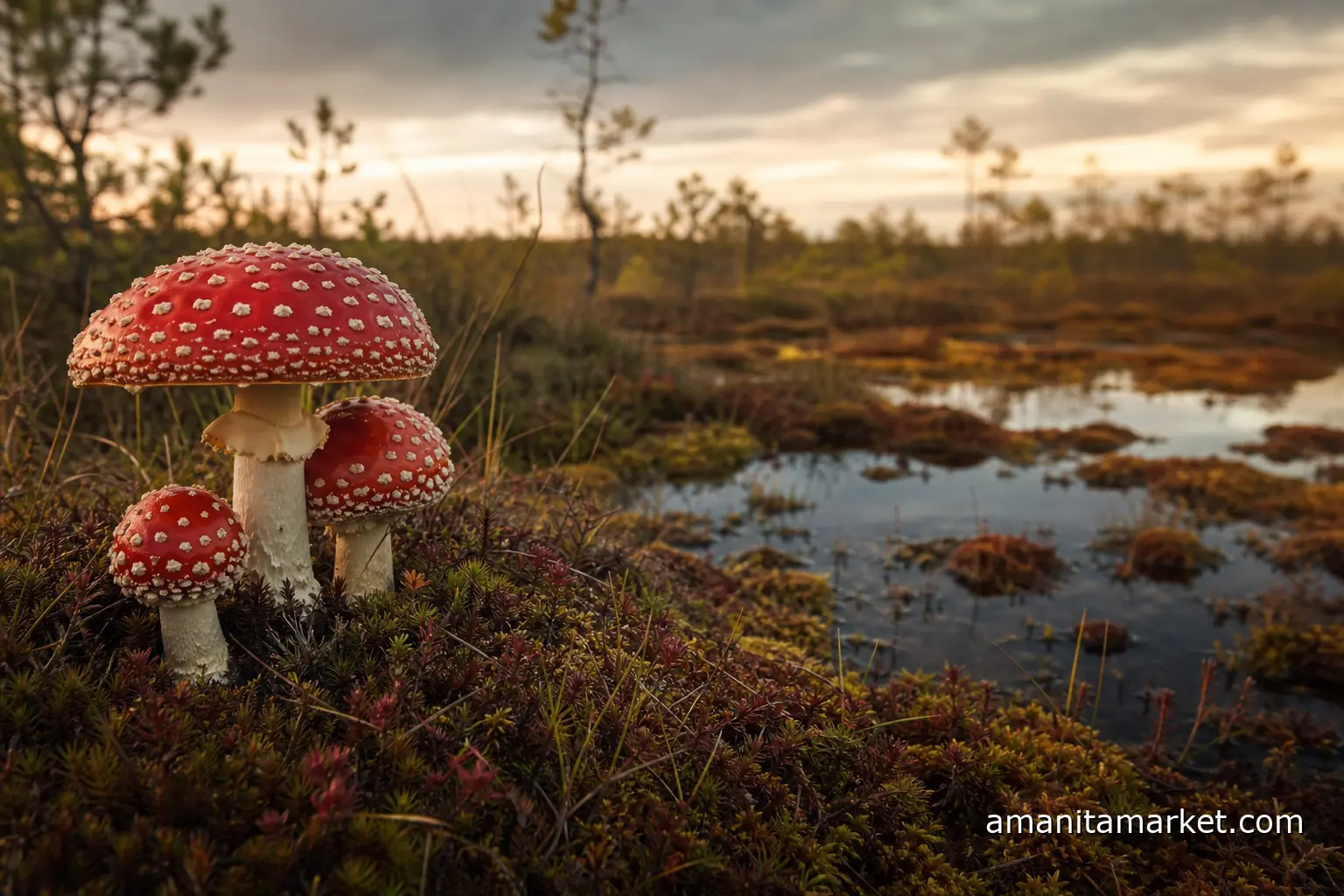
Fly agaric powder is made from the dried, ground caps of Amanita muscaria — but what exactly does that powder contain, and what does the toxicological and biochemical literature document about its properties? This article covers the compound profile of dried fly agaric powder, based on peer-reviewed research, without making recommendations or promoting consumption.
The Compound Profile of Fly Agaric Powder
Fly agaric powder produced from dried Amanita muscaria caps contains several chemically characterised compounds. The two primary active constituents are muscimol and ibotenic acid — both isoxazole derivatives with documented effects on the central nervous system. Additional compounds include muscarine (in very low concentrations — far below pharmacologically active levels in normal preparations), muscazone, and a range of secondary metabolites including beta-glucans and the pigments muscapurpurin and muscaflavin responsible for the cap’s red colouration.
The relative concentrations of muscimol and ibotenic acid in dried powder depend critically on the drying process. Tsujikawa et al. (2019, PubMed 30782612) systematically analysed commercial dried samples and documented significant variation in the muscimol-to-ibotenic acid ratio between products, driven by differences in drying temperature and duration. Higher drying temperatures produce more complete conversion of ibotenic acid to muscimol through decarboxylation. For the detailed chemistry, see our article on ibotenic acid vs muscimol.
How Drying Changes the Compound Profile
Fresh Amanita muscaria contains predominantly ibotenic acid, with muscimol as a minor constituent. The drying process reverses this ratio. Ibotenic acid is thermally unstable — it undergoes decarboxylation (loss of CO₂) to form muscimol when heated or simply aged at room temperature over time. The rate and completeness of this conversion depends on temperature, time, and pH.
At low drying temperatures (35–45°C, the standard for quality ethnobotanical products), conversion is partial — both compounds remain present. At higher temperatures (70°C+), conversion is more complete, approaching predominantly muscimol. This means dried fly agaric powder is not a chemically uniform product — its compound profile is a function of its processing history, and quality producers are transparent about their drying methods. The table below summarises how the profile shifts.
| State / drying | Dominant compound | Conversion | Resulting profile |
|---|---|---|---|
| Fresh cap | Ibotenic acid | Minimal | High ibotenic acid, low muscimol |
| Low-temp dried (35–45°C) | Mixed | Partial decarboxylation | Both compounds present |
| High-temp dried (70°C+) | Muscimol | More complete | Predominantly muscimol |
| Aged at room temp | Shifts to muscimol | Slow, over time | Gradually muscimol-dominant |
What “Effects” Means in a Toxicological Context
When toxicological literature documents the “effects” of fly agaric powder, it refers to outcomes observed in poisoning cases — not intended or recommended uses. The BfR (Germany’s Federal Institute for Risk Assessment) and pharmacological reference works document the Pantherina syndrome: central nervous system effects (sedation, confusion, dissociation) following ingestion. These are medical toxicology data points, not use recommendations. Our products are sold for incense and collecting, not consumption.
Variability: Why Consistency Matters
Geml et al. (2006, PubMed 16367842) demonstrated that genetic variation between Amanita muscaria populations across different geographic regions contributes to biochemical variation. Specimens from different regions and different seasons can have meaningfully different compound profiles even before processing differences are considered. This variability is why origin transparency — knowing where and when a product was harvested — matters when selecting quality dried fly agaric.
Baltic wild harvest, from the birch-pine forests of Lithuania, Latvia, and Estonia, represents the most consistently documented and commercially established source for quality dried fly agaric in the European market. The region’s stable forest ecology, consistent seasonal patterns, and experienced foraging tradition contribute to product consistency.
Incense Use: A Separate Category
The toxicological data on fly agaric — which relates entirely to ingestion — is not applicable to the use of dried caps as incense material. Burning dried fly agaric on charcoal or heated stones produces aromatic smoke with an earthy, distinctive character. There are no published reports of adverse effects from this use in the medical literature. The legal positioning of dried fly agaric as an ethnobotanical incense material and the toxicological documentation of ingestion effects are entirely separate matters. For more on incense use, see our guide to fly agaric as ethnobotanical incense.
Frequently Asked Questions
What does fly agaric powder contain?
Primarily muscimol and ibotenic acid (both isoxazoles), plus trace muscarine, muscazone, beta-glucans, and the red pigments muscapurpurin and muscaflavin. The exact ratio depends on drying.
Why does the muscimol-to-ibotenic acid ratio vary so much?
Because ibotenic acid converts to muscimol by decarboxylation during drying. Low-temperature drying leaves both present; higher temperatures and ageing shift the balance toward muscimol.
Do the toxicological “effects” apply to incense use?
No. The documented effects relate entirely to ingestion. There are no published reports of adverse effects from burning dried caps as incense, which is a separate category from consumption.
Sources
- Tsujikawa et al., 2019 — Ibotenic acid and muscimol in dried Amanita muscaria (PubMed)
- Geml et al., 2006 — Genetic variation and biogeography of fly agaric (PubMed)
- Michelot & Melendez-Howell, 2003 — Amanita muscaria pharmacology (PubMed)
- BfR — Gesundheitliche Risiken muscimolhaltiger Produkte (bfr.bund.de)
Premium Baltic fly agaric powder — wild-harvested, low-temperature dried, clearly positioned as an ethnobotanical incense and collector’s botanical.