
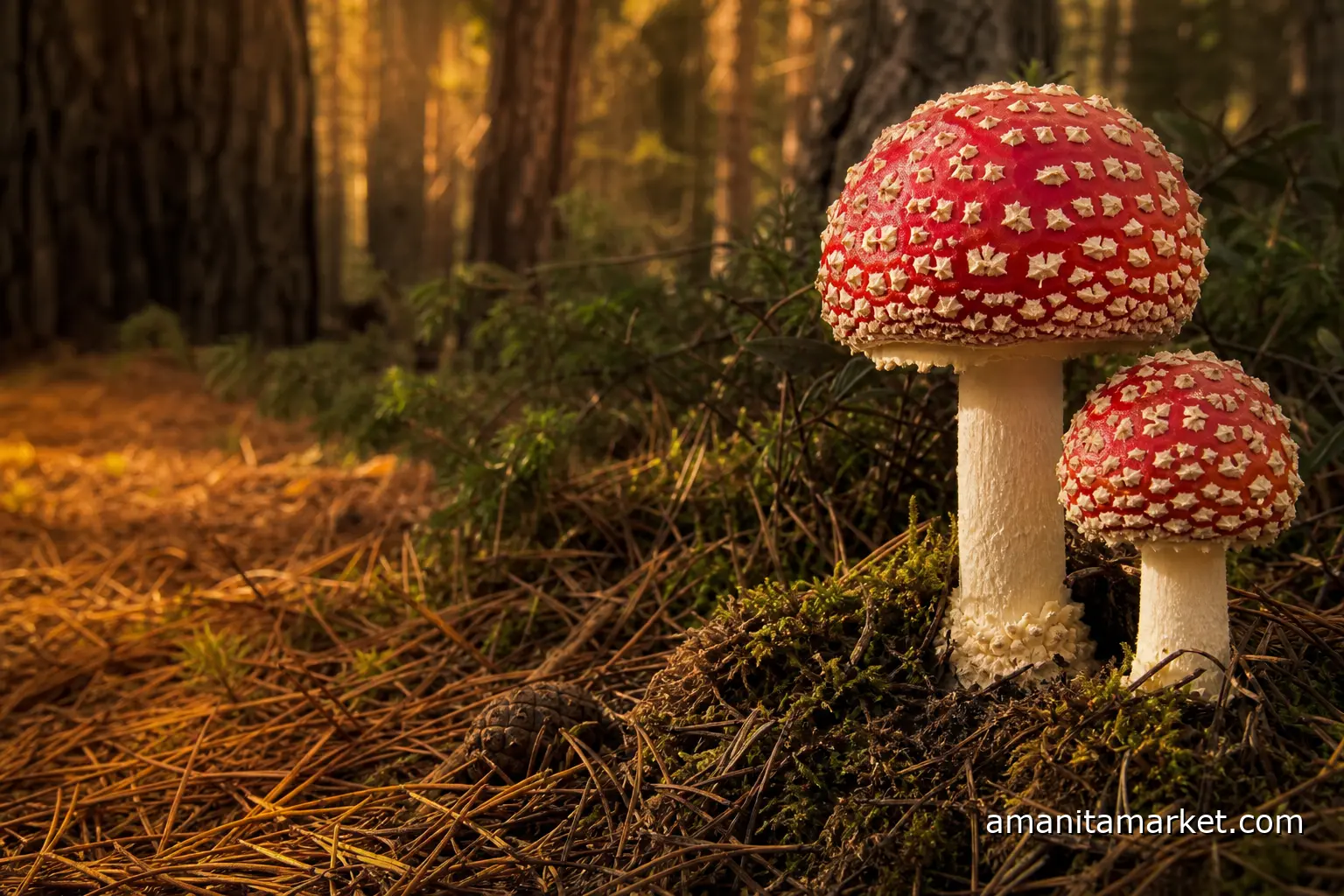
Amanita muscaria has occupied a unique position in medical history for centuries — documented in folk healing traditions across three continents, investigated by early naturalists and physicians, and now the subject of growing preclinical research into its active compounds. This article provides a comprehensive overview of what the scientific and ethnobotanical literature documents about the fly agaric’s medicinal dimensions — from ancient external applications to current laboratory research.
Historical Folk Medicine: The Documented External Uses
The ethnobotanical record across Europe and Asia documents Amanita muscaria’s use in folk medicine primarily through external applications. In Finnish tradition — documented by ethnobotanist Christian Rätsch in his Encyclopedia of Psychoactive Plants (1998) — alcohol-based preparations from fly agaric caps were applied topically to relieve joint pain and rheumatic conditions. Similar practices were documented in Russian, Baltic, and Slavic ethnobotanical surveys of the 19th century.
In Siberian shamanic tradition, the mushroom’s applications extended beyond the ceremonial — ethnographers documented its use as a topical preparation for fatigue, muscle soreness, and what modern medicine would recognise as stress-related somatic symptoms. These applications were invariably external, not consumed. The distinction between internal consumption (pharmacologically active) and external application (localised effect) is critical for understanding the historical medical record.
The Active Compounds: What Science Has Characterised
The pharmacological foundation for understanding Amanita muscaria’s potential medicinal dimensions rests on the characterisation of its two primary active compounds. Michelot and Melendez-Howell’s comprehensive 2003 review in Mycological Research (PubMed 12747324) established the definitive scientific account: muscimol acts as a potent GABA-A receptor agonist; ibotenic acid acts on NMDA glutamate receptors. Both compounds cross the blood-brain barrier and have documented effects on the central nervous system.
Additional compounds include muscarine (in trace quantities), muscazone, and a range of secondary metabolites. The concentration and ratio of these compounds varies significantly depending on origin, season, and processing — a variability that complicates any standardised medical application.
The Preclinical Research Landscape
Published research has examined Amanita muscaria’s active compounds across several therapeutic areas. Every line of this work remains preclinical — conducted in cell cultures or animal models, with no completed human clinical trials. The table below summarises where the science currently stands.
| Research area | Proposed mechanism | Key reference | Stage |
|---|---|---|---|
| Sleep regulation | GABA-A agonism, increased non-REM sleep | Lancel & Faulhaber 1996 | Preclinical |
| Anxiety | GABAergic anxiolysis | Animal models | Preclinical |
| Neuropathic pain | Spinal GABA-A activation | Rode et al. 2020 | Preclinical |
| Epilepsy | Seizure-threshold / kindling models | Animal models | Preclinical |
| Neuroinflammation | Reduced microglial activation | Wagner et al. 2023 | Preclinical |
Sleep Research
The relationship between GABA-A receptor activation and sleep architecture is well established. Lancel and Faulhaber (1996, PubMed 8797193) demonstrated that muscimol administration increased non-REM sleep duration in animal models. This finding is pharmacologically consistent: most pharmaceutical sleep aids target the same GABA-A system through different mechanisms (benzodiazepines and Z-drugs are modulators; muscimol is a direct agonist). The distinction is pharmacologically significant — direct agonism at the GABA site may have different tolerance and withdrawal profiles than modulator drugs. For detailed analysis, see our article on muscimol sleep research.
Pain Research
Neuropathic pain — pain arising from nervous system damage rather than tissue injury — is notoriously resistant to standard analgesics. GABAergic inhibition in the spinal cord plays a documented role in pain signal modulation, and muscimol’s direct GABA-A agonism has been studied in preclinical pain models. Rode et al. (2020, PubMed 32056278) examined GABA-A activation in neuropathic pain models, reporting reduction of pain-related behaviour (allodynia) in treated animals. For detailed analysis, see our article on muscimol neuropathic pain research.
Neuroinflammation Research
The most recent research direction connects muscimol to neuroinflammation — the overactivation of the brain’s immune cells (microglia) implicated in neurodegenerative diseases and mood disorders. Wagner et al. (2023, PMC10130647) reported that muscimol reduced pro-inflammatory microglial activation in cell culture models. The proposed mechanism — GABA-A receptor activation in microglia — is consistent with evidence that these immune cells express functional GABA-A receptors. For detailed analysis, see our article on muscimol neuroinflammation research.
What the Research Does Not Show
The honest summary of the current research landscape: there is a coherent and growing body of preclinical evidence suggesting that muscimol’s GABAergic mechanism produces measurable effects in multiple relevant biological systems. There are no human clinical trials. There are no regulatory approvals. There is no clinical evidence of safety and efficacy in humans for any of the proposed applications. The gap between “interesting preclinical finding” and “approved medical treatment” is large and requires extensive clinical research to bridge.
Amanita muscaria is sold in our shop as a dried ethnobotanical product — for incense use, collecting, and engagement with its remarkable cultural history. The scientific content of this article is provided for informational purposes only.
Frequently Asked Questions
Is Amanita muscaria an approved medicine?
No. It is not an approved medicine in any country, and there is no clinical evidence of safety or efficacy in humans for any health application. All existing research is preclinical.
What were its traditional medicinal uses?
The documented folk uses were almost entirely external — alcohol-based topical preparations for joint pain, rheumatism, and muscle soreness across Finnish, Russian, Baltic and Slavic traditions, not internal consumption.
Why is there so much preclinical interest in muscimol?
Because muscimol is a potent, selective GABA-A agonist, and the GABA-A system is central to sleep, anxiety, pain and neuroinflammation — making it a useful research tool, though not a proven treatment.
Sources
Premium dried fly agaric from Baltic wild harvest — available as an ethnobotanical incense and collector’s botanical. Buy fly agaric from a traceable source.