
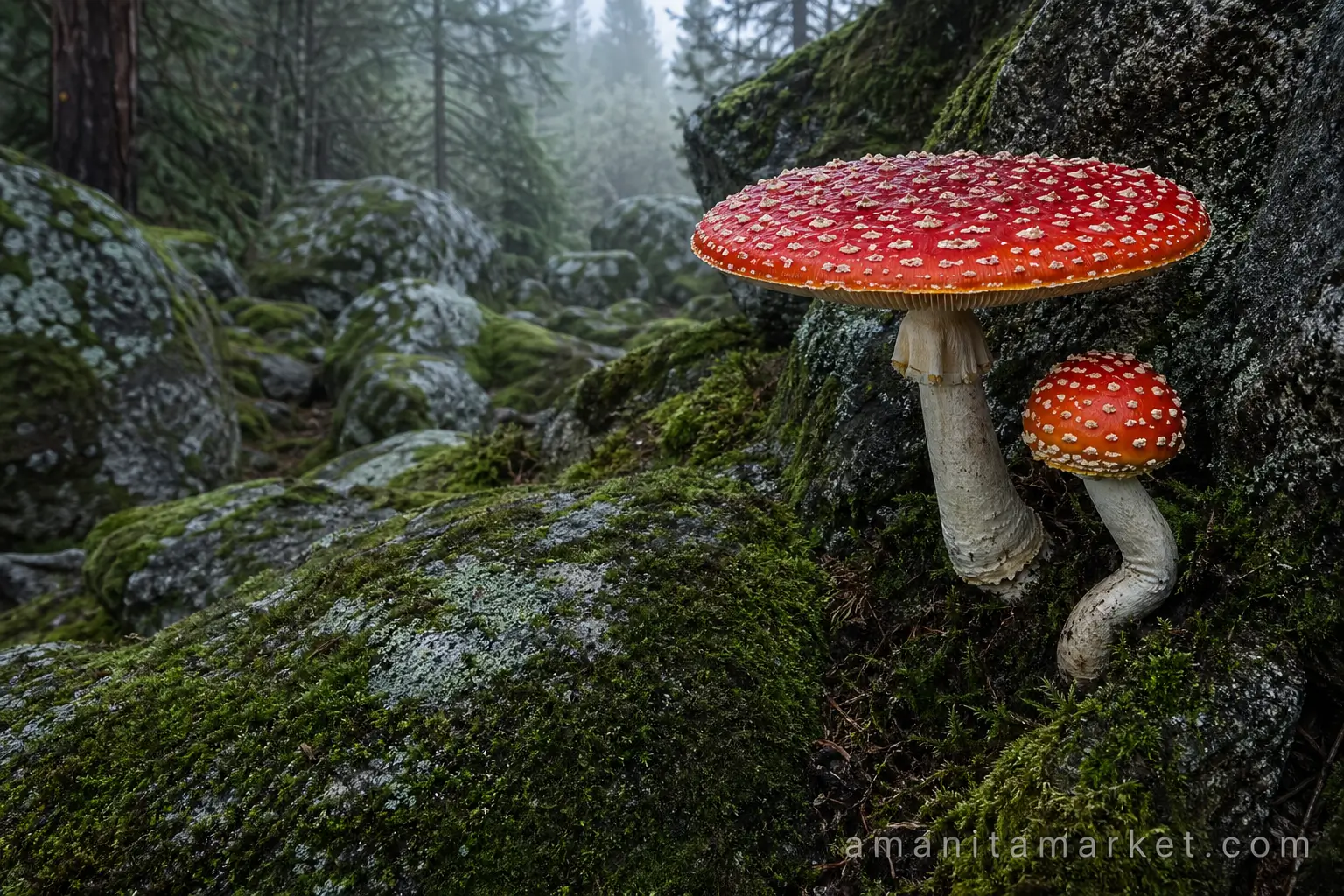
Amanita muscaria is one of Europe’s most reliably seasonal mushrooms — and knowing when and where it grows is the foundation of understanding this iconic fungus. Whether you are a forager, a naturalist, or someone interested in dried fly agaric as an ethnobotanical product, the mushroom’s growing season tells you everything about its ecology, its harvest quality, and why Baltic-sourced specimens are considered the standard for quality.
Across most of Europe, fly agaric (Amanita muscaria) fruits from late summer through autumn — typically August to November, with peak season in September and October. In the Baltic states the main flush runs from late August to late October. Fruiting is triggered by cooling temperatures (soil below ~15 °C) and moisture after late-summer rain, so the exact timing shifts a little each year and by region.
When Does Fly Agaric Grow?
In most of Europe, Amanita muscaria fruits from late summer through autumn — typically from August through November, with peak season in September and October. The precise timing depends on latitude, altitude, and local weather conditions. In northern regions such as the Baltic states, Scotland, and Scandinavia, the season begins slightly earlier. In central Europe — Germany, Austria, the Czech Republic — peak season tends to fall in October.
The trigger for fruiting is a combination of cooling temperatures and adequate soil moisture following late summer rains. The mushroom requires soil temperatures to drop below approximately 15°C to initiate the fruiting process. After the right conditions are met, the characteristic white egg-shaped buttons can emerge within days, expanding rapidly into the recognisable red-capped adult within a week.
In Lithuania, Latvia, and Estonia — the primary source of quality wild-harvested fly agaric — the main season runs from late August through late October. The combination of continental climate, abundant birch and pine forest, and clean forest soils produces mushrooms of exceptional size and colour intensity during this window.
Where Does Fly Agaric Grow?
Amanita muscaria is a mycorrhizal fungus — it cannot grow without a living tree partner. In Europe, its primary hosts are birch (Betula spp.), Scots pine (Pinus sylvestris), Norway spruce (Picea abies), and occasionally oak (Quercus spp.) and fir. You will almost never find fly agaric in the absence of these trees. The mushroom’s fruiting bodies typically appear in the leaf litter or short grass directly beneath or within a few metres of its host tree.
Look for fly agaric in mixed birch-pine woodland, in the transitional zones between forest and open land, and on the edges of forest paths where light penetrates to the forest floor. In old-growth forests with undisturbed soils, the mycelial network can persist for decades, returning to the same locations year after year. Experienced foragers in the Baltic region know specific birch groves and pine stands that produce reliably season after season.
Habitat by Region: Across Europe
The fly agaric’s range spans the entire temperate and boreal zone of the Northern Hemisphere. In Europe, it is most abundant in the Nordic and Baltic countries, where birch and pine dominate the landscape. Scotland and northern England have excellent populations, particularly in Caledonian pine forest remnants and birch woodland. In central Europe, the mushroom is found throughout Germany, Austria, Switzerland, and the Czech Republic in mixed montane forest.
In the south, Amanita muscaria becomes less common in the Mediterranean lowlands but reappears in the mountains — the Pyrenees, Apennines, and Balkans all support populations at altitude where cooler temperatures and appropriate tree cover exist. The species is absent from treeless landscapes: grasslands, tundra, and heavily managed agricultural zones will not support it.
Identifying the Season by Growth Stage
Fly agaric passes through several distinct stages during the season, each visually distinctive. The earliest stage — the white egg — appears as a rounded, cream-coloured button pushing through the soil surface. This can be easily overlooked or confused with puffballs, but slicing the egg vertically reveals the outline of the mushroom inside.
As the cap expands, the red surface becomes visible beneath the splitting white veil. The hemispherical stage — red, domed, with white wart remnants — is the most frequently photographed. The mature stage sees the cap flatten and open to a wide, thin plate that can reach 20cm across. In rainy periods, the white warts may wash off, leaving a plain red cap. Late in the season, old specimens collapse and darken — these are not suitable for collection.
The best quality dried fly agaric comes from specimens collected at peak maturity — fully open caps with intact warts, vivid red colour, and firm texture. Too early (hemispherical stage) and the cap hasn’t fully developed. Too late (collapsed, soft) and degradation has begun. The harvest window for optimal specimens is narrow — typically a few days per individual mushroom.
Altitude and Microhabitat
Within its range, Amanita muscaria shows preferences for specific microhabitats. North-facing slopes, where moisture is retained longer and temperatures are cooler, often produce earlier and more abundant fruiting. Forest edges adjacent to open land — where root systems of edge trees can access more soil volume — are particularly productive. Disturbed soils such as paths and track edges, where soil compaction has been partially relieved, sometimes produce exceptional clusters.
In mountainous regions, the season runs later at higher altitudes, extending the overall harvest window across an elevation gradient. Alpine populations at 1,000–1,500m may still be fruiting in November when lowland populations have finished. This vertical distribution is ecologically important and practically useful for wild harvesters working across a landscape.
The Baltic Advantage
The Baltic states — Lithuania, Latvia, and Estonia — combine several factors that make them Europe’s premier source of wild fly agaric. Vast, undisturbed birch and pine forests cover much of the landscape. The continental climate produces cool, moist autumns ideal for abundant fruiting. Low agricultural and industrial pressure means clean soils with minimal contamination. And a centuries-old tradition of forest mushroom harvesting means knowledge of productive sites is deep and well-maintained.
Our dried amanita muscaria powder is wild-harvested annually during this Baltic season — collected at peak maturity, low-temperature dried, and vacuum-sealed to preserve quality. For guidance on selecting quality dried fly agaric, see our fly agaric powder guide. For information on storing your product through the off-season, see our article on how to store fly agaric.
Year-to-Year Variation
Like all wild mushrooms, fly agaric fruiting varies considerably from year to year. Warm, dry autumns suppress fruiting; cool, wet conditions from September onward typically produce abundant crops. In exceptional years — such as those following unusually wet late summers — entire forests can be carpeted with fly agaric in October. In poor years, the same locations may produce only scattered specimens.
This variability is one reason why experienced harvesters monitor multiple sites across a landscape and time their collection precisely. It is also why well-dried and properly stored fly agaric from an abundant year is worth treating with care — the next season may produce less.
Fly Agaric Season: Frequently Asked Questions
When do amanita muscaria grow?
Amanita muscaria grows from late summer through autumn — typically August to November across Europe, with the heaviest fruiting in September and October. In the Baltic states the main flush is late August to late October.
When does amanita muscaria grow in central Europe?
In Germany, Austria, Switzerland and the Czech Republic, peak season usually falls in October, with fruiting possible from late summer into November in mild years.
What month is best to find fly agaric?
September and October are the most reliable months across most of Europe; at higher altitudes the season can extend into November.
What conditions make fly agaric fruit?
Cooling soil temperatures (below about 15 °C) combined with adequate moisture after late-summer rain. Long dry spells delay or suppress fruiting, which is why abundance varies from year to year.
Where does amanita muscaria grow?
Only alongside host trees — birch, Scots pine, Norway spruce, and occasionally oak or fir — typically in mixed birch-pine woodland, forest edges and path margins. It is absent from treeless landscapes.
Sources
Our amanita muscaria powder is wild-harvested at peak season in the Baltic forests — dried and vacuum-sealed for maximum quality. Order fly agaric online with fast EU delivery.