
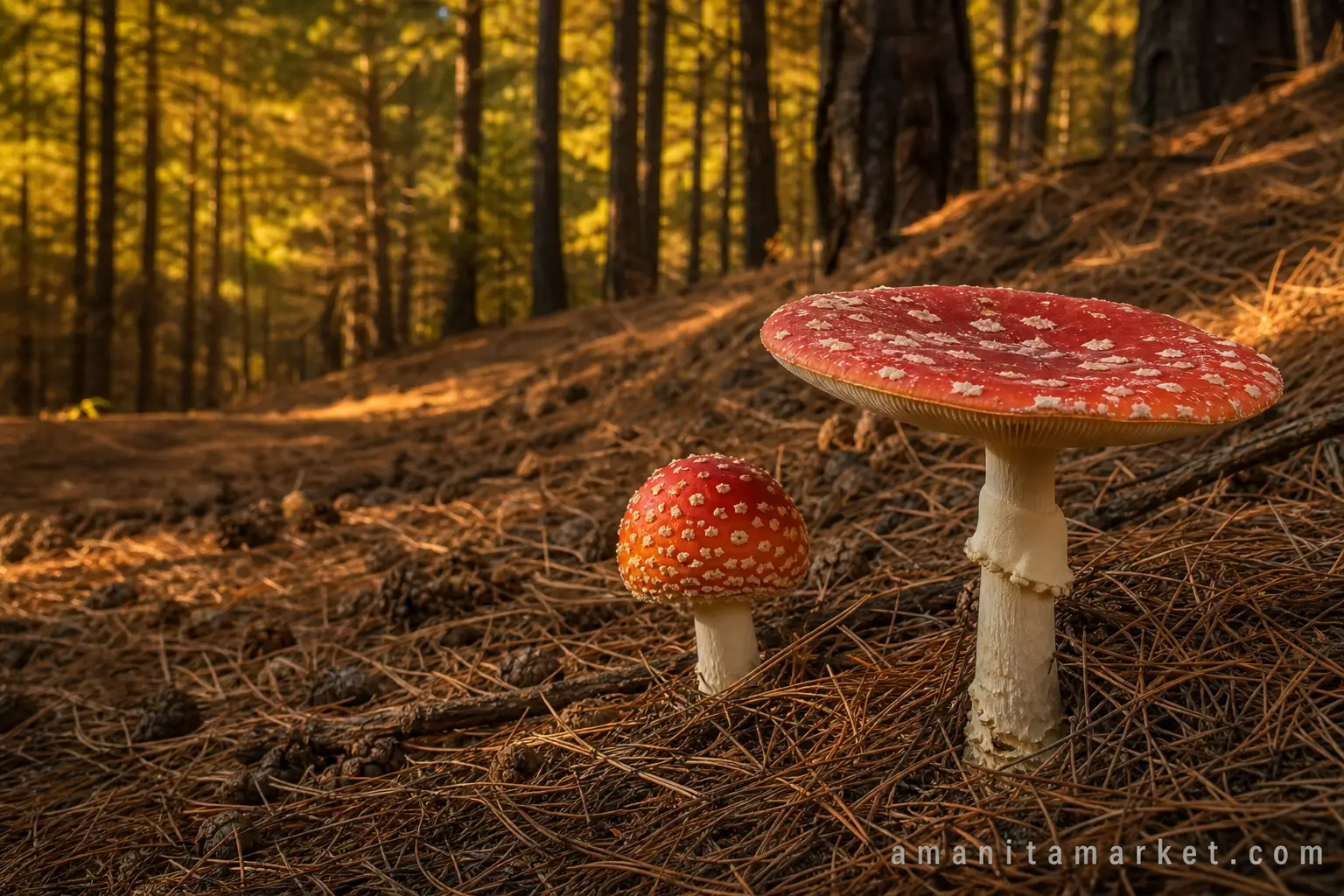
Scientific interest in Amanita muscaria has grown considerably over the past two decades. Once confined to toxicology and mycology, research into the fly agaric mushroom now spans neuropharmacology, sleep science, and ethnobotany. This article brings together the key peer-reviewed studies and what they actually tell us about the compounds found in dried amanita muscaria — without overstating what the evidence supports.
A Mushroom That Kept Surprising Researchers
For much of the 20th century, Amanita muscaria was studied primarily as a poisonous species. The focus was on its toxicological profile — understanding what caused intoxication, and how to treat it. What emerged from that work, however, was a pharmacological picture far more nuanced than expected: a mushroom whose active compounds interact with fundamental neurotransmitter systems in ways that are still being explored.
The two primary active compounds — muscimol and ibotenic acid — turned out to be pharmacologically distinct and scientifically significant. Ibotenic acid is a potent excitatory amino acid that acts on glutamate receptors, while muscimol is a direct agonist at GABA-A receptors. Together they give Amanita muscaria a uniquely complex pharmacological profile among psychoactive fungi.
The Foundational Study: Michelot and Melendez-Howell (2003)
The most frequently cited overview of Amanita muscaria pharmacology remains Michelot and Melendez-Howell’s 2003 review published in Mycological Research. The authors systematically reviewed the chemistry, toxicology, and ethnomycology of the species, providing the clearest available account of the relationship between muscimol, ibotenic acid, and their physiological effects.
Key findings of that review include the confirmation that muscimol’s binding affinity for GABA-A receptors exceeds that of GABA itself, making it one of the most potent naturally occurring GABAergic compounds identified. The review also established the role of drying and decarboxylation in converting ibotenic acid to muscimol — a transformation relevant to understanding traditional preparation methods used across Siberian cultures.
MDPI 2021: A Modern Overview
A 2021 review by Tylš, Páleníček, and Horáček, published in the open-access MDPI journal, provided an updated synthesis of Amanita muscaria research incorporating more recent neuroscience literature. The paper is notable for its interdisciplinary scope — it covers ecology, chemistry, pharmacology, and cultural history in a single document, making it the most comprehensive recent English-language resource on the species.
The 2021 review confirmed the growing scientific consensus that muscimol’s action on the GABAergic system is distinct from other psychoactive compounds and warrants continued preclinical and potentially clinical investigation. It also documented the mushroom’s widespread geographic distribution and its historical role across multiple cultural traditions.
Muscimol is a direct GABA-A receptor agonist — structurally and pharmacologically distinct from serotonergic psychedelics (psilocybin, LSD) and from GABAergic modulators (benzodiazepines). It has been studied in preclinical models for sleep, anxiety, neuroprotection, and seizure activity. All human-relevant applications remain at early research stages.
Sleep Research
Several preclinical studies have examined the relationship between muscimol and sleep architecture. Research published in Pharmacology Biochemistry and Behavior documented dose-dependent increases in non-REM sleep duration in rodent models following muscimol administration. GABAergic mechanisms are well established as central to the regulation of sleep onset and sleep maintenance — the same mechanisms targeted by pharmaceutical sleep aids such as benzodiazepines and Z-drugs, though through different pharmacological pathways. For a dedicated overview of this research, see our article on muscimol sleep research.
Anxiety and Mood Research
The relationship between GABAergic activity and anxiety regulation is one of the best-established in neuropharmacology. Preclinical studies using standard anxiolytic assays — elevated plus maze, open field — have documented anxiolytic-like effects of muscimol in animal models. These findings are consistent with the known role of GABA-A receptor activation in reducing neuronal excitability in anxiety-related brain circuits. See our article on muscimol anxiety and depression research for the full picture.
Neuroprotection Research
A separate body of preclinical literature has investigated muscimol’s potential neuroprotective properties. The theoretical basis is the role of excitotoxicity — excessive neuronal stimulation — in brain injury following stroke and traumatic events. GABA-A agonism, by reducing excitatory activity, has been proposed as a protective mechanism. Animal model studies have reported reduced lesion size in ischaemia models where muscimol was administered, though this research remains early-stage and has not translated to clinical trials.
Research Limitations to Understand
It is worth being direct about the limits of the current research base. Virtually all muscimol studies are preclinical — conducted in rodents or cell cultures. The pharmacokinetics of muscimol in humans, the dose-response relationships, and the clinical relevance of animal model findings are not yet established through controlled human trials. Additionally, research on isolated pharmaceutical-grade muscimol does not directly describe the effects of consuming dried Amanita muscaria, which contains a complex mixture of compounds.
The scientific interest in muscimol is genuine and growing. But the research is at an early stage, and claims that go beyond what the studies demonstrate should be treated with appropriate scepticism. For a broader overview of the mushroom itself, see our article on what is Amanita muscaria.
Sources
- Michelot & Melendez-Howell, 2003 — Amanita muscaria: chemistry, biology and toxicology (PubMed)
- Tylš et al., MDPI 2021 — Amanita muscaria: Ecology, Chemistry, Myths
- Lancel & Faulhaber, 1996 — GABAA receptors and sleep regulation (PubMed)
- Wikipedia — Ibotenic acid: excitatory compound and precursor to muscimol
Looking for premium dried fly agaric powder? Our 250g pack is the most popular choice for serious collectors — wild-harvested in the Baltic, vacuum-sealed for freshness.