
The Celtic peoples of Iron Age and early medieval Europe left no written records of their own — their knowledge traditions were oral, transmitted through the druid class. This makes direct evidence of Celtic Amanita muscaria use frustratingly elusive. Yet the circumstantial evidence — botanical, archaeological, and mythological — suggests that fly agaric played a role in Celtic ritual life, and the question is one of the more intriguing open problems in European ethnobotany.
The Druids: Specialists in Sacred Plants
The druids were the priestly, scholarly, and judicial class of Celtic societies across Gaul, Britain, Ireland, and parts of Iberia. Ancient sources — Caesar, Strabo, Pliny — describe them as specialists in natural philosophy, astronomy, and the ritual use of sacred plants. Pliny’s famous account of the mistletoe-cutting ceremony (Natural History, XVI) describes druids harvesting mistletoe with a golden sickle at specific lunar phases, underlining the precision with which plant ritual was conducted.
The druids’ botanical knowledge was extensive. They used plants for healing, for divination, for ritual purification, and for inducing altered states of consciousness. Mistletoe, vervain, selago, and samolus are among the plants Pliny names in druidic contexts. The use of henbane (Hyoscyamus niger) and other psychoactive plants in Celtic ritual contexts is supported by archaeological finds — burned henbane seeds have been recovered from Iron Age ritual sites.
Celtic evidence for Amanita muscaria use is circumstantial rather than direct. No classical source names fly agaric in a druidic context, and no written Celtic sources exist. The case rests on: (1) the mushroom’s abundance in Celtic homelands, (2) parallels with confirmed shamanic traditions to the east, (3) mythological motifs, and (4) isolated archaeological finds. This is suggestive but not conclusive.
The Otherworld and the Sacred Forest
Celtic cosmology centred on the concept of the Otherworld — Tír na nÓg in Irish tradition, Annwn in Welsh mythology — a realm of eternal youth, abundance, and divine presence accessible through liminal spaces: lakes, caves, mounds, and the deep forest. The forest itself was sacred to the Celts; the word druid may derive from the Proto-Celtic root *dru-wids — “oak knower” or “deep-forest knower.”
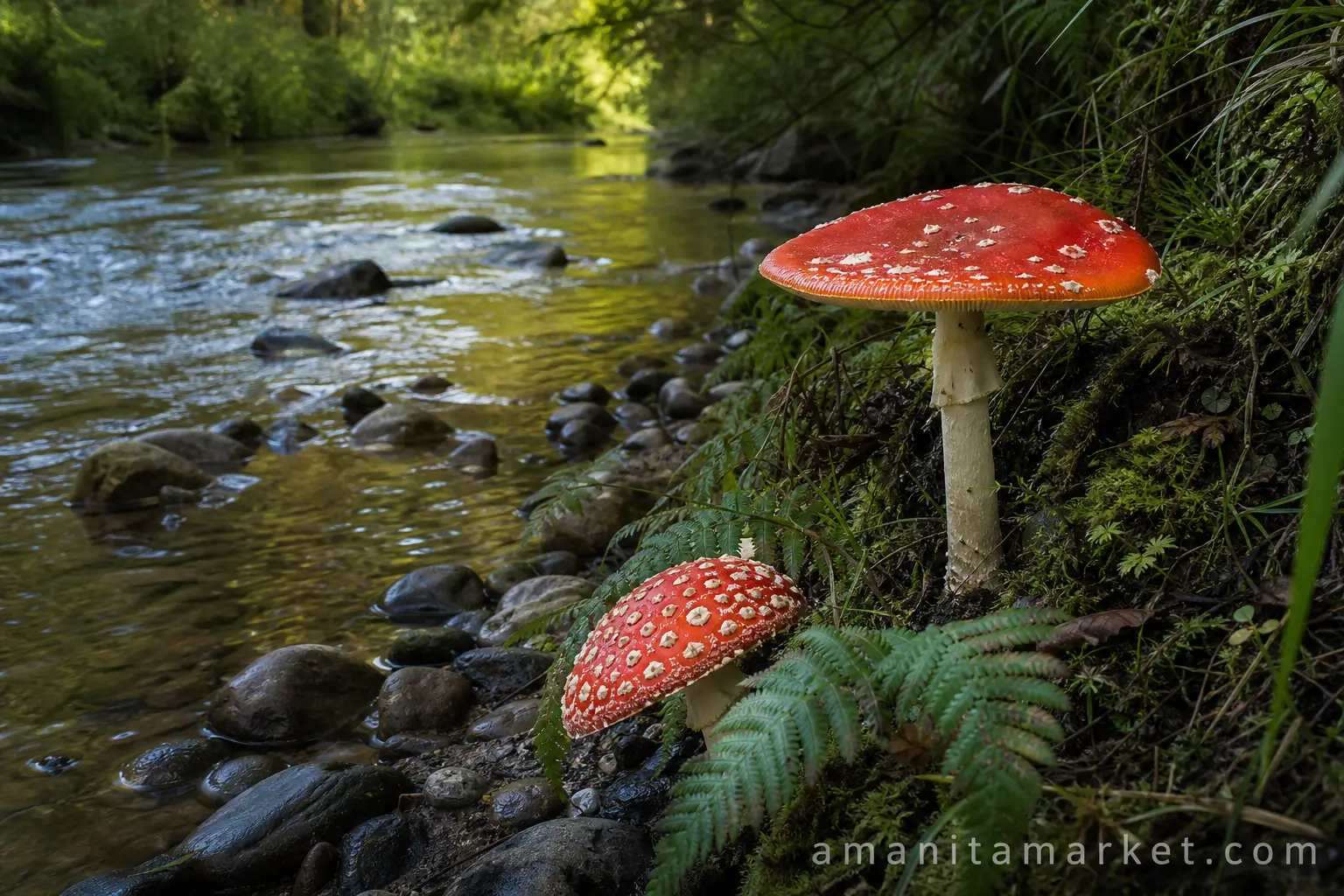
In this cosmological context, a mushroom that grows in old forests, that appears suddenly and dramatically, that is associated with altered consciousness, and that has a visually spectacular appearance would naturally attract ritual attention. The fly agaric grows abundantly in the oak-birch-pine woodlands that covered Celtic Europe, and its autumn appearance — at the boundary between the productive season and winter — aligns with the Celtic calendar’s most spiritually charged transition: Samhain.
Samhain and the Mushroom Season
Samhain (November 1st, with its eve on October 31st — the origin of Halloween) was the most important of the four Celtic seasonal festivals. It marked the end of the harvest, the beginning of winter, and — crucially — a thinning of the boundary between the living world and the Otherworld. Spirits could cross over; the dead could walk; divination and contact with the supernatural was possible.
Amanita muscaria fruits from August through November across its European range, with peak fruiting in October — exactly the season leading into Samhain. Whether or not direct use occurred, the visual presence of fly agaric in the autumn forest during the approach to the Celtic year’s most supernatural festival would have been impossible to ignore.
Irish Mythology and the Red Mushroom
Irish mythology — the richest surviving body of Celtic mythological literature — contains several passages that scholars have proposed as possible references to psychoactive fungal use. The concept of fírinne (truth, divine revelation) obtained through altered states appears in druidic narratives. The fénnidecht — the warrior frenzy of heroes like Cú Chulainn — parallels the Norse berserker phenomenon and may have a similar pharmacological dimension.
More speculatively, the figure of the fear dearg (“red man”) — a mischievous fairy figure in Irish folklore — has been proposed by some folklorists as a personification of the fly agaric, whose red appearance and transformative properties align with fairy symbolism in Celtic tradition. This remains a hypothesis rather than established scholarship.
Baltic Parallels
The Baltic peoples — Lithuanians, Latvians, and Old Prussians — were the last pagans in Europe, with documented nature-religious practices extending into the 14th and 15th centuries. Baltic mythology shares structural elements with Celtic cosmology: the sacred oak, the underworld ruled by a serpent deity, the forest as spiritual realm. The fly agaric’s role in Baltic folk tradition is better documented than in Celtic contexts, and may offer comparative evidence for the wider Indo-European pattern. For more, see our article on fly agaric in Baltic mythology.
For the wider pattern of fly agaric across world cultures including Celtic Europe, see our article on fly agaric in world cultures.
Sources
- Wikipedia — Druid: priests, sacred plants and ritual practice in Celtic society
- Wikipedia — Samhain: Celtic midwinter festival and liminal tradition
- Wikipedia — Celtic mythology: the Otherworld, sacred forests and supernatural beings
- Wikipedia — Henbane: psychoactive plant documented in Celtic archaeological contexts
Wild Baltic fly agaric powder — buy amanita muscaria online with fast EU shipping from our shop.