
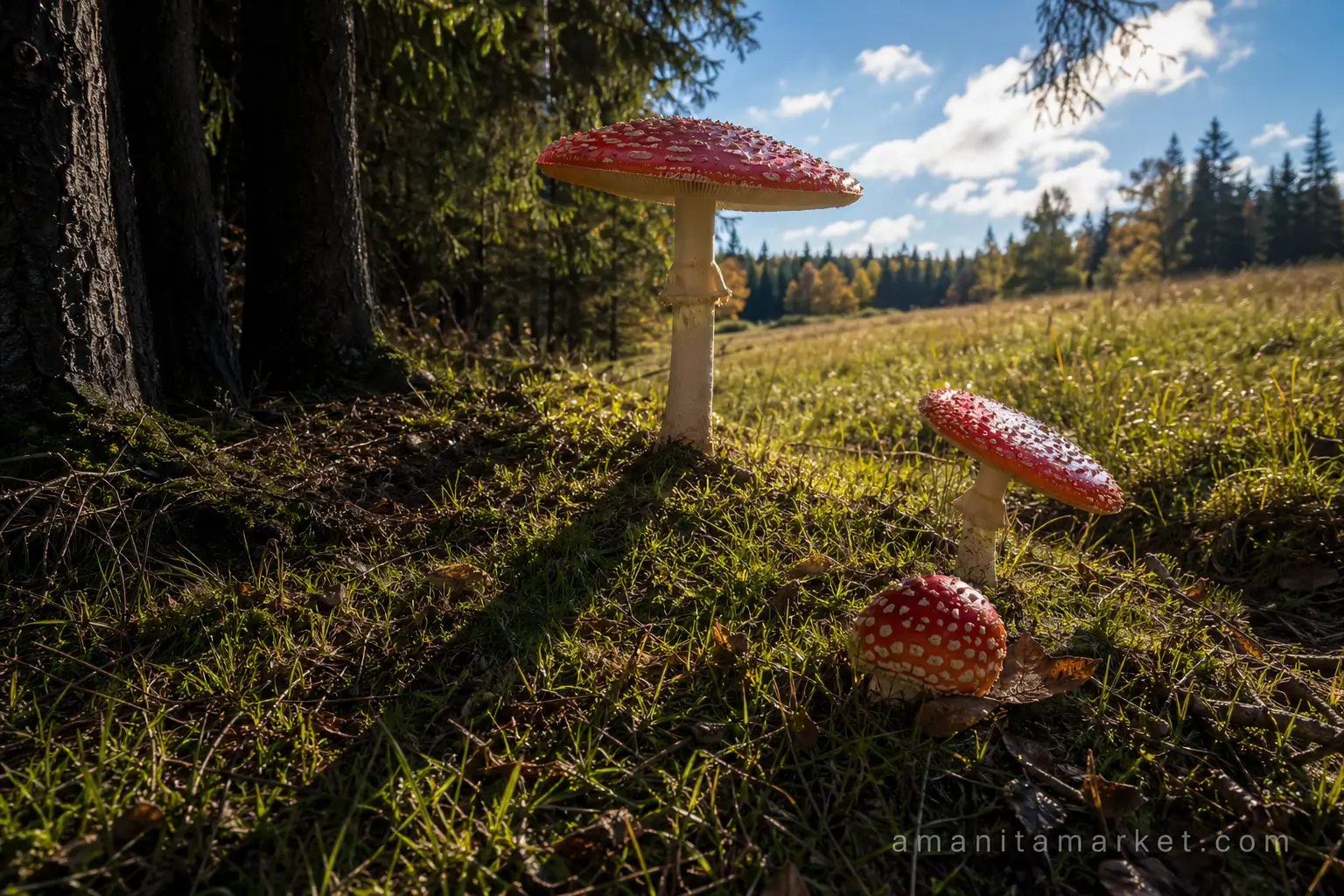
The Baltic peoples — Lithuanians, Latvians, and the now-extinct Old Prussians — were the last pagans of Europe, maintaining pre-Christian religious traditions longer than any other European group. When Christian missionaries finally converted the last Lithuanian nobles in the late 14th century, they encountered a nature-religious worldview of extraordinary richness. At its heart was the forest — and within the forest, the fly agaric held a place that no other mushroom could claim.
The Baltic World: Forest as Sacred Space
For the Baltic peoples, the forest was not wilderness — it was the primary sacred space. The Lithuanian word giria (deep forest) carries connotations of mystery, power, and the presence of the divine that are difficult to translate. Sacred groves — romuva in Lithuanian — were the centres of religious practice, presided over by vaidilutės (vestal virgins) who maintained eternal sacred fires and by krivis (priests) who mediated between the human and spirit worlds.
The oak was the most sacred tree — associated with the thunder god Perkūnas — but the entire forest ecosystem was understood as animate and spiritually significant. Mushrooms, growing overnight from invisible mycelial networks, were among the most mysterious products of the forest floor, and their sudden appearance was a matter of folk attention and interpretation.
The Lithuanian pantheon included specific forest deities: Medeina (forest goddess, often depicted with wolves and hunting), Žvorūna (wild hunting goddess), and Velnias/Vels (underworld deity, lord of cattle and the dead, associated with serpents and the roots of the world tree). The forest was thus simultaneously the domain of hunting, of death, and of hidden knowledge — a liminal space where human and spirit worlds overlapped.
Amanita Muscaria in Baltic Folk Tradition
Direct ethnographic documentation of Amanita muscaria in Baltic ritual is more fragmentary than for Siberian traditions, partly because the conversion to Christianity disrupted the recording of indigenous practices. However, 19th and early 20th-century folklore collections — particularly the work of Krišjānis Barons in Latvia (Latvju dainas, 1894–1915) and Jonas Basanavičius in Lithuania — contain material relevant to the mushroom’s cultural position.
The fly agaric appears in Baltic folk art with striking regularity. The red-and-white spotted mushroom is a recurring motif in Lithuanian and Latvian woven textiles (juostos and jostas — decorative bands), embroidered garments, and painted wooden objects. This decorative presence suggests that the mushroom was not merely noticed but symbolically significant — worthy of being incorporated into the visual vocabulary of material culture.
The Daina Tradition and the Forest
The Baltic daina — folk song — is one of the world’s great oral literary traditions. UNESCO has recognised the Lithuanian and Latvian dainas as Intangible Cultural Heritage. These songs, numbering in the hundreds of thousands, encode generations of folk knowledge about the natural world, seasonal rhythms, and the spirit landscape of the Baltic countryside.
Several daina themes touch directly on the forest world that fly agaric inhabits: songs about mushroom picking, about the daughters of the forest, about the spirits encountered in the deep woods. While few songs name the fly agaric directly in a ritual context, the broader framework they describe is one in which the forest’s most spectacular denizens — including Amanita muscaria — were understood as part of a living spiritual landscape.
The Mushroom and Baltic Animism
Baltic religion was animistic at its foundation: the world was understood as inhabited by spirits (dvasios in Lithuanian) who resided in particular trees, stones, springs, and natural phenomena. The thunder deity Perkūnas was the most powerful, but beneath him were countless lesser spirits governing specific aspects of the natural world.
In this worldview, the sudden appearance of a vivid red mushroom in an otherwise drab autumn forest would not have been interpreted as random. It was a sign — of the forest’s mood, of the season’s character, of the spirit world’s proximity. The fly agaric’s visual distinctiveness made it a natural candidate for symbolic significance in a tradition that saw meaning in every notable natural occurrence.
Continuity into Folk Medicine
As in Slavic tradition — see our article on fly agaric in Slavic mythology — Baltic folk medicine incorporated Amanita muscaria in external applications. 19th-century ethnobotanical surveys in the Baltic provinces document the use of fly agaric preparations for joint pain and rheumatism, applied as poultices or alcohol tinctures rather than consumed. This practical knowledge co-existed with the mushroom’s symbolic and potentially ritual significance.
The Baltic region remains today the primary source of wild-harvested fly agaric sold commercially in Europe. The vast, undisturbed birch and pine forests of Lithuania, Latvia, and Estonia produce mushrooms of exceptional quality in extraordinary abundance — a living expression of the same forest landscape that shaped Baltic culture over millennia. For more on fly agaric across European cultures, see our article on fly agaric in world cultures.
Sources
Authentic fly agaric from the Baltic region — buy amanita muscaria powder direct from source, shipped across Europe.