Amanita muscaria and psilocybin mushrooms are both psychoactive fungi — but they are entirely different species, with different active compounds, different mechanisms of action, and different legal statuses. If you are researching fly agaric or considering purchasing dried amanita muscaria powder, understanding this distinction matters. This article presents a factual, science-based comparison.
Two Completely Different Fungi
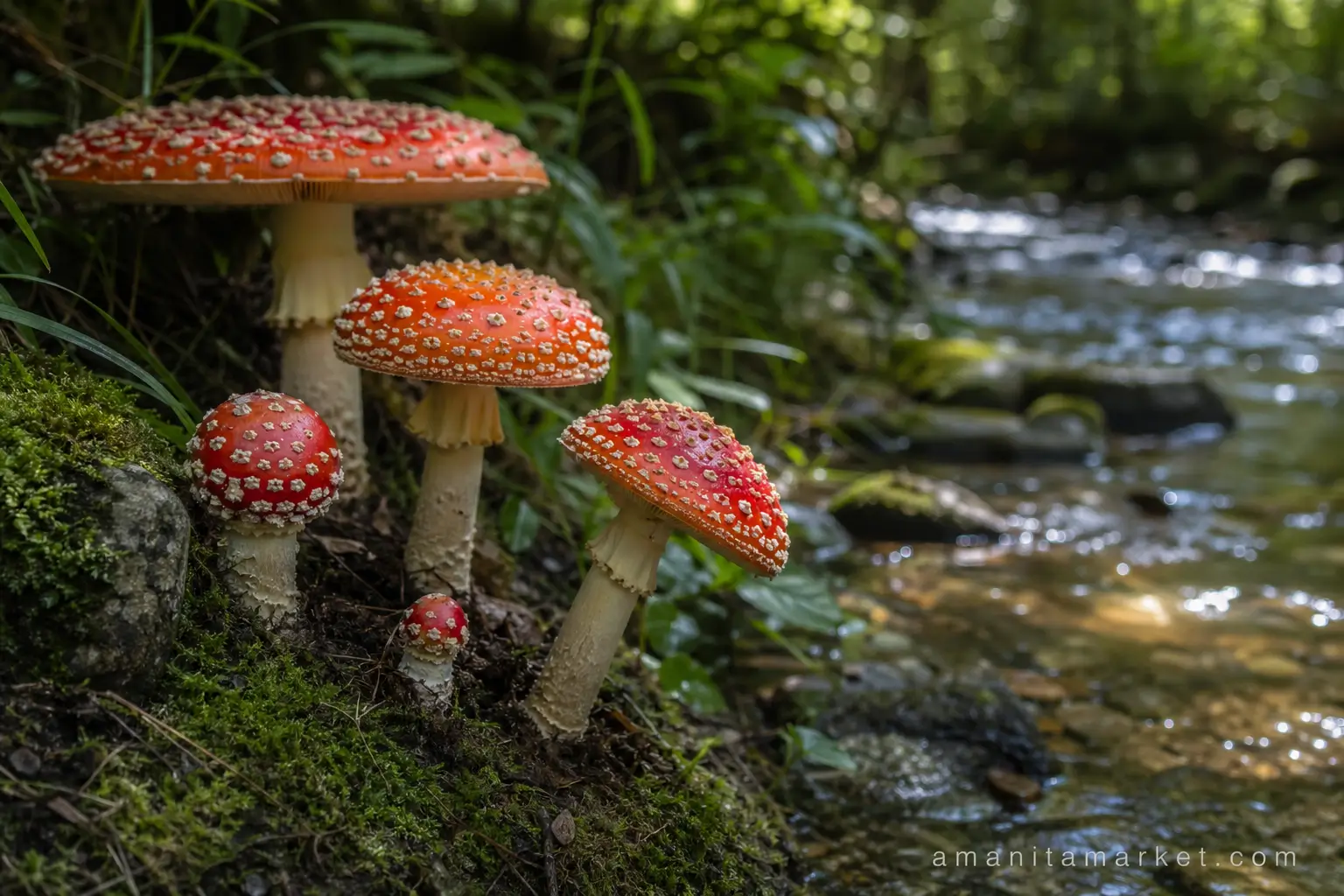
The confusion between Amanita muscaria and psilocybin mushrooms is understandable at a surface level — both are fungi with psychoactive properties. But taxonomically, chemically, and legally, they are worlds apart. Psilocybin mushrooms belong primarily to the genus Psilocybe, a group of small, brown, often unremarkable-looking fungi. Amanita muscaria is a large, visually striking basidiomycete in the family Amanitaceae, recognisable worldwide by its red cap and white spots.
The two genera are not closely related. Amanita muscaria forms mycorrhizal relationships with trees and cannot be cultivated. Psilocybe species are typically saprotrophic — decomposers — and can be cultivated artificially. Their habitats, ecology, and growing conditions differ fundamentally.
Amanita muscaria: active compound is muscimol, acts on GABA-A receptors. Psilocybe mushrooms: active compound is psilocybin (converted to psilocin), acts on serotonin 5-HT2A receptors. These are completely different neurotransmitter systems.
Active Compounds: Muscimol vs. Psilocybin
The primary active compound in Amanita muscaria is muscimol — a potent GABA-A receptor agonist. GABA is the brain’s primary inhibitory neurotransmitter, and muscimol’s action on GABA-A receptors produces sedative, dissociative, and hypnotic effects rather than the classic psychedelic effects associated with serotonergic compounds.
Psilocybin, by contrast, is a tryptamine that acts primarily on serotonin receptors — specifically the 5-HT2A receptor. This mechanism is shared with LSD and mescaline and is responsible for the characteristic visual and perceptual distortions associated with classic psychedelics. The two mechanisms produce fundamentally different subjective experiences and have different research profiles in neuroscience.
A second compound in Amanita muscaria, ibotenic acid, acts as an excitatory NMDA receptor agonist. In dried mushrooms, ibotenic acid partially converts to muscimol during the drying process. For a deeper look at muscimol specifically, see our article on muscimol effects research.
Legal Status: A Critical Difference
The legal distinction between the two is equally significant. Psilocybin and psilocin are listed as Schedule I controlled substances under the 1971 UN Convention on Psychotropic Substances. This means they are controlled in virtually every country that has ratified the convention, including all EU member states.
Muscimol and ibotenic acid — the active compounds in Amanita muscaria — are not listed in any UN drug convention. As a result, fly agaric is legal to possess, sell, and purchase in Germany, Austria, the Netherlands, France, and most EU member states. The notable exception is Switzerland, which banned muscimol-containing products in May 2025.
This legal difference is not a technicality — it reflects a genuine difference in how regulatory bodies have assessed the two substances. For more on sourcing and quality, see our fly agaric buyer’s guide.
| Property | Amanita muscaria | Psilocybe mushrooms |
|---|---|---|
| Active compound | Muscimol / Ibotenic acid | Psilocybin / Psilocin |
| Receptor target | GABA-A (inhibitory) | 5-HT2A serotonin |
| EU legal status | ✓ Legal in most EU countries | ✗ Controlled substance |
| UN Convention | ✓ Not scheduled | ✗ Schedule I (1971) |
| Cultivation | Impossible (mycorrhizal) | Possible (saprotrophic) |
| Appearance | Large, red cap, white spots | Small, brown, unremarkable |
Historical and Cultural Use
Both fungi have deep roots in human cultural history, but in very different contexts. Amanita muscaria has documented use in Siberian shamanic traditions stretching back thousands of years, and appears extensively in European folklore, mythology, and Christmas iconography. It was used as ritual incense and ceremonial gift in circumpolar cultures.
Psilocybin mushrooms have their primary historical use in Mesoamerican indigenous traditions — particularly among the Mazatec people of Oaxaca, Mexico, where they were used in healing ceremonies documented by R. Gordon Wasson and others in the 1950s. The two traditions are geographically and culturally distinct.
Research Profiles
Both compounds are the subject of active scientific research, but in different areas. Psilocybin has received substantial clinical research funding in recent years, with trials at Johns Hopkins, NYU, and Imperial College London examining its potential in treating depression, addiction, and end-of-life anxiety. Several of these trials have produced promising results in peer-reviewed journals.
Muscimol research is more limited in scope but growing. Preclinical studies have examined its effects on sleep, anxiety, and neuroprotection via GABAergic mechanisms. The research base is smaller and primarily preclinical — human trials are limited. For an overview of what is currently known, see our article on what is Amanita muscaria.
Why the Confusion Exists
The conflation of Amanita muscaria with “magic mushrooms” is largely a product of popular culture. Both are fungi, both are psychoactive, and both have appeared in counterculture contexts. But the phrase “magic mushroom” in scientific and regulatory language refers specifically to psilocybin-containing species — primarily Psilocybe cubensis and related species.
Amanita muscaria is not a psilocybin mushroom. It does not contain psilocybin or psilocin. Its legal status, mechanism of action, historical use, and ecological role are all distinct. Understanding this difference is essential for anyone researching or purchasing ethnobotanical products in Europe.
Sources
Explore our fly agaric for sale — wild Baltic amanita muscaria powder, carefully dried and vacuum-sealed, shipped across Europe.