
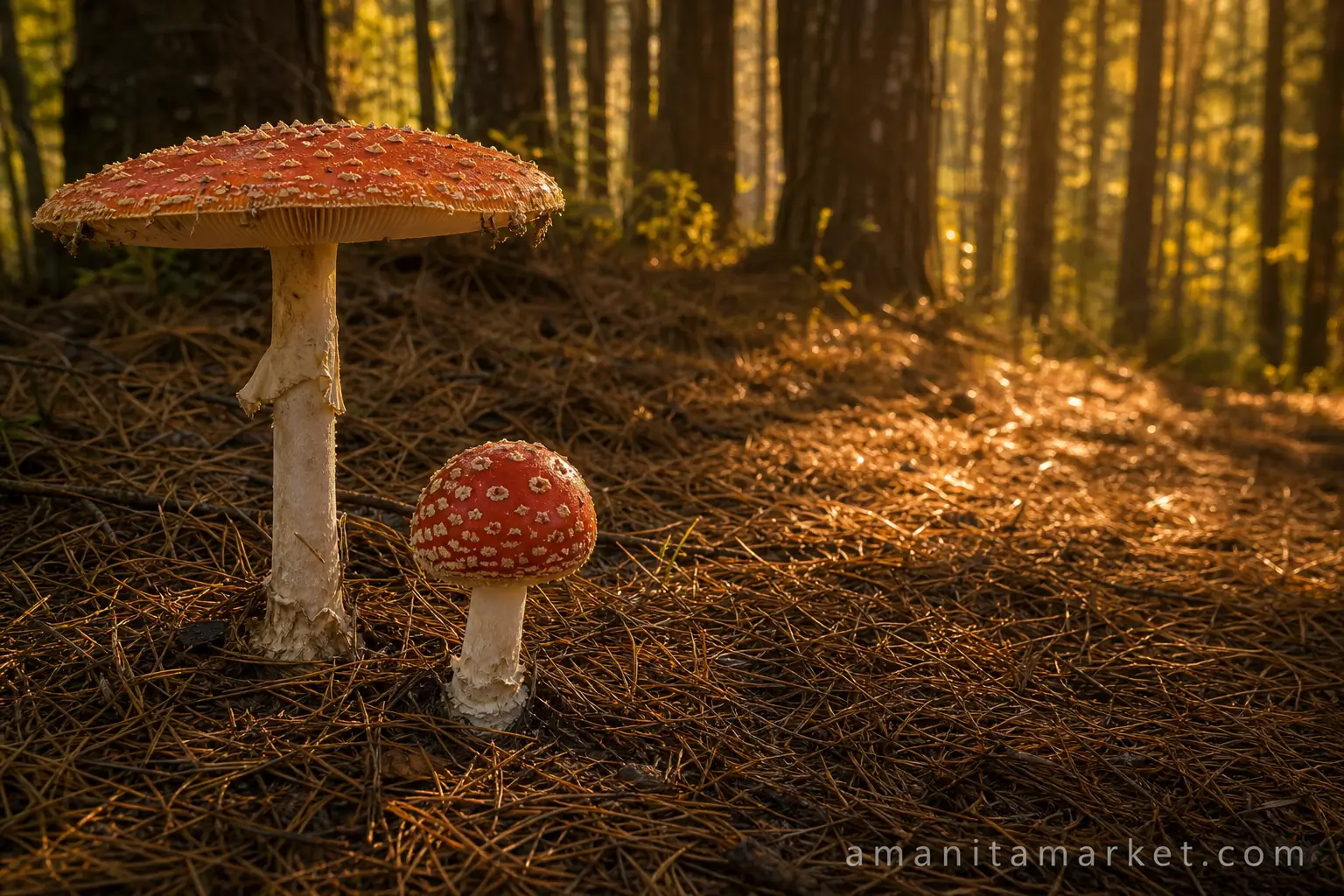
The name “fly agaric” is one of the more evocative common names in the fungal world — and one of the more puzzling, if you think about it. What do flies have to do with a mushroom? And why “agaric”? The story behind the name connects medieval pest control, Linnaean taxonomy, and centuries of European folk knowledge into a surprisingly rich etymology.
The Fly Connection: Medieval Pest Control
The “fly” in fly agaric does not refer to the mushroom flying, or to a general association with insects. It refers to a specific and very practical use: killing flies. For centuries across Europe, pieces of Amanita muscaria cap were placed in bowls of milk and left on windowsills or near food preparation areas. Flies — attracted to the milk — would drink from the mixture, become intoxicated or stupefied by the muscimol and ibotenic acid, and either die or become incapacitated.
This use is documented across multiple European countries and languages. The German name Fliegenpilz (fly mushroom) records it directly. The French amanite tue-mouches means “fly-killing amanita.” The Dutch vliegenzwam is “fly swamp” or “fly mushroom.” In Russian and Polish — мухомор and muchomor respectively — the name also means “fly killer.” The linguistic consistency across unrelated European languages confirms that this use was genuinely widespread and practically significant across the continent.
The traditional fly trap preparation — cap pieces soaked in milk — exploits two biological facts: flies are attracted to fermented and protein-rich liquids, and muscimol is soluble in water and milk. The active compound leaches from the cap material into the liquid, which flies then drink. The compound’s effects on the insect nervous system (which also uses GABA as an inhibitory neurotransmitter) cause rapid incapacitation. This was a practical and widely used household pest control method before the development of chemical insecticides.
Why the Fly-Killing Effect Works
The effectiveness of fly agaric as a fly killer is not coincidental — it reflects a fundamental similarity between insect and vertebrate nervous systems at the receptor level. GABA is a conserved inhibitory neurotransmitter across the animal kingdom, and GABA-A type receptors function in insects as well as in mammals. Muscimol’s agonist action at these receptors is effective across a wide range of species, which is why the folk tradition of using it as an insecticide has a solid biological basis.
This is also, incidentally, why the name “fly agaric” communicates something real about the mushroom’s chemistry — it is named for an observable pharmacological property, not for a random association. The medieval European householders who named it knew exactly what it did, even without understanding the mechanism.
Agaric: What Does It Mean?
The second part of the name — “agaric” — has a longer and more complex history. Agaricum was a term used in ancient Greek and Roman medicine, derived from Agaria, a region of Sarmatia (in modern-day Ukraine and southern Russia) where a specific medicinal fungus was harvested. The ancient agaricum was most likely a bracket fungus — probably Laricifomes officinalis (larch bracket) — used medicinally for centuries.
When early naturalists and physicians began classifying fungi systematically in the 16th and 17th centuries, they applied the term “agaric” broadly to gill-bearing mushrooms as a category, largely because the gilled mushrooms were the most common and familiar fruiting bodies. By the time Carl Linnaeus formalised biological nomenclature in the 18th century, “Agaricus” had become the default genus name for gilled mushrooms generally — and fly agaric was named Agaricus muscarius, later reclassified as Amanita muscaria.
Muscaria: The Latin for Fly
The scientific name Amanita muscaria encodes the same fly connection as the common name. Muscarius is a Latin adjective meaning “of or relating to flies,” derived from musca (fly). When Linnaeus described the species in his 1753 Species Plantarum, he chose the specific epithet muscarius explicitly to record the mushroom’s use as a fly killer — making the scientific name a direct translation of the vernacular tradition. The naming decision preserves in formal Latin the same folk knowledge that gave the mushroom its German, French, Dutch, Russian, and English names.
This convergence — the same observation recorded independently in the scientific name and in multiple vernacular languages — is striking evidence of how widely and consistently the fly-killing use was known across European cultures. It was not a regional curiosity but a genuinely pan-European piece of practical knowledge.
Amanita: A Name Within a Name
The genus name Amanita comes from the Greek amanitai — a term used for fungus in ancient Greek texts, possibly derived from Mount Amanus in Asia Minor (modern Turkey), where certain fungi were reportedly gathered. The genus Amanita was established as a formal taxonomic group in the late 18th and early 19th centuries to group the characteristic mushrooms sharing the ring, volva, and free gills — distinguishing them from the broader Agaricus category.
Today, Amanita is one of the most recognisable fungal genera, containing both some of the world’s most toxic mushrooms (death cap, destroying angel) and some of its most culturally significant ones. The genus name links the fly agaric to ancient Greek knowledge of fungi — one more thread in the deep historical relationship between humans and this extraordinary organism. For more on the biology of the species itself, see our guide to what is Amanita muscaria, or explore how it is identified in the wild at fly agaric identification.
Sources
Explore our full range of dried fly agaric — Baltic wild-harvested amanita muscaria powder in sizes from 50g to 500g, shipped across Europe.