
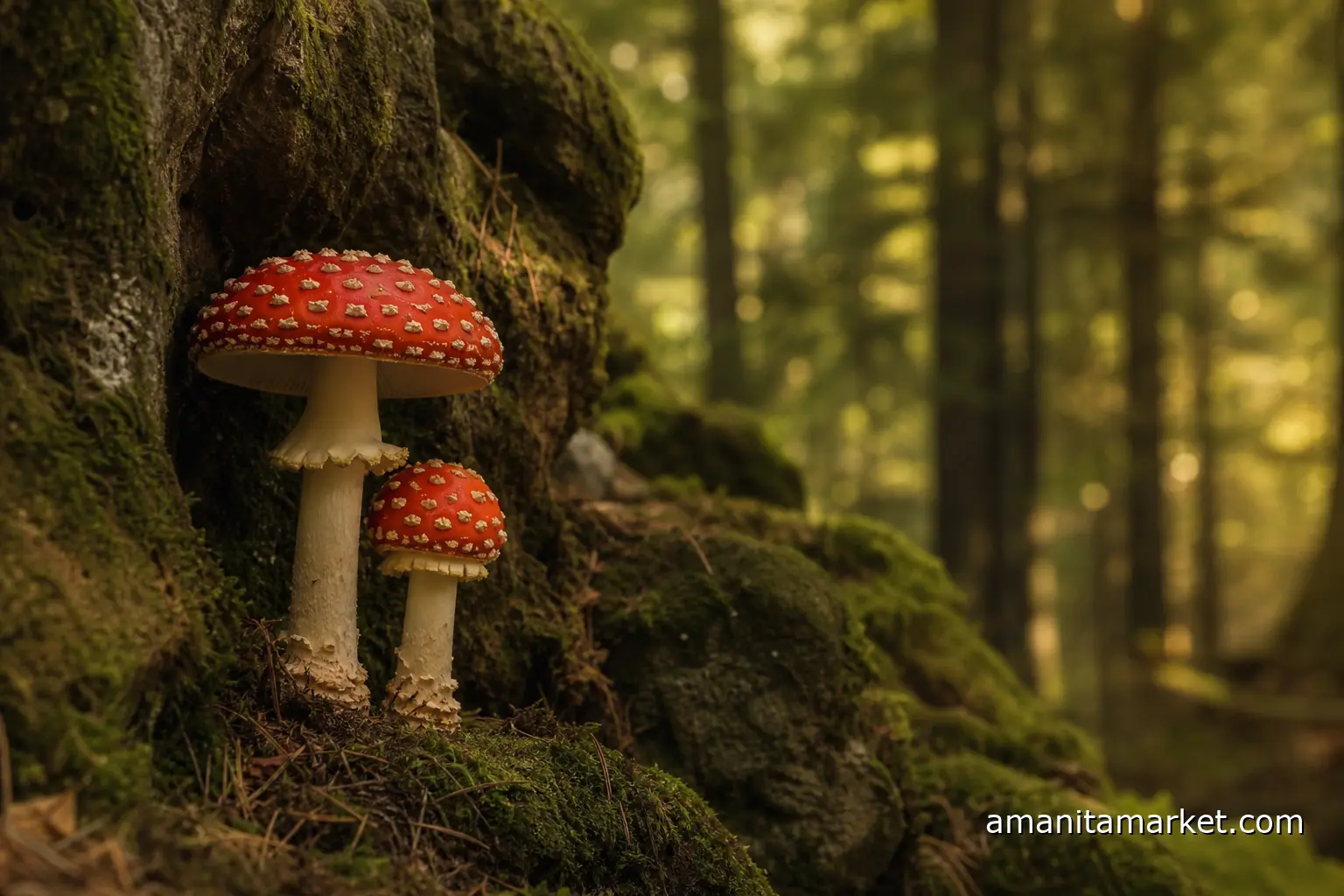
Dried Amanita muscaria is biochemically different from fresh fly agaric — a fact with significant implications for understanding the mushroom’s properties, its historical uses, and the quality of commercial dried products. This article covers what science documents about dried fly agaric specifically: how drying transforms its compound profile, what the toxicological literature records, and why the incense use category is separate from ingestion concerns.
The Biochemistry of Drying: What Changes
When fresh Amanita muscaria caps are dried, the primary biochemical change is the decarboxylation of ibotenic acid to muscimol. Ibotenic acid — the dominant active compound in fresh specimens — is thermally unstable. In the presence of heat or even at room temperature over time, it loses a carboxyl group (CO₂) and converts to muscimol. The extent of this conversion depends on drying temperature, duration, and the mushroom’s pH at harvest.
Tsujikawa et al. (2019, PubMed 30782612) provided the most systematic analysis of this process in commercial dried samples. Their study found that dried commercial specimens consistently showed higher muscimol-to-ibotenic acid ratios than fresh specimens, with variation between products reflecting different processing methods. The practical consequence: dried fly agaric is pharmacologically shifted toward the more inhibitory, GABA-A active profile of muscimol rather than the more excitatory NMDA-active profile of ibotenic acid.
Fresh vs Dried: What Actually Changes
It helps to be precise about what the drying process does and does not alter. The table below contrasts the two states across the dimensions that matter.
| Property | Fresh fly agaric | Dried fly agaric |
|---|---|---|
| Dominant compound | Ibotenic acid | Muscimol (after conversion) |
| Pharmacological lean | More excitatory (NMDA) | More inhibitory (GABA-A) |
| Moisture / shelf life | High moisture, perishable | Low moisture, long storage |
| Toxicological activity | Present | Present — transformed, not removed |
Toxicological Documentation of Dried Fly Agaric
The toxicological literature documents dried Amanita muscaria in the context of the Pantherina syndrome — the recognised poisoning presentation following ingestion. Pharmacological reference works and poison control centre resources describe the syndrome as primarily muscimol-mediated in dried specimens: sedation, confusion, dissociation, and in severe cases, more profound central nervous system depression.
Importantly, the literature consistently notes the high variability of outcomes. Michelot and Melendez-Howell (2003) highlighted that Amanita muscaria intoxication presentations vary more than those of most other toxic fungi, reflecting the compound variability documented by Tsujikawa and the genetic variability documented by Geml et al. (2006). This unpredictability is a consistent finding across all historical and modern toxicological accounts.
A Common Myth: “Drying Detoxifies”
A persistent misconception holds that drying Amanita muscaria reduces its toxicity by breaking down active compounds. This is incorrect. Drying shifts the compound profile from more ibotenic acid toward more muscimol — it does not eliminate pharmacological activity. The BfR (2024) confirmed that dried fly agaric has the same health significance as fresh material, with a different compound ratio. Toxicological activity is not removed by drying — it is transformed.
What Drying Does NOT Change
Beyond compound transformation, drying also reduces moisture content (preserving the product for long-term storage), partially converts ibotenic acid (as described above), and affects aroma — releasing some of the volatile compounds that give dried fly agaric its characteristic earthy smell. What drying does not do is make the mushroom pharmacologically inert, eliminate the active compounds, or render it safe for consumption in the way that cooking renders many toxic plants non-toxic.
Dried Fly Agaric as Incense: Why It Is a Separate Category
The entire body of toxicological documentation on Amanita muscaria — whether fresh or dried — relates to ingestion. The use of dried fly agaric as aromatic incense material (burned on charcoal or heated stones) is a fundamentally different route of exposure and has not produced reported adverse events in the medical literature. This is why the legal positioning of dried Amanita muscaria as an ethnobotanical incense material is both legally sound and factually appropriate.
The BfR’s 2024 advisory specifically addressed food products containing muscimol — gummies, supplements, beverages — not traditional botanical preparations used as incense. European and German law permits the sale of dried fly agaric as Räucherwerk (ritual incense), and this positioning is reflected in how responsible suppliers market the product. For our complete ethnobotanical product overview, see Amanita muscaria as an ethnobotanical product.
Frequently Asked Questions
Does drying make fly agaric safe to eat?
No. Drying transforms ibotenic acid into muscimol but does not remove pharmacological or toxicological activity. Dried material carries the same health significance as fresh, with a different compound ratio.
How is dried fly agaric different from fresh?
Fresh caps are dominated by excitatory ibotenic acid; dried caps are richer in inhibitory muscimol. Drying also lowers moisture for long storage and develops the earthy aroma.
Why is incense use treated separately?
All toxicological data concerns ingestion. Burning dried caps as incense is a different route of exposure with no reported adverse events in the medical literature, which is why it is sold as Räucherwerk.
Sources
Dried Amanita muscaria from Baltic wild harvest — low-temperature dried, vacuum-sealed, sold as ethnobotanical incense and collector’s botanical.