
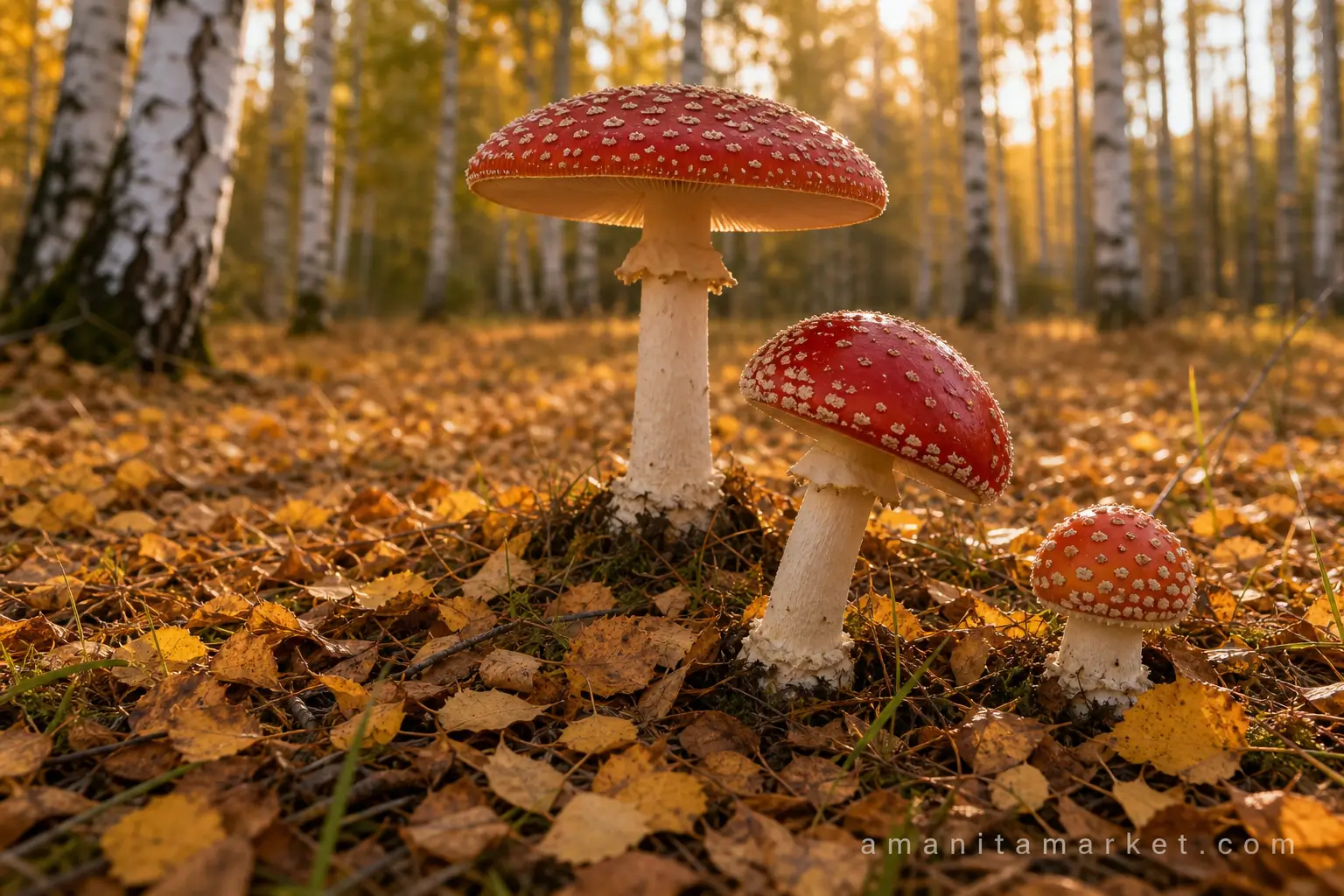
Most people picture Amanita muscaria as a single type: vivid red cap, white spots, unmistakable. But the fly agaric is not one uniform species — it encompasses several recognised varieties with distinct cap colours, geographic ranges, and slightly different chemical profiles. Understanding these varieties matters both for field identification and for understanding what you are getting when you buy dried amanita muscaria powder.
Taxonomy: One Species, Several Varieties
Amanita muscaria (L.) Lam. — first formally described by Carl Linnaeus in 1753 — is a single species, but mycologists have long recognised regional forms with distinctive appearances. The classification of these forms has evolved considerably; some were historically treated as separate species before DNA analysis confirmed their relationships. The current consensus recognises several varieties within the species, each adapted to slightly different ecological conditions.
What unites all varieties is the core biology: mycorrhizal lifestyle, association with birch, pine, and related trees, the characteristic ring and volva on the stem, free white gills, and white spore print. What varies is primarily cap colour, geographic distribution, and in some cases the potency and ratio of active compounds.
Var. muscaria — The Classic Red Form
The variety most people know — and the standard for commercial dried fly agaric products — is Amanita muscaria var. muscaria. This is the scarlet to deep red-capped form with white wart remnants, found across Europe and northern Asia. It is the variety associated with Siberian shamanic traditions, with European folklore and Christmas symbolism, and with the highest concentrations of muscimol and ibotenic acid among the recognised varieties.
In Europe, var. muscaria is the dominant form across the entire range — from the British Isles and Scandinavia through the Baltic states, Central Europe, and eastward into Siberia. The Baltic states, where our wild-harvested fly agaric powder originates, produce classic var. muscaria specimens of exceptional quality during autumn fruiting seasons.
The key features of the classic red variety: scarlet to deep red cap (not orange-yellow, not brown), white wart remnants on cap surface (may wash off in rain), white gills, white stem with skirt-like ring, bulbous base with white volva. Found under birch and pine in temperate and boreal forest. Autumn fruiting, August–November.
Var. guessowii — The North American Yellow-Orange Form
Amanita muscaria var. guessowii is the predominant form across most of North America. Its cap is yellow to orange-yellow rather than red, with yellow-tinged wart remnants. The difference in cap colouration reflects variation in the pigments responsible — muscapurpurin and related compounds — rather than a fundamental difference in active compound chemistry, though some studies suggest var. guessowii may contain slightly lower concentrations of ibotenic acid than the European red form.
This variety was for a long time considered synonymous with the European red form, but morphological and genetic analysis established it as a distinct variety. It is rarely encountered in commercial European products, where var. muscaria is the standard.
Var. formosa — The European Orange-Yellow Form
Amanita muscaria var. formosa is found in Europe alongside the classic red form, particularly in central and southern European forest zones. Its cap is orange-yellow to pale yellow — distinctly different from the scarlet of var. muscaria. The white spots tend to have a slight yellowish tinge. It grows in similar habitats to the red form and is equally associated with birch and pine.
Var. formosa is sometimes confused with Amanita caesarea — Caesar’s mushroom — by inexperienced observers, though the two species are readily distinguished by gill colour (white in var. formosa, yellow in caesarea) and stem colour. The orange-yellow form is less commonly used in traditional ethnobotanical contexts than the classic red variety.
Var. alba — The Rare White Form
Amanita muscaria var. alba is an unpigmented form in which the cap is white or very pale cream rather than red. The white spots may be barely visible against the pale cap. This variety is rare and of limited practical importance, but it is taxonomically interesting — it demonstrates that the red pigmentation of fly agaric is not essential to the species’ identity or ecological function.
The white form is easily confused with other white Amanita species in the field, including the highly toxic Amanita phalloides (death cap) and Amanita virosa (destroying angel). This is one reason why knowledge of full identification features — beyond cap colour — is important when working with Amanita species. For the full identification guide, see our article on fly agaric identification.
Var. flavivolvata — The American Southwest Form
Amanita muscaria var. flavivolvata is found in the Pacific Coast of North America, Mexico, and Central America. It has a red cap like the European form but is distinguished by its yellow to orange volva — the cup at the base of the stem. Some researchers have proposed that this is the form most associated with pre-Columbian Mesoamerican knowledge of the species, though the historical evidence for fly agaric use in Mesoamerica is far less clear than for Siberian traditions.
Active Compound Variation Between Varieties
Chemical analyses across varieties have generally confirmed that the classic European red form (var. muscaria) contains the most consistent and well-characterised concentrations of muscimol and ibotenic acid. Concentrations in the cap can reach 0.1–0.2% muscimol by dry weight, with ibotenic acid present in variable amounts depending on drying conditions. The orange and yellow forms have been reported to contain lower concentrations in some analyses, though the data is not consistent across all studies.
This chemical variation is one reason why sourcing matters when purchasing dried fly agaric. Products labelled simply as “Amanita muscaria” without specifying variety or origin may include multiple forms. Premium products specify European origin and the classic red variety. Our full range of amanita muscaria powder comes from European Baltic forests — classic var. muscaria only.
Sources
Buy fly agaric powder — classic Baltic var. muscaria, 200g pack. Wild-harvested, dried and shipped across Europe with discreet packaging.