
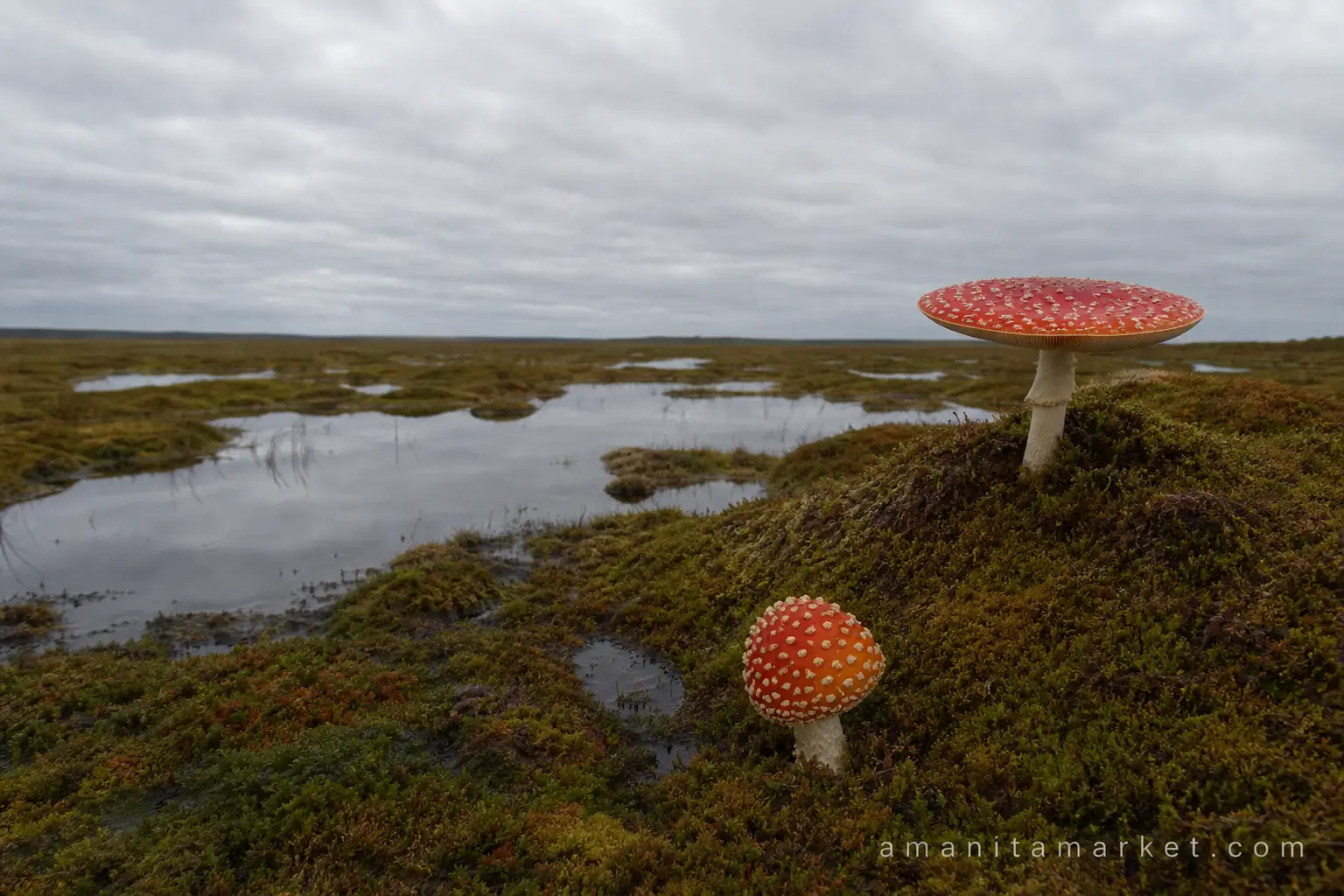
The Slavic peoples — Russians, Poles, Czechs, Slovaks, Ukrainians, Bulgarians, and Serbs — have one of Europe’s richest folk traditions surrounding the natural world. Forests, rivers, and their inhabitants were populated by a vivid cast of spirits, deities, and beings. Amanita muscaria occupies a distinctive place in this mythology: it is known across the Slavic world, carries deep symbolic associations, and its name in Russian — мухомор (mukhamor, “fly killer”) — points to ancient practical knowledge of the mushroom’s properties.
The Russian Name: Mukhamor
The Russian word for Amanita muscaria — мухомор — literally means “fly killer” or “fly poison,” from муха (fly) and мор (plague, mass death). This name echoes the mushroom’s centuries-old use across Europe as a fly repellent: cap pieces soaked in milk attract and intoxicate flies. The same etymological root appears in the scientific name muscaria — from Latin musca (fly).
The prevalence of “fly” in the mushroom’s name across Slavic, Germanic, and Latin linguistic families reflects a pan-European awareness of this property. In Polish, the mushroom is muchomor; in Czech and Slovak, muchomůrka; in Ukrainian, мухомор. The linguistic consistency across the entire Slavic zone confirms that the fly-poison association was ancient, widespread, and practically significant.
In Slavic folk cosmology, the forest was the domain of powerful spirits: the Leshy (forest lord) in Russian tradition, the Borowy in Polish, the Lisovyk in Ukrainian. These figures governed the forest and all its creatures — including mushrooms. The appearance of striking or unusual fungi was often interpreted as a sign of the forest spirit’s presence or mood.
The Leshy and the Red Mushroom
The Leshy (Russian: леший) is one of the most complex figures in Slavic mythology — a shapeshifting forest deity who could appear as a giant, a peasant, an animal, or a whirlwind of leaves. The Leshy governed the movements of forest animals, the growth of trees, and the fate of those who entered the forest. Mushroom picking — one of the most important subsistence activities in Slavic rural life — was understood to occur in the Leshy’s domain and required ritual respect.
Ethnographic accounts collected in 19th-century Russia by researchers including Alexander Afanasyev document folk beliefs in which certain mushrooms — particularly the most visually distinctive ones — were associated with the Leshy’s presence. Amanita muscaria, as the forest’s most conspicuous fungus, naturally attracted this kind of attention. In some regional traditions, finding fly agaric was considered a mixed omen: the forest spirit was present, which could mean good hunting or dangerous encounters depending on one’s conduct.
Russian and Ukrainian Folk Medicine
Across the Slavic world, fly agaric appeared in folk medicine — primarily for external application. Ethnobotanical surveys conducted in the 19th and early 20th centuries document the use of Amanita muscaria tinctures and poultices for joint pain, rheumatism, and skin conditions in rural communities of Russia, Ukraine, Poland, and the Carpathian region. The mushroom was never consumed internally in mainstream Slavic folk medicine — the toxicity risk was well understood — but external preparations were widespread.
This tradition of external medicinal use distinguishes the Slavic relationship with fly agaric from the Siberian shamanic tradition (internal use) and aligns more closely with the practical, botanical approach to the natural world that characterised Slavic village medicine.
Czech and Slovak Traditions
In Bohemia, Moravia, and Slovakia — regions with exceptionally strong mushroom-foraging cultures — fly agaric has a complex folk reputation. The Czechs and Slovaks are among Europe’s most dedicated mushroom pickers, and their folklore surrounding fungi is correspondingly rich. Amanita muscaria appears in regional folk art, textile motifs, and decorated ceramics, particularly in Moravia and the Carpathian zone.
The Czech diminutive muchomůrka (“little fly killer”) carries an almost affectionate tone, reflecting the ambiguous relationship between familiarity and danger that characterises Slavic attitudes toward the mushroom. It is toxic, it is beautiful, it is part of the forest — and the forest is both home and hazard.
Slavic Mythology and the Wider European Context
Slavic mythology shares structural elements with other Indo-European mythological systems — the world tree, the cosmic serpent, the solar deity, the underworld journey. These parallels suggest a common ancestral mythological vocabulary that dispersed with the Indo-European language expansion roughly 5,000–6,000 years ago. In this context, the Slavic fly agaric traditions may reflect the same deep cultural stratum as the Siberian shamanic use and the Vedic Soma traditions — all branches of a single ancient tree.
For the Baltic traditions most geographically adjacent to the Slavic world, see our article on fly agaric in Baltic mythology. For the broader global picture, see fly agaric in world cultures.
Sources
Looking for quality fly agaric? Our dried amanita muscaria powder ships to most EU countries — wild-harvested in the Baltic forests.