
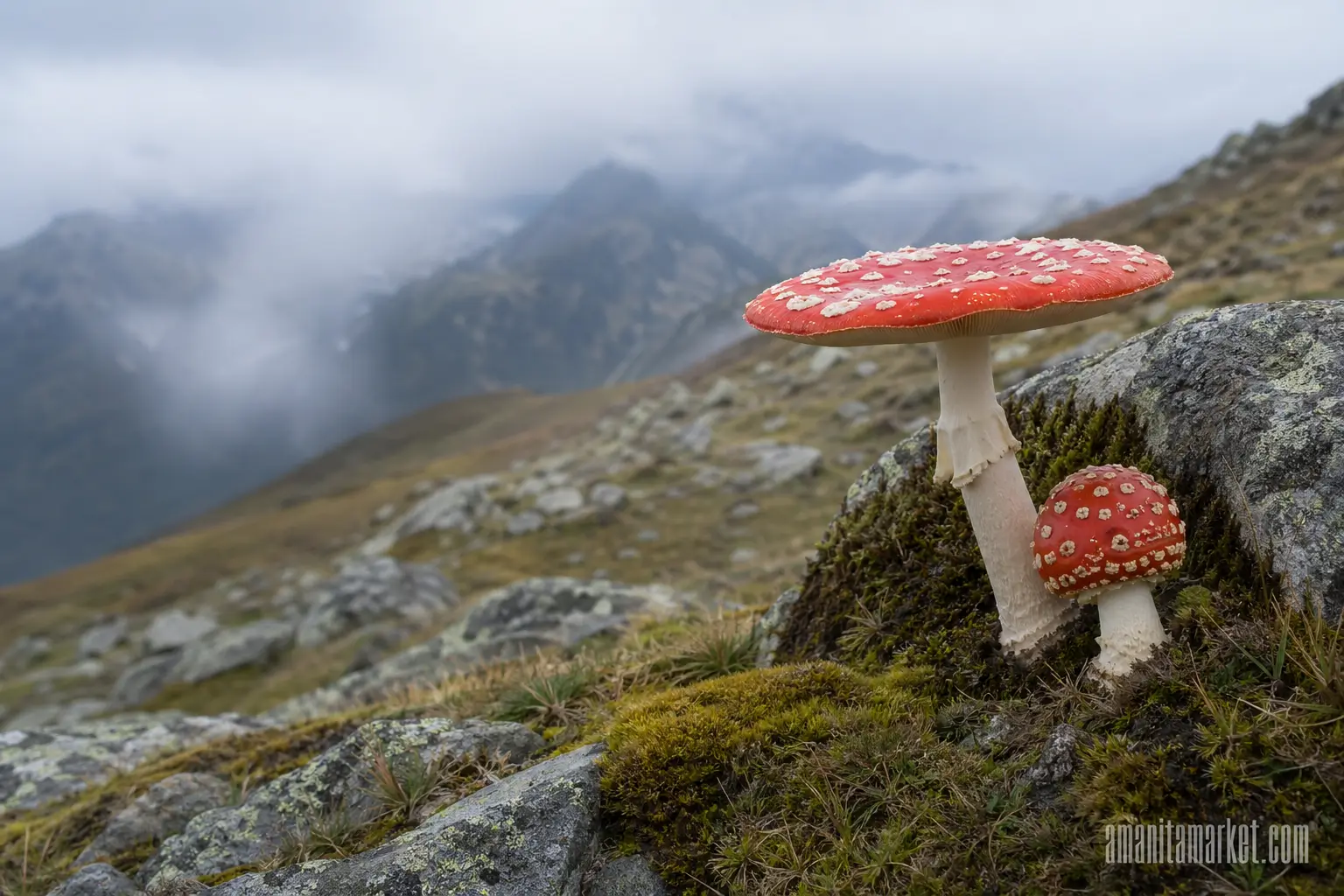
Amanita muscaria — known worldwide as the fly agaric — is one of the most recognisable mushrooms on the planet. Its vivid red cap dotted with white spots has appeared in folklore, art, and science for thousands of years. Today, dried amanita muscaria powder is sought by collectors, ethnobotanists, and those fascinated by this iconic fungus across Europe.
What Exactly Is Amanita Muscaria?
Amanita muscaria is a basidiomycete fungus belonging to the family Amanitaceae. It grows across temperate and boreal forests of the Northern Hemisphere — from Scandinavia and the Baltic states to Siberia, Japan, and North America. It forms a symbiotic mycorrhizal relationship with trees, particularly birch, pine, and spruce, making it impossible to cultivate commercially.
The mushroom’s cap typically ranges from 8 to 20 centimetres in diameter and is covered with white warts — remnants of the universal veil that once enclosed the entire fruiting body. These warts can wash off in heavy rain. The gills are white, free from the stem, and the base of the stem features a distinctive bulbous volva.
Kingdom: Fungi · Division: Basidiomycota · Order: Agaricales · Family: Amanitaceae · Species: Amanita muscaria (L.) Lam. — first formally described by Carl Linnaeus in 1753 as Agaricus muscarius.
The Chemical Compounds of Fly Agaric
Amanita muscaria contains several biologically active compounds that have drawn scientific interest for decades. The primary constituents are muscimol and ibotenic acid. Muscimol acts as a potent agonist at GABA-A receptors in the central nervous system. Ibotenic acid, a structural analogue of glutamic acid, partially converts to muscimol during the drying process.
Additional compounds include muscarine (present in trace amounts), muscazone, and a range of pigments such as muscapurpurin, which are responsible for the mushroom’s characteristic red colouration. According to a 2021 review published in MDPI, the pharmacological profile of these compounds has attracted growing interest in neuroscience research.
Where Does Fly Agaric Grow?
Amanita muscaria is one of the most widely distributed mushrooms in the world. In Europe, it thrives across the Baltic states, Scandinavia, Germany, Austria, and the British Isles. It typically fruits from late summer through autumn — from August to November depending on latitude and altitude. The mushroom prefers acidic soils and is almost always found near its mycorrhizal host trees.
According to the Woodland Trust, fly agaric is a common sight in Scottish birch and pine woodlands, where it plays a vital ecological role supporting tree health through nutrient exchange. The mushroom’s global spread has accelerated through human activity — it has been recorded in Australia, New Zealand, and South America, where it arrived alongside introduced pine and birch plantations.
Amanita muscaria is not a decomposer but a mycorrhizal partner. It connects to tree root systems and exchanges minerals for carbohydrates — a relationship that can persist for decades and is essential to forest health in many ecosystems.
Amanita Muscaria in Human History
Few organisms have played such a prominent role across so many cultures. Archaeological and ethnographic evidence suggests that Amanita muscaria has been used in ritual and ceremonial contexts for thousands of years. The most extensively documented use comes from Siberian shamanic traditions, where members of the Koryak, Evenki, and Yakut peoples used the mushroom in spiritual ceremonies.
Ethnomycologist R. Gordon Wasson, in his 1968 work Soma: Divine Mushroom of Immortality, proposed that Amanita muscaria was the mysterious Soma drink described in the ancient Rig Veda — a theory that sparked decades of academic debate. The mushroom also appears prominently in European folklore, Central Asian mythology, and as a Christmas symbol whose origins may trace back to Siberian shamanic winter rituals.
In Europe, dried fly agaric has a long history as an ethnobotanical product and Räucherwerk (ritual incense). Today it is used as a collector’s item, a decorative botanical, and an object of ethnobotanical study. You can buy dried fly agaric powder from our shop — wild-harvested in the Baltic region.
Fly Agaric as an Ethnobotanical Product
In contemporary Europe, Amanita muscaria is widely available as a dried ethnobotanical product. It is sold as incense, as a collector’s specimen, and as a traditional botanical with deep cultural roots. The mushroom is not classified as a controlled substance in Germany, Austria, the Netherlands, France, or most EU member states.
Quality dried fly agaric is typically prepared from the caps only — harvested in autumn at peak maturity, carefully dried at low temperatures to preserve the mushroom’s natural properties, and vacuum-sealed to ensure long shelf life. Our fly agaric powder guide covers everything you need to know about quality, storage, and what to look for when purchasing.
Amanita Muscaria vs. Other Psychoactive Fungi
A common point of confusion is the relationship between Amanita muscaria and psilocybin-containing mushrooms. These are entirely different fungi with different active compounds, different receptor targets, and different legal statuses. Psilocybin mushrooms (Psilocybe species) act on serotonin receptors, while muscimol acts on GABA receptors — a fundamentally different mechanism.
Amanita muscaria is not related to the Psilocybe genus in any taxonomic sense, and possession of dried fly agaric is legal in most of Europe. For a detailed comparison, see our article on fly agaric vs psilocybin.
Legal Status in Europe
Amanita muscaria is legal to possess, sell, and purchase in the majority of European countries. Germany and Austria have no restrictions on the mushroom under their narcotics laws. The Netherlands, France, and Italy are similarly permissive. The notable exception is Switzerland, which banned muscimol-containing products in May 2025.
As always, buyers are responsible for verifying the laws applicable in their own country. See our FAQ for general guidance on purchasing.
Sources
Looking to buy fly agaric powder? Explore our premium wild-harvested selection — dried Amanita muscaria from pristine Baltic forests, carefully processed and shipped across Europe.