
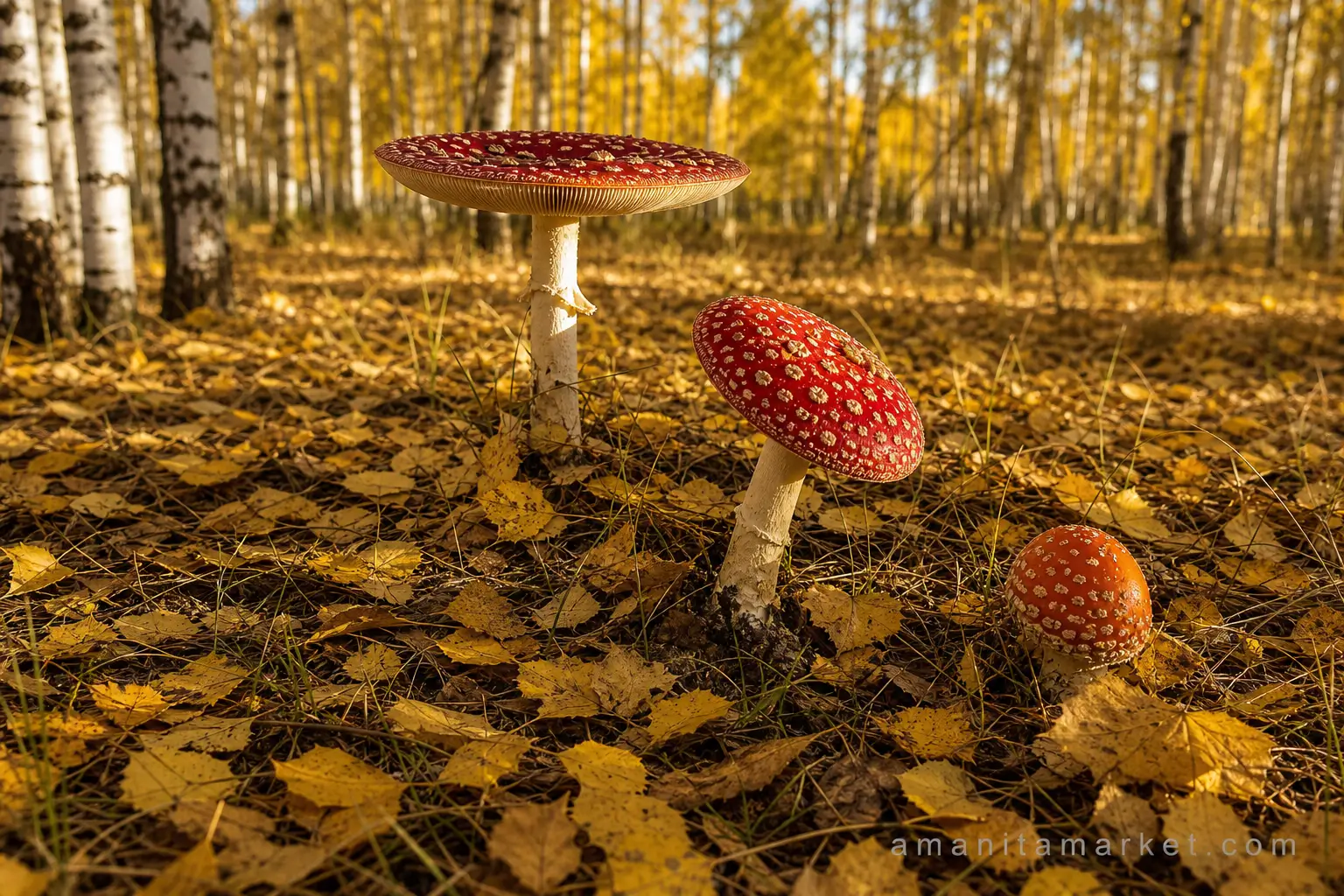
The red of Amanita muscaria is one of the most instantly recognisable colours in the natural world. It is vivid, saturated, and almost entirely unlike the muted browns and creams of most other fungi. This is not accidental. The fly agaric’s colouration is the product of specific pigment compounds, evolutionary pressures, and biological functions that researchers have spent decades working to understand.
The Pigments Responsible
The red and yellow pigments of Amanita muscaria belong to a chemical family called betalains — specifically the betaxanthins and betacyanins. Within Amanita muscaria, the primary pigments responsible for the red colouration have been identified as muscapurpurin and muscaflavin — compounds first isolated and characterised by German chemist Wilhelm Steglich and colleagues in 1984.
These pigments are concentrated in the cap surface and in the wart remnants. The cap flesh itself is white — cut a fly agaric open and the interior is uniformly pale. The colour is entirely a surface phenomenon, produced by pigment-rich cells in the outer cap layer (the cuticle). This is why heavy rain can wash some of the colour and wart remnants from old specimens — the surface layer is the first to be affected by physical weathering.
Betalain pigments are found in a relatively small group of plants and fungi — including beetroot (red colour), some cacti, and several Amanita species. They are structurally distinct from the anthocyanin pigments that produce red colour in most flowering plants. In fungi, betalains are relatively rare and their presence in Amanita muscaria has attracted interest as a potential biosynthetic model.
Why Red? The Evolutionary Question
A bright red colour in a fungus is striking enough to demand an explanation. Mushrooms do not photosynthesize and have no obvious reason to attract insects for pollination. So what selective advantage does vivid red colouration provide to Amanita muscaria?
Several hypotheses have been proposed, none of which is entirely proven. The most widely discussed is aposematism — warning colouration that signals toxicity or unpalatability to potential consumers. Bright red and yellow colours are used as warning signals by many toxic animals (poison dart frogs, wasps, certain beetles) and plants. An animal that learns to associate red with an unpleasant experience will avoid red mushrooms — protecting the fly agaric from being consumed before it can disperse spores.
The problem with the aposematism hypothesis is that Amanita muscaria is not reliably avoided by all animals. Reindeer consume it actively. Red squirrels have been observed collecting and drying fly agaric caps in tree branches — apparently for later consumption. Some flies and insects lay eggs on the caps. The warning signal, if that is what it is, does not function uniformly across all potential consumers.
The Visibility Hypothesis
An alternative perspective focuses on spore dispersal rather than consumer deterrence. Red is one of the most visible colours in the dappled light environment of a temperate forest floor. A vivid red cap is visible from a distance — both to animals that might spread spores on their bodies or in their droppings, and to large mammals including deer and rodents that carry fragments of the cap away from the original site.
Under this hypothesis, the bright colour is not a warning but an advertisement — making the mushroom easier to find for the organisms that will inadvertently contribute to spore dispersal. This would make fly agaric’s colouration analogous to the red colour of ripe fruit — a signal to consumers that benefits the producing organism.
Colour Variation and the Varieties
The existence of yellow and orange varieties of Amanita muscaria — var. formosa in Europe, var. guessowii in North America — complicates any single explanation for the red colouration. If red were essential for a specific function (predator deterrence, for instance), yellow varieties should be at a selective disadvantage. The persistence of multiple colour forms across different geographic regions suggests that the precise colour is less critical than simply being conspicuous — any bright, saturated colour may serve the relevant function.
This interpretation is supported by the geographic patterning: red-capped var. muscaria dominates in Europe and northern Asia, while yellow-orange forms prevail in parts of North America and Europe. Both are successful in their respective ranges, suggesting that neither colour is definitively superior.
The Chemistry Behind the Colour and the Compounds
One of the more intriguing questions is whether the pigment chemistry is related to the active compound chemistry in any functional way. Muscapurpurin and muscaflavin share structural elements with some of the biologically active compounds in Amanita muscaria, but a direct biosynthetic link between the pigments and the pharmacologically active muscimol and ibotenic acid has not been established.
What is clear is that the pigment intensity of the cap surface can be used as a rough indicator of the mushroom’s maturity and condition. Young, freshly emerged specimens typically show the most intense pigmentation. Faded, weathered old specimens have often lost some of their surface pigment along with other surface characteristics. This is one reason why experienced harvesters favour recently emerged specimens at peak maturity — relevant both to the visual quality of the product and to its overall condition.
For more on the biology of fly agaric, see our complete guide to Amanita muscaria. To explore the different varieties and what distinguishes them, see Amanita muscaria varieties. Our wild-harvested 500g Baltic fly agaric powder is sourced from classic red var. muscaria at peak harvest.
Sources
Buy dried fly agaric in bulk — our 500g pack offers the best value for collectors. Wild-harvested classic red var. muscaria from the Baltic, vacuum-sealed and shipped EU-wide.